

Special to CosmicTribune.com, November 12, 2026
Few expected the 2026 midterm elections to directly impact America’s rapid preparations and multiple launches needed to establish strategic bases on the Moon ahead of communist China.
Two days after her unlikely landslide victory over Republican incumbent Gov. Greg Abbott, Texas Gov.-elect Gina Hinojosa picked up the phone and called the head of the Texas Parks and Wildlife Department to “request that no action be taken” before she takes power, in effect freezing talks over the possible sale of Boca Chica State Park to Elon Musk’s SpaceX.
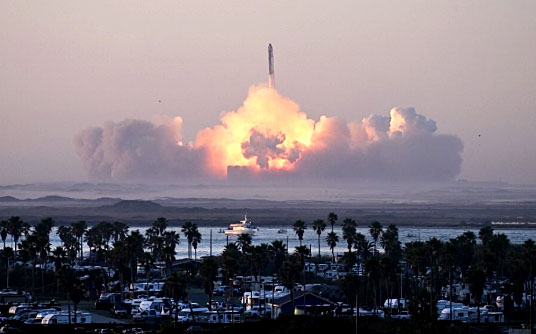
The geopolitical implications would be lost on average media consumer but not subscribers to Geostrategy-Direct.com, who know that communist China and the United States are locked in a battle over AI (Super Intelligence) dominance and in a new race to the Moon which could determine which nation calls the shots on Earth in mid-century.
Related: The world is divided into two camps in all-out fight for AI (SI) supremacy, November 3, 2026
Boca Chica State Park runs about 3.5 miles along the Gulf Coast, immediately adjacent to Starbase, the launch-and-factory site for SpaceX launch vehicles. The state park serves as a buffer and staging ground around it.
SpaceX’s Starship has been contracted to serve as the Human Landing System (HLS) for Artemis missions, specifically to transport astronauts from lunar orbit to the Moon’s surface starting with Artemis III in 2028.
Texas is the operational hub for U.S. human spaceflight, housing NASA’s Johnson Space Center in Houston and SpaceX’s Starbase launch complex in South Texas. While Texas Republican Sen. Ted Cruz has used his chairmanship on the Senate Commerce Committee to secure billions in supplemental funding for NASA’s Artemis missions, the Democrats’ midterm victory will likely see a shift in legislative focus away from big-ticket lunar infrastructure toward social spending.
The U.S. strategy to land astronauts near the lunar south pole and build a base by the late 2020s relies heavily on SpaceX’s Starship. Political friction between Musk and the incoming Democrat Senate delegation could invite heightened regulatory scrutiny, environmental reviews, or delays to commercial space contracts.
NASA is targeting 2028 to return astronauts to the lunar surface and begin assembling a permanent outpost, following the Artemis II flyby in April 2026. Meanwhile, China plans to land taikonauts on the Moon by 2030 and deploy a nuclear-powered lunar base.
As chronicled by Geostrategy-Direct’s Space coverage, the race with China to the Moon is not just to get there first, but to get there with the most, so as to gain strategic advantage. Namely, to be able to defend, if needed, the locations the United States chose to explore and develop by getting there first.
Beyond the current political fight over Boca Chica State Park therefore are the high stakes in the U.S.-China race to establish bases on the Moon:
• U.S. needs Starship to win the race for the Moon.
• China wants to control the Moon to control cislunar space, and thus deny full U.S. freedom for the military space assets that U.S. need to defend against Chinese nuclear missiles and against Chinese space combat weapons.
Which leads to the question: Does the governor-elect of Texas have the right to potentially deny strategic advantages and national security objectives desired by Americans and their allies?
Related: Believability of Nov. 3 voting data challenged in Texas, November 5, 2026
SpaceX, sought to acquire or gain control of Boca Chica State Park (roughly 1,300 acres) next to its Starbase facility in South Texas for several key operational reasons:
Facility and space constraints: SpaceX’s Starbase launch and manufacturing site is partially surrounded by public federal and state land, limiting the physical footprint available for workforce growth, testing, and infrastructure.
Scaling rocket launch operations: SpaceX plans to dramatically scale up its operations at Starbase — increasing from roughly 25 annual Starship/Super Heavy orbital launches and landings to hundreds per year (with proposals scaling significantly higher), requiring greater spatial and safety buffers.
Minimizing land-use conflicts: Controlling the adjacent acreage helps buffer the industrial site from public access points, environmental disputes, and regulatory friction over noise, debris, and safety closures at Boca Chica Beach.
Corporate city ambitions: SpaceX and its supporters have sought greater local and regulatory control over the surrounding area, including efforts to transition beach-closure and administrative oversight toward the growing corporate/industrial footprint of Starbase.
Texas Parks and Wildlife had reportedly considered selling the 1,300-acre Boca Chica State Park to SpaceX for $26 million.
Full Text . . . . Current Edition . . . . Subscription Information

Texas election could sabotage U.S. in race with China for lunar bases, leverage on Earth added by Cosmic1 on
View all posts by Cosmic1 →
You must be logged in to post a comment Login