

Special to CosmicTribune.com, November 30, 2025
Excerpts from weekly Astronomy.com report.
Sunday, November 30
Titan reappears from an occultation behind Saturn this evening beginning at 6 P.M. EST, a short-lived event visible for those with dark skies in the eastern half of the U.S. Those on the East Coast will have the easiest time; observers across the Midwest will find the sky starting to darken but may also have some luck.
Make sure your telescope is zeroed in on Saturn at least several minutes before the start time. Keep a close eye on the planet’s southeastern limb, as this is where the large moon will appear. It takes some 15 minutes for mid-8th-magnitude Titan to fully emerge from behind Saturn, and it’s a fascinating event to watch.
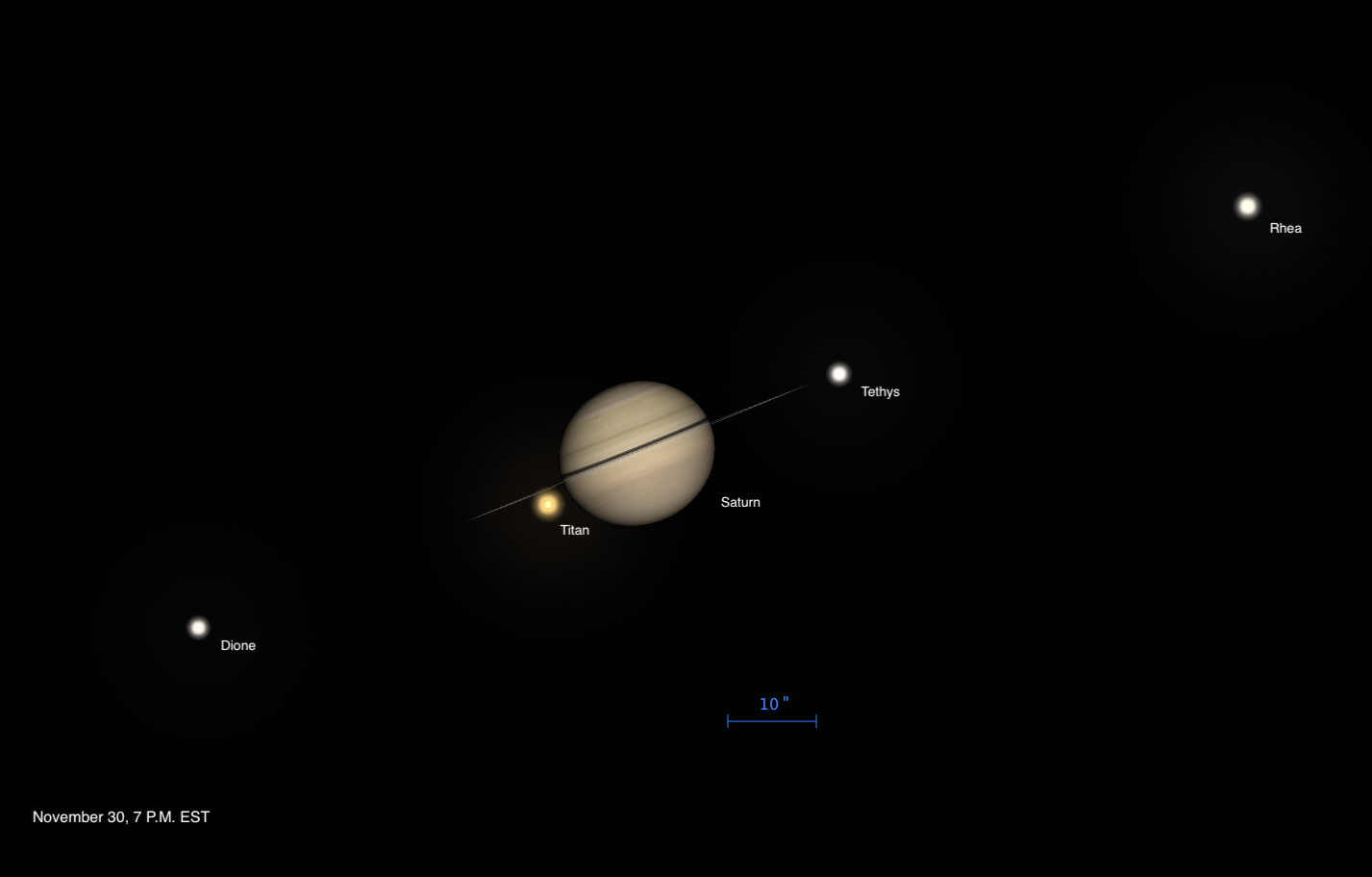 Also visible may be Saturn’s trio of 10th-magnitude moons, Tethys, Rhea, and Dione. Dione lies to Saturn’s east, off the end of the rings, while Rhea is far from the planet on the west and Tethys closer to Saturn, also on the west. Tethys is closing in for its own occultation behind the ringed world, and will disappear behind Saturn’s northwestern limb shortly after 9:45 P.M. EST. Note, however, that Tethys is very close to the edge-on rings, which may dim the moon’s brightness somewhat.
Sunrise: 7:02 A.M.
Sunset: 4:35 P.M.
Moonrise: 1:36 P.M.
Moonset: 1:43 A.M.
Moon Phase: Waxing gibbous (80%)
Monday, December 1
Jupiter is the object you’ll want to be watching this evening, as Ganymede prepares to transit along with its shadow. About an hour before that event starts, Ganymede and Europa line up as the two moons pass each other east of Jupiter.
The gas giant rises shortly before 8 P.M. local time. Once it’s visible above the horizon, train your telescope on it to check out the view. Io lies alone to the planet’s west; Callisto is far to the planet’s east. Early in the evening, Europa sits off Jupiter’s eastern limb and Ganymede is farther east. Watch as the two moons approach each other, finally passing just minutes before midnight EST, when Ganymede moves 12” due south of Europa. The two moons may appear to briefly blur into one for observers.
Around 1:07 A.M. EST (now December 2nd for the Eastern and Central time zones), Ganymede’s shadow appears on Jupiter’s cloud tops to precede the moon across. It will take the large shadow some 10 minutes to fully appear. It continues across the face of Jupiter as Ganymede approaches; by 4:18 A.M. EST (now the 2nd across the U.S.), the shadow finally reaches the western limb and begins its egress. Ganymede finally moves onto the disk not long after, at 4:44 A.M. EST. The large moon will take more than three hours to cross Jupiter’s disk.
Sunrise: 7:03 A.M.
Sunset: 4:35 P.M.
Moonrise: 2:02 P.M.
Moonset: 2:57 A.M.
Moon Phase: Waxing gibbous (88%)
Tuesday, December 2
The colorful double star Albireo in Cygnus the Swan is a summertime treat. Although different constellations now grace our year-end sky, there’s a similar jewel visible on December evenings in the constellation Canis Major the Big Dog.
Most famous for its brightest star, Sirius (Alpha [α] Canis Majoris), Canis Major is home to many other worthy sights. One is 145 CMa, a lovely double star also called the Winter Albireo for its resemblance to the eponymous pair. 145 CMa is located near the hindquarters of the Big Dog, to the lower left of bright Sirius. Around local midnight, the entire constellation is visible in the southeast, with blazing Sirius well on display. From Sirius, drop down about 11° to find 2nd-magnitude Wezen (Delta [δ] CMa). From this star, move about 3.6° northeast to 145 CMa.
Shining with a combined magnitude of 4.8, 145 CMa consists of a magnitude 5.0 primary and magnitude 5.9 companion. They are separated by almost 27”; Astronomy contributor Phil Harrington says he can regularly split them in 16×70 binoculars. Any small scope should also do the trick.
The reason for their name is the pair’s contrasting colors: The brighter primary shines with a distinct golden hue, while the fainter secondary appears blue-white.
Sunrise: 7:04 A.M.
Sunset: 4:35 P.M.
Moonrise: 2:34 P.M.
Moonset: 4:14 A.M.
Moon Phase: Waxing gibbous (95%)
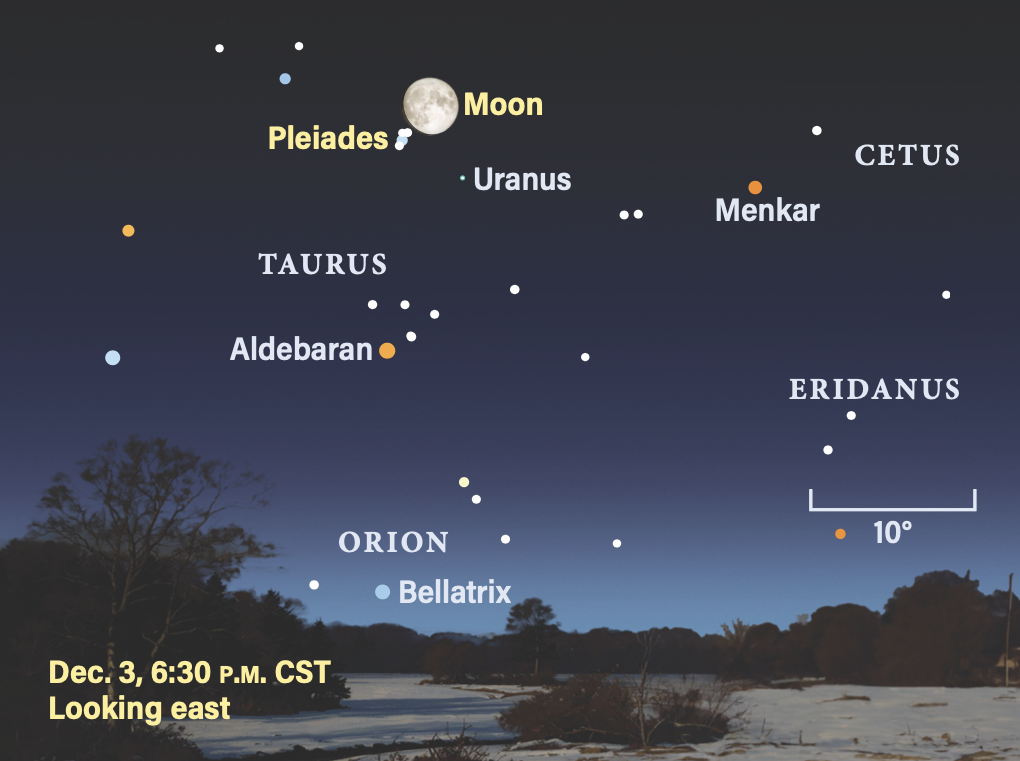 One day from Full, the Moon closes in on the Pleiades for an occultation the night of Dec. 3. Uranus will require optical aid to view. Credit: Astronomy: Roen Kelly
Wednesday, December 3
The Moon passes 5° north of Uranus in the constellation Taurus at 10 P.M. EST; before that, though, a nearly Full Moon passes in front of several stars in the Pleiades star cluster (M45), occulting them for observers in North America, Greenland, and parts of Europe. The entire event takes place between about 7 P.M. and 9:30 P.M. CST, with at least some disappearances and reappearances visible across the U.S.
By the time darkness falls, the Pleiades and the Moon should be visible close together in the eastern sky. The first bright star in the cluster to disappear behind our satellite is magnitude 3.7 Electra (17 Tauri), which vanishes behind the dark leading edge of the Moon just after 7 P.M. CST. Other stars, including magnitude 4.3 Taygeta (19 Tau) and magnitude 3.9 Maia (20 Tau), follow. To watch the event, you’ll want binoculars or a telescope — the latter is best. Bump up the magnification to really zoom in on the Moon’s leading edge, which will cut more of the bright, blinding Moon out of your field of view and let you focus on its approach to each star.
For details on the exact timing of disappearances and reappearances from your location, visit the International Occultation Timing Association’s website for lunar occultations here and scroll down to the December 4 events (all times are given in Universal Time).
Uranus, now just past opposition, still lies about 4.5° south of the Pleiades. It is not far from a pair of similarly bright 6th-magnitude stars, 13 and 14 Tau, just 0.4° east of the latter. You’ll need binoculars or a telescope to spot the planet, and may find it challenging with the bright Moon nearby.
Sunrise: 7:05 A.M.
Sunset: 4:35 P.M.
Moonrise: 3:13 P.M.
Moonset: 5:36 A.M.
Moon Phase: Waxing gibbous (99%)

Thursday, December 4
The Moon reaches perigee, the closest point to Earth in its orbit, at 6:07 A.M. EST, when it stands 221,806 miles (356,962 kilometers) away. Some 12 hours later, Full Moon occurs at 6:14 P.M. EST, bringing us the December Cold Moon.
Because this Full Moon occurs when the Moon is near its closest point to Earth, it is classified as a Super Moon, closing out the year as the third in a series of four Super Moons that began in October. According to the late astronomer Fred Espenak’s AstroPixels website, the next Super Moon will be January 3, 2026, followed by a lull until November 2026. (Note, however, that the definition of Super Moon can differ between resources; for example, the Royal Observatories Greenwich doesn’t consider January or November 2026’s Full Moons close enough to Earth to be called Super Moons. Instead, this institution classifies December 2026’s Full Moon as the next Super Moon after today.)
With the Moon so big and bright in the sky, it makes for a prime target with a telescope. Look toward Luna’s western edge for the dark, round spot of the crater Grimaldi. Spanning some 107 miles (173 km) and sinking 1.7 miles (2.7 km) deep, Grimaldi appears at first glance to have a flat, dark floor of uniform gray. But look closer, and you’ll notice color variations in the shading, as well as streaks of lighter ejecta thrown across the crater by later impacts. Also compare Grimaldi’s smooth floor to that of Riccioli to its east. The latter’s floor is much rougher, as it is too far from Oceanus Procellarum to have been flooded with lava from this source.
Sunrise: 7:06 A.M.
Sunset: 4:34 P.M.
Moonrise: 4:03 P.M.
Moonset: 6:57 A.M.
Moon Phase: Full
Friday, December 5
Our view of Mercury has continued to improve over the past few days. Rising almost two hours before the Sun, the little planet appears 7° high an hour before sunrise in the east. It shines at magnitude –0.3, an easy-to-find naked-eye object in the slowly brightening sky. Through a telescope, its disk now appears 54 percent lit, a bigger chunk receiving sunlight compared to earlier in the week and a tidy explanation for its increase in brightness.
Mercury will reach its greatest elongation west of the Sun in just two days, when it will stand 21° from our star. High above it and slightly to the left is magnitude –0.1 Arcturus in Boötes, while magnitude 1.0 Spica sits to Mercury’s upper right. See how long you can follow these stars as well as the planet into the encroaching dawn.
Bright Venus (magnitude –3.9) chases Mercury up into the predawn sky, now rising about 30 minutes before the Sun. There’s a brief opportunity to view it, but only if your horizon is clear. Venus is still 99 percent lit and virtually indistinguishable from a full phase.
As always, make sure to put away any optics at least several minutes before sunrise from your location.
Sunrise: 7:07 A.M.
Sunset: 4:34 P.M.
Moonrise: 5:05 P.M.
Moonset: 8:14 A.M.
Moon Phase: Waning gibbous (98%)

The sky: Nov. 30 – Dec. 5: Moon occultation with Pleiades on Dec. 3 added by Cosmic1 on
View all posts by Cosmic1 →
You must be logged in to post a comment Login