

Special to CosmicTribune.com, January 4, 2026
Excerpts from weekly Astronomy.com report.
Saturday, January 3
Full Moon now officially occurs at 5:30 A.M. EST. The January Full Moon is also known as the Wolf Moon. This month’s Full Moon is also a Super Moon — a Full Moon that occurs while our satellite is near perigee, the closest point to Earth in its orbit, which it reached January 1.
The Moon is located in Gemini, visible in the west this morning standing just to the lower right of bright Jupiter. The two hang directly below the Twins’ heads, Castor and Pollux, as the constellation sets in the hours before dawn. The Moon will pass 4° north of Jupiter at 5 P.M. EST this afternoon and will rise in Cancer, which lies east of Gemini, tomorrow evening.
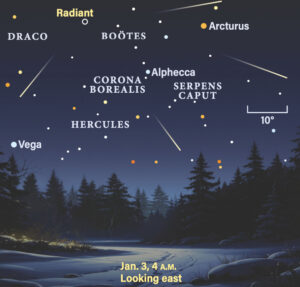 The Quadrantid meteor shower peaks today, unfortunately suffering from the bright moonlight flooding the sky. Nonetheless, if you’re up in the hours before dawn, the radiant is already some 40° high in the northeast by 4 A.M. local time and rising higher as sunrise approaches. Although the Super Moon will reduce the visible rate of meteors to likely less than a dozen an hour, the Quadrantids are known for producing brighter fireballs — and these will still be visible, even in the moonlit sky.
Sunrise: 7:22 A.M.
Sunset: 4:47 P.M.
Moonrise: 5:05 P.M.
Moonset: 7:55 A.M.
Moon Phase: Waning gibbous (99%)
Sunday, January 4
You may have heard of the Summer Triangle, but do you know the Winter Hexagon?
This large asterism spans six constellations and, just as the Summer Triangle is easily visible on warm summer nights, the Winter Hexagon stands above the horizon on cold winter evenings. By 9 P.M. local time, the entire star pattern is well above the eastern horizon. The lowest star at this time is Sirius in Canis Major, who sits at the feet of Orion the Hunter and lies below Orion’s Belt as the pair rises. Sirius, shining at magnitude –1.4, is the brightest star in the sky.
From here, move your gaze counterclockwise into Orion. The next star in the Hexagon is Rigel, which shines at magnitude 0.2 and depicts the Hunter’s right knee (as the figure is often drawn facing away from us). From Rigel, next look upward and slightly to the left to magnitude 0.9 Aldebaran, the eye of Taurus the Bull.
The magnitude 0.1 star Capella in Auriga caps the Hexagon as the highest star as it rises in the sky, standing to the upper left of Aldebaran. Now we start moving down toward the horizon again — the heads of Gemini the Twins, magnitude 1.6 and 1.2 Castor and Pollux (respectively), together form the next point in the Hexagon and lie below and slightly to the left of Capella. Note that bright magnitude –2.7 Jupiter is nearby, to the right of Pollux.
The last star in the Winter Hexagon is magnitude 0.4 Procyon in Canis Minor, to the lower right of Castor and Pollux and roughly halfway between Castor and Sirius.
Sunrise: 7:22 A.M.
Sunset: 4:48 P.M.
Moonrise: 6:23 P.M.
Moonset: 8:41 A.M.
Moon Phase: Waning gibbous (96%)
Monday, January 5
Rising shortly before midnight on January 4 and best viewed in the hours before dawn, Comet 24P/Schaumasse is located in northern Virgo, traveling through a rich region of the sky. Although the bright Moon will likely interfere, observers with larger scopes or astrophotography rigs may want to brave the moonlight to spot Schaumasse near the globular clusters M53 and NGC 5053 this morning.
By 4 A.M. local time, this region of the sky is some 50° high in the southeast. Schaumasse, recently observed around magnitude 10, lies roughly between the stars Diadem (Alpha Comae Berenices) and Vindemiatrix (Epsilon [ε] Virginis). For a more precise position, look 4° due south of Diadem to find it.
M53 and NGC 5053 lie just over 1° east of Diadem, so you can use this star as a jumping-off point to find them as well. Both are roughly the same angular size (10’) but M53 is brighter at magnitude 7.6, compared to NGC 5053’s magnitude of 9.8. The latter is much closer to the current magnitude of the comet.
The comet remains near the two clusters for the next several days, but the Moon — although waning — is also approaching this region day by day, so your best chance to see the grouping is now, while Luna still floats relatively far away in the sky.
Sunrise: 7:22 A.M.
Sunset: 4:49 P.M.
Moonrise: 7:39 P.M.
Moonset: 9:16 A.M.
Moon Phase: Waning gibbous (90%)
Tuesday, January 6
Venus reaches superior conjunction with the Sun at noon EST. At this time, the planet will lie on the other side of our star from Earth’s point of view; it will reappear in the evening sky in mid-February.
The Moon passes 0.5° north of Regulus in Leo, also at noon EST. The two will rise a few hours after sunset this evening, with the Moon now near Rho (ρ) Leonis — in fact, some observers from the U.S. East Coast to the eastern portion of the Midwest may see Luna occult this star shortly before 9 P.M. EST. The timing and visibility of this event will be heavily location-dependent.
With the gibbous Moon in Leo, our best bet for observing other targets lies in the western sky this evening. Visible there are the two famous open clusters of Taurus: the Pleiades and Hyades.
The Pleiades (M45) is the more easily recognizable of the two because it is more compact. Often called the Seven Sisters, this cluster spans about 110’ on the sky and is still nearly 60° high in the west by 11 P.M. local time. Most casual observers can spot six stars by eye, though some can see more. However, the bright moonlight may interfere a bit with naked-eye observing, so try zooming in with binoculars or a small telescope — or even your finder scope — for a closer look at these stars. They are roughly 100 million years old.
To the Pleiades’ upper left is Aldebaran, which appears to sit among — but is not physically part of — the stars of the Hyades. This cluster is much more spread out, spanning some 5.5° sprinkled across the nose of the Bull. These stars are about 625 million years old and are also best viewed with binoculars or a finder scope if you want a closer look.
Sunrise: 7:22 A.M.
Sunset: 4:50 P.M.
Moonrise: 8:50 P.M.
Moonset: 9:45 A.M.
Moon Phase: Waning gibbous (83%)
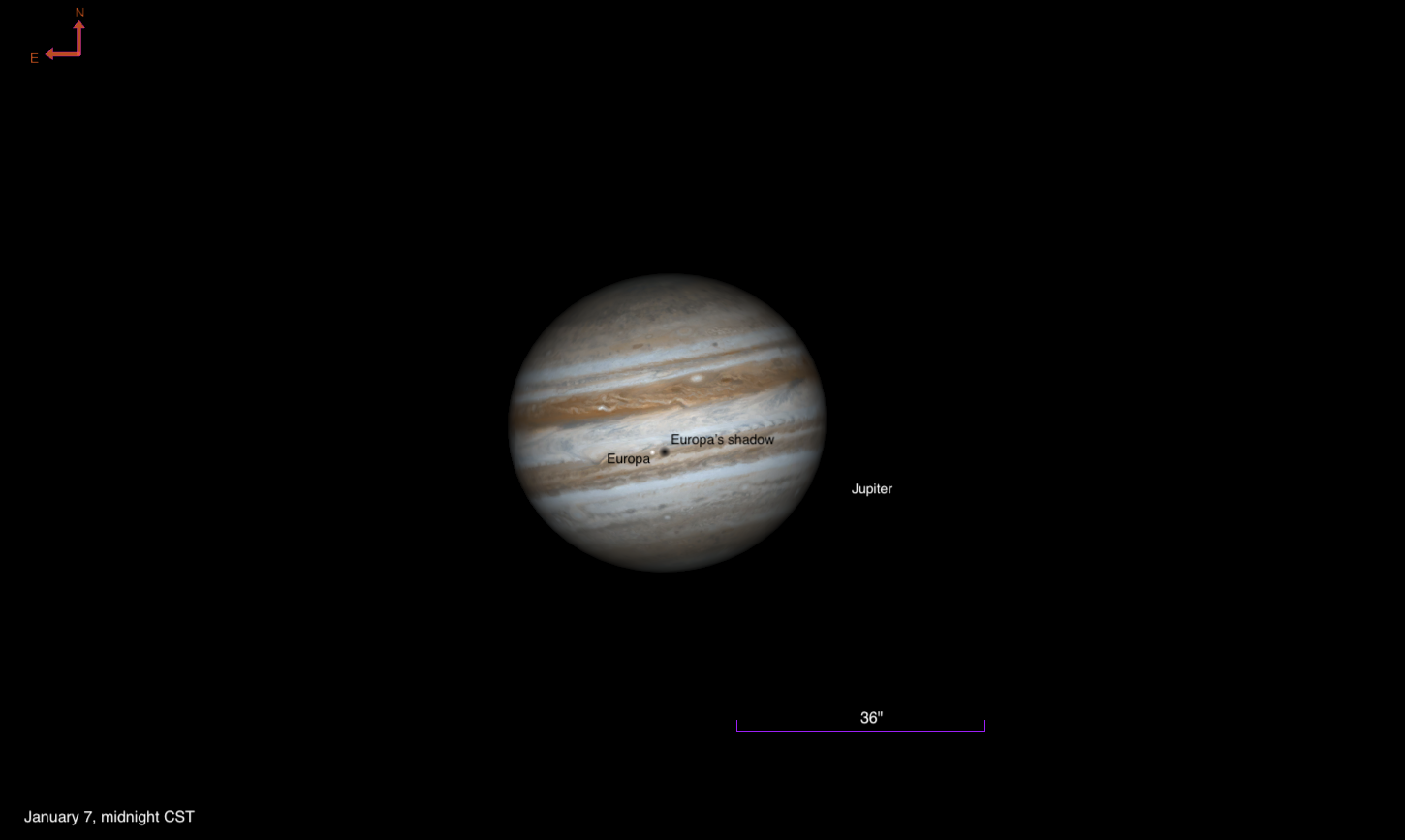
By midnight CST on January 7, Europa and its shadow appear at the center of Jupiter’s disk, mid-transit. Credit: Alison Klesman (via TheSkyX)
Wednesday, January 7
The icy moon Europa and its shadow transit the disk of Jupiter this evening as the planet nears opposition in less than a week. This close to opposition, the moon and shadow are barely separated, with less than 10 minutes between the start of their transits.
Because we are watching before opposition occurs, Europa’s shadow appears first, followed by the moon. After opposition, the moons will precede their shadows, so now is your last chance to watch the shadow lead. (Plus, stay tuned for a special event the morning of opposition next week, when Callisto and its shadow transit simultaneously!)
Jupiter is now rising around the time the Sun sets; by 11:15 P.M. EST, shortly before Europa’s transit begins, the planet is high in the east, to the right of the star Pollux in Gemini. Shining at magnitude –2.7, Jupiter is unmissable, much brighter than either Castor or Pollux — or even Sirius, the brightest star in the sky, which lies in Canis Major.
Zoom in on Jupiter with a telescope around this time, and you’ll see two moons to its east and two to its west. On the eastern side, Europa is closer — and closing in for its transit — while Callisto lies farther east. On the western side, Io is closer, with Ganymede farther west.
Europa’s shadow appears on Jupiter’s eastern limb beginning at 11:35 P.M. EST, followed by the moon itself crossing onto the disk just seven minutes later. By midnight CST (now 1 A.M. EST on the 8th in the Eastern time zone) Europa and its shadow are roughly central on the disk. While the dark spot of the shadow will be relatively easy to spot through a telescope, the small, bright moon itself might be lost against the glare of the cloud tops.
The two continue to cross the disk for another 90 minutes, until the shadow disappears from the eastern limb by 2:30 A.M. EST (now early on the 8th for all but the Pacific time zone). Again Europa follows seven minutes later, ending its transit by 2:37 A.M. EST.
Sunrise: 7:22 A.M.
Sunset: 4:51 P.M.
Moonrise: 9:58 P.M.
Moonset: 10:09 A.M.
Moon Phase: Waning gibbous (74%)
Thursday, January 8
Now that the Moon doesn’t rise until late in the evening, we can use the dark window after sunset to observe fainter objects in the evening sky once more.
Two hours after sunset, the constellation Perseus is high in the eastern sky. Our target tonight is a region near the star Algol (Beta [β] Persei), sometimes known as the Demon Star for its variable brightness, which swings between magnitude 2.1 and 3.4 every 2.867 days.
Center Algol in your telescope and drop some 2.2° to the lower left (east-northeast on the sky) to locate the rich Perseus Cluster of galaxies, the brightest member of which is NGC 1275. Glowing at magnitude 11.7, you’ll want as large a telescope as you can get to view this strange galaxy, also known as Perseus A. Classified as a peculiar galaxy, Perseus A is sending out strong emission that includes radio waves and X-rays — a clue to the feasting supermassive black hole in its heart. Through a telescope, this galaxy appears roughly circular, though tendrils of gas can be picked up in long-exposure astrophotos.
Many other galaxies should dot your view as well, especially in larger scopes (10 inches or more). In particular, note the slightly fainter (magnitude 12) galaxy NGC 1272, which appears just 5’ west of NGC 1275.
Sunrise: 7:22 A.M.
Sunset: 4:52 P.M.
Moonrise: 11:01 P.M.
Moonset: 10:30 A.M.
Moon Phase: Waning gibbous (65%)
The Keystone of Hercules is visible to the naked eye rising in the east a few hours before sunrise. Credit: Stellarium
Friday, January 9
Mars is in conjunction with the Sun at 7 A.M. EST, rendering the Red Planet invisible. We’ll have to wait until mid-March to see it once more, when it will shine in the predawn sky.
If you are up early today, however, try finding the famous Keystone of Hercules in the eastern sky, about 40° high two hours before sunrise. Looking east, you’ll see a bright star (magnitude 0.0) some 20° high at that time — that’s Vega, the alpha star of Lyra the Lyre.
From here, glance to the upper right for a rough square of four stars located about ⅓ of the way from Vega to the bright star Arcturus (magnitude –0.1) in Boötes the Herdsman. That’s the Keystone. Its brightest star is magnitude 2.8 Zeta (ζ) Herculis, which anchors the southwestern corner (the star farthest right as the constellation rises, at the upper righthand corner of the Keystone). To its upper right in the sky this morning is Eta Her (magnitude 3.5), about 7° to Zeta’s north and forming the upper lefthand corner of the Keystone in this configuration. Then drop 6.5° southeast (to the lower left) to Pi (π) Her (magnitude 3.2), and finally slide another 6.5° southwest (to the lower right) to find magnitude 3.9 Epsilon Her at the lower right corner of the box.
If you have a telescope, take a moment to glance about ⅓ of the way along a line from Eta to Zeta Her — there you’ll find the famous Hercules Cluster (M13), a magnificent globular cluster glowing at 6th magnitude.
Sunrise: 7:22 A.M.
Sunset: 4:53 P.M.
Moonrise: —
Moonset: 10:51 A.M.
Moon Phase: Waning gibbous (55%)

The sky, Jan. 4-9: Quadrantid meteor shower added by Cosmic1 on
View all posts by Cosmic1 →
You must be logged in to post a comment Login