

Special to CosmicTribune.com, January 22, 2026
By Richard Fisher
With the potential to greatly increase the utility and value of building a permanent presence on the Moon, on Jan. 20, 2026 Chinese state media lit up with the news that Chinese scientists had discovered naturally occurring carbon nanotubes (CNTs) in lunar regolith samples returned to Earth by the 2024 Chang’e-6 far side of the Moon mission.
This discovery was announced in the Chinese journal Nature Astronomy in an article titled, “Discovery of Naturally Occurring Single-Walled Carbon Nanotubes and Graphitic Carbon on the Far Side of the Moon,” written by a team of 16 scientists from China’s Jilin University.
Nine of them are affiliated with the Key Laboratory of Automobile Materials, Ministry of Education, School of Material Sciences and Engineering, Electron Microscopy Center, International Center of Future Science, Changbaishan Laboratory, of Jilin University.
On June 25, 2024 the Chang’e-6 sample return capsule landed in Inner Mongolia with about 2 kilograms (4.4 lbs) of lunar samples collected from about 2 meters (6.6ft) below the surface of the Moon.
The often harsh nationalist Global Times led Chinese state media reporting, saying, “for the first time internationally, discovered and confirmed the presence of naturally formed single-walled carbon nanotubes and graphitic carbon, proving that geological activity on the far side of the moon has been more intense.”
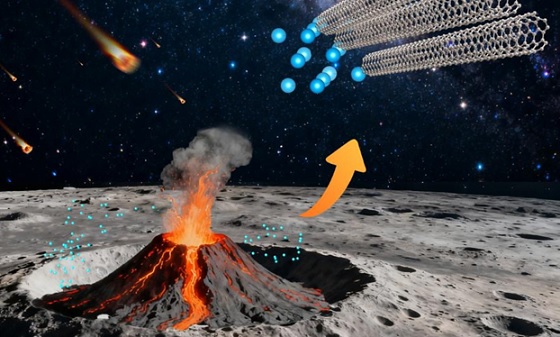
Global Times also noted that these findings, “indicate that the formation of these carbon nanotubes is closely linked to micrometeorite impacts and an iron-driven catalysis process under early volcanic activities and solar wind irradiation on the lunar surface. This demonstrates nature’s ability to synthesize key materials under extreme conditions.”
In short, CNTs exist naturally on the Moon due to millions of years of lunar volcanic activity and micrometeorite impacts and may exist in greater quantities on the far side of the Moon.
However, apart from simply revealing this discovery, Chinese state media coverage, nor the source article, apparently, offered additional useful information such as estimates of the volume of carbon nanotubes that might be harvested from a given volume of lunar regolith.
While this news was certainly of value to the Chinese Communist Party’s Propaganda Department to trumpet the accomplishments of China’s Moon program and its lunar scientists, China was also revealing a reason for the United States and its 60-nation Artemis Accords partners to commit to achieving an early permanent presence on the Moon.
Full Text . . . . Current Edition . . . . Subscription Information

China announces discovery of carbon nanotubes on 2024 mission to far side of Moon added by Cosmic1 on
View all posts by Cosmic1 →
You must be logged in to post a comment Login