

Special to CosmicTribune.com, January 29, 2026
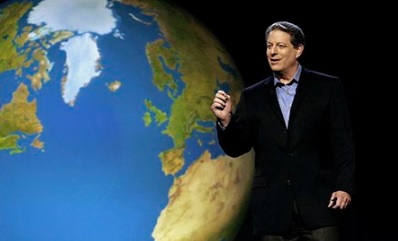
Al Gore’s “An Inconvenient Truth” premiered at the Sundance Film Festival on Jan. 24, 2006. It was released to theaters the following May and went on to gross over $25 million worldwide and won the Oscar for Best Documentary.
In a Jan. 26 analysis, Just the News energy reporter Kevin Killough cites critics as saying the biggest disaster of Gore’s film 20 years later is its failed predictions.
 The ice is stubborn
Gore predicted in the 2006 documentary that Africa’s Mt. Kilimanjaro would have no more snow on it by 2016. In 2020, The Times reported that the snow on the 19,000-foot mountain remained.
“But the documentary had caused some to rush to climb the mountain before the snow disappeared. Instead, the tourists are surprised to find glaciers still clinging to it,” Killough noted.
Gore also predicted that Glacier National Park would be “the park formerly known as Glacier” after all the ice melted away in the blazing hot temperatures that were to descend upon the human race.
The U.S. Geological Survey predicted all the glaciers in the park would be gone by 2020. Signs were placed throughout the park warning visitors of the impending end of glaciers, which never happened. Instead, CNN reported, the signs had to be removed in 2020 when it was clear the glaciers remained.
Global warming or climate change?
Gore also connected Hurricane Katrina to global warming – later renamed climate change – and he predicted that these storms would become more frequent.
“The reality of human contributions to hurricane activity is far more nuanced and uncertain than Gore discusses in the documentary,” Killough noted.
The National Oceanic and Atmospheric Administration (NOAA) has a section on its website dedicated to the topic.
“In summary, it is premature to conclude with high confidence that human-caused increases in greenhouse gases have caused a change in past Atlantic basin hurricane activity that is outside the range of natural variability, although greenhouse gases are strongly linked to global warming,” the page reads.
Uncertainty and nuance
Meteorologist Chris Martz said that climate science is full of the kind of uncertainty and nuance you see on the NOAA website, which “An Inconvenient Truth” dismisses entirely.
Since Gore’s film was released – which was given a sequel in 2017 – the former vice president has continued to make false predictions, the meteorologist said. In 2009, Gore stated that the Arctic would be ice-free in summer within five to seven years. As of today, the Arctic still has ice in summer.
“We look at the Arctic ice now and yes, it’s declined since 1979 when satellite records began … But over the last 18 to 20 years, there’s really been no trend. And this caught scientists off guard. The models never predicted this,” Martz told Just the News.
Martz added that there have been multiple studies on Arctic ice, and while some predicted an ice-free Arctic, others find the ice extent in the region recedes or grows as a result of natural variability.
“Predictions of cataclysm stemming from climate change regularly get reported in the media, but there’s little reporting when the predictions fail,” Killough noted.
In 2022, NBC News was one of many outlets reporting that California and the American West were in the midst of a “megadrought,” which was the worst the region had seen in over 1,000 years.
Earlier this month, NBC reported that California is drought free for the first time in 25 years. The article makes no mention of the previously predicted “megadrought,” nor does it mention climate change.
Martz said that many of his critics respond to these failed predictions by arguing they weren’t made by scientists in peer-reviewed articles published in journals. Instead, they’re made by politicians or scientists in interviews. But most people don’t get their information from scientific journals. They get it from the media, Martz said.
“That communication is what’s more important in terms of public perception of what science is,” he said.
“An Inconvenient Truth”, Killough noted, “was a primary catalyst for the climate activist movement, and it generated a lot of concern about global warming following its release. The movie left audiences with the impression that the human race was hurtling toward a dystopian future on a planet baking in unbearable temperatures where extreme weather caused frequent disasters. ”
Almost 13 years to the day after its release, New York Democrat Rep. Alexandria Ocasio-Cortez was telling people the world would end in 12 years – presumably five years from now – because of the burning of fossil fuels.
Matt Wielicki, who writes about climate and energy on his “Irrational Fear” Substack, was once an assistant professor in the Department of Geological Sciences at the University of Alabama. In the early part of his academic career, he taught at a local college.
He told Just the News that he showed “An Inconvenient Truth” to his students. Over time, he began to question the “gloom and doom” narratives Gore presents in his film, he said.
“People took that as a starting point, and they just kept running further and further with it,” Wielicki said.
Larry Behrens, communications director for Power the Future, told Just the News that AOC likely spent the seven-year anniversary of her prediction doing exactly what she does any other day.
“Because she knows it was nonsense when she said it, and it’s nonsense now,” he said. “Make no mistake, she’ll join the rest of the eco-left in their convenient climate silence, hoping voters forget their green crusade delivered record energy prices and crushing inflation. On this anniversary, ‘climate’ is the last word AOC and her allies want to utter because midterms are coming, and voters remember exactly who made life more expensive.”

20 years later, Al Gore has made millions for ‘truths’ that were not added by Cosmic1 on
View all posts by Cosmic1 →
You must be logged in to post a comment Login