

Special to CosmicTribune.com, February 5, 2026
By Richard Fisher
As the Trump Administration maneuvers to block the Chinese Communist Party’s (CCP) quest for hegemony on Earth — attacking its proxies Iran and Venezuela while arming Taiwan — in January 2026 is its becoming clear that the United States and China are also locked in a contest to dominate the Solar System.
In this contest there is a vital contrast: China’s quest for space dominance is methodical, has long striven to integrate military and economic goals, starts in Low Earth Orbit (LEO) but extends to the Moon, Mars and beyond, and is led by its largest funding-assured state-owned corporation, the China Aerospace Science and Technology Corporation (CASC) — assisted by the Aviation Industries of China (AVIC).
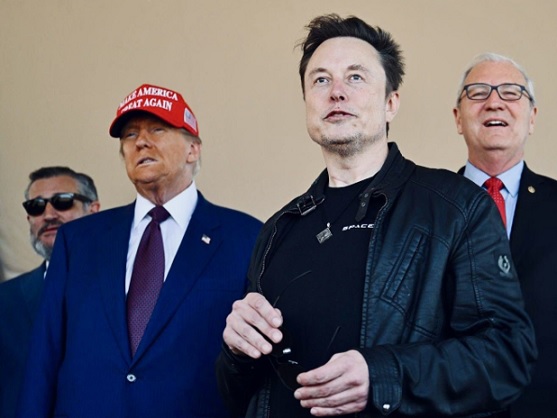
The American effort is a hodge-podge; It is dependent on the transforming visions of President Donald Trump and private sector leaders like Elon Musk.
The integration of Department of War (military) and National Aeronautics and Space Administration (science-economic) goals is just beginning. While the private sector and U.S. allies could make decisive contributions, they are also financially vulnerable which challenges program resilience.
President Donald Trump’s vision and leadership has been essential.
During his first term Trump revived the U.S. manned Moon program in December 2017, and in January 2025 inaugurated his Golden Dome national missile defense program — ending decades of debate over whether American and their allies should be defended from nuclear missile attack — and whether the U.S. should “weaponize” space.
It is likely that Trump’s realization that Golden Dome assets required defending that led to his Dec. 18, 2025 Executive Order, “Ensuring American Superiority In Space,” which stated:
“Superiority in space is a measure of national vision and willpower, and the technologies Americans develop to achieve it contribute substantially to the Nation’s strength, security, and prosperity. The United States must therefore pursue a space policy that will extend the reach of human discovery, secure the Nation’s vital economic and security interests, unleash commercial development, and lay the foundation for a new space age.”
By January 2026 the U.S. Department of War’s Space Development Agency (SDA) was planning to deploy a Proliferated Warfare Space Architecture (PWSA) of 506 space tracking and communication satellites to support national and allied missile defense operations.
In a Feb. 2 speech at Capa Canaveral, Secretary of War Pete Hegseth stated that the U.S. is building the:
“…next generation sensors and satellites that will see every threat from every corner of the globe paired with a network of space-based interceptors ready to neutralize any ballistic missile, any hypersonic weapon, any drone long before it threatens our homeland. The kind of protection President Trump has promised the American people and the War Department will deliver. That is how we establish total orbital supremacy.”
A U.S. investment in space superiority will both enable and generate business for the growing U.S. commercial space sector, led by SpaceX Corporation founder Elon Musk, Blue Origin’s Jeff Bezos, and Rocket Lab’s Sir Peter Beck.
Elon Musk forged a political alliance with Trump during the 2024 presidential campaign, that waned in mid-2025 but likely remains centered around their shared goals in space.
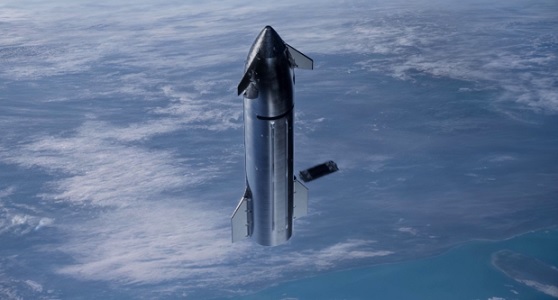
Musk has famously pioneered the development of commercially profitable reusable space launch vehicles (SLVs), to include his massive Starship with which he plans to colonize Mars, and the creation of his Starlink mega-constellation of an eventual 42,000 broadband-internet satellites.
But Musk previewed his most ambitious projection into space with a Jan. 31, 2026 filing with the U.S. Federal Communications Commission (FCC) to launch an amazing 1 million Artificial Intelligence (AI) driven solar powered space data centers, amid reports that he was going to merge his SpaceX and his “xAI” artificial intelligence companies.
Full Text . . . . Current Edition . . . . Subscription Information

In battle for the heavens Trump-Musk are in lead, but China’s vision is long-term added by Cosmic1 on
View all posts by Cosmic1 →
You must be logged in to post a comment Login