

Special to CosmicTribune.com, February 26, 2026
Citing evidence of reduced distraction and improved academic performance, a number of states are considering “bell-to-bell” bans on the use of cellphones for students in kindergarten through high school.
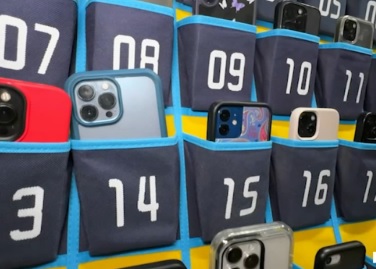 Lawmakers in Georgia, Kansas, Indiana, Michigan, Pennsylvania, Wisconsin, and Massachusetts are considering stronger legislation as child safety experts endorse stricter policies for cellphone use at school, Sean Salai reported for The Washington Times earlier this month.
Currently, students in 19 states and the District of Columbia are required to store their phones in a pouch or locker for the duration of the school day.
In May 2023, Gov. Ron DeSantis signed House Bill 379, making Florida the first state to use the legislative process to ban cell phones in classrooms. Both chambers of the state legislature approved the bill unanimously.
“A student may possess a wireless communications device while the student is on school property or in attendance at a school function; however, a student may not use a wireless communications device during instructional time, except when expressly directed by a teacher solely for educational purposes,” the bill states. “A teacher shall designate an area for wireless communications devices during instructional time. Each district school board shall adopt rules governing the use of a wireless communications device by a student while the student is on school property or in attendance at a school function.”
Allison Bonacci, director of education for Cyber Safety Consulting, which works with schools to develop technology policies, noted: “We have learned that the most successful policies include a complete bell-to-bell ban with phones locked away in pouches.”
• In Georgia, a Republican-sponsored bill would extend the state’s bell-to-bell ban from K-8 students to high schools.
• In Wisconsin, Republican lawmakers are seeking to extend their state’s K-12 cellphone ban to cover the entire school day.
• In Pennsylvania, a bipartisan bill for a “bell-to-bell” ban has received support from Democrat Gov. Josh Shapiro.
• In Massachusetts, Democrats have advanced legislation that would ban tablets, smartphones, and Bluetooth devices at all K-12 campuses starting in the fall.
“The general consensus is that students are more engaged in class, distractions are down and social interaction has shifted back toward in-person peer relationships instead of life online,” said Scott Kollins, a developmental psychologist and chief medical officer at Aura, a Boston-based app for parents monitoring children’s digital activity.
Margaret Murray, a University of Michigan-Dearborn professor who studies the issue, said she expects bell-to-bell bans to become “the gold standard” as schools see the results.
“The states that have bell-to-bell bans will see improvements in test scores, attendance and behavior,” Murray said. “The states that don’t will fall further behind.”
Some parents groups oppose the bans.
Sheri Few, president and founder of the conservative United States Parents Involved in Education, said student cellphones provide “a vital check on classroom content and teacher delivery” for political bias.
“Without the ability to record, parents lose visibility into how controversial topics are taught,” Few said.
A 2024 Pew Research Center survey showed that 67% of adults supported banning smartphones during class time, but only 36% favored bell-to-bell bans.

Cellphone bans, ‘bell-to-bell,’ spreading nationwide added by Cosmic1 on
View all posts by Cosmic1 →
You must be logged in to post a comment Login