

Special to CosmicTribune.com, May 4, 2026
Excerpts from weekly Astronomy.com report.
Sunday, May 3
Venus officially passes 7° north of Aldebaran at 3 A.M. EDT this morning.
But the bigger story occurs late tonight, as the Moon rises around 10:30 P.M. local daylight time in northwestern Scorpius and passes 0.5° south of Alpha (α) Scorpii, better known as Antares, at 11 P.M. EDT. Some locations in the Southern Hemisphere — parts of South America, Antarctica, and very southern Africa and a small portion of Madagascar — will see an occultation as the Moon passes in front of Antares. The rest of the world, including the U.S., will just see the two objects nestled close in the sky.
The pair spends the late evening low in the southeast, rising higher over time. They’re unmissable with the Moon not long past Full, still some 95 percent lit. But Antares is also bright — magnitude 1.1 — and won’t be drowned out by the Moon’s light. As the hours pass overnight and into the early morning of May 4, you’ll notice the Moon seems to lag behind Antares, pulling away to the east over time. That’s because the Moon is much closer, making it appear to move faster than the background stars in the sky as they rise and set. Our satellite appears to move at an average of roughly 13° per day across the sky.
Related: See the Moon meet Antares
Sunrise: 5:58 A.M.
Sunset: 7:57 P.M.
Moonrise: 10:25 P.M.
Moonset: 6:36 A.M.
Moon Phase: Waning gibbous (95%)
Monday, May 4
The Moon reaches apogee, the farthest point from Earth in its orbit, at 6:30 P.M. EDT. At that time, our satellite will sit 252,177 miles (405,840 kilometers) away.
In honor of May the 4th, grab your telescope and head out shortly after sunset to catch NGC 2359, often called Thor’s Helmet but also — and of particular importance today — the Baby Yoda Nebula.
Located in northeastern Canis Major, the nebula sets a few hours after the Sun. By about 9 P.M. local daylight time, you’ll find it roughly 20° high in the southwest, to the far upper left of Sirius, the brightest star in the sky. From that star, it’s about an 8.8° jump northeast to land on NGC 2359, which surrounds the 11th-magnitude star WR7, also cataloged as HIP 35378. The nebula is visible as a small, 8’-wide fuzzy patch in scopes smaller than 6 inches. Large telescopes (10 inches or bigger) will start to bring out its structure: a round edge with two protrusions, both pointing in the same direction. These look like the dome of Grogu’s head, framed by his pointed ears.
WR7 is a hot, massive Wolf-Rayet star some 16 times our Sun’s mass. It is blowing away huge amounts of material over time, which feed into and create the nebula around it. Such stars don’t live very long, only 10 million years or so, ultimately dying in supernova explosions.
Sunrise: 5:56 A.M.
Sunset: 7:58 P.M.
Moonrise: 11:22 P.M.
Moonset: 7:17 A.M.
Moon Phase: Waning gibbous (90%)
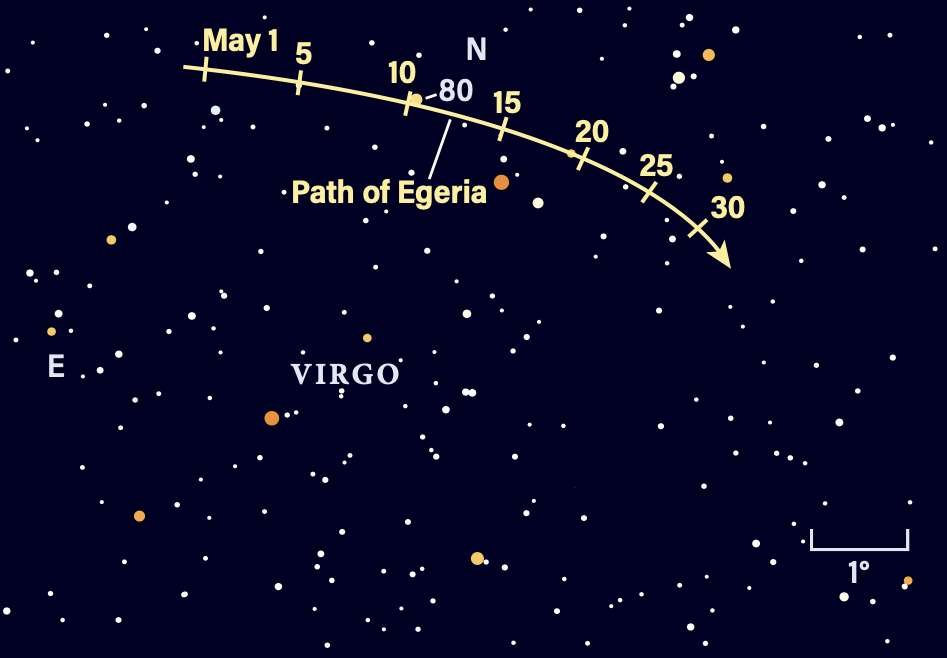 Egeria is a 6° hop from bright Spica (south of this field) in May. Credit: Astronomy: Roen Kelly
Tuesday, May 5
Asteroid 13 Egeria is moving through the constellation Virgo this month, and today is a particularly good opportunity to try to spot its motion over just a few hours.
Shining at 10th magnitude, Egeria can be picked up with a small scope even under mild light pollution. A few hours after dark, you’ll find Virgo more than 40° high in the south. It’s a big constellation: Egeria is located in its eastern reaches, about 7° northeast of the bright star Spica. Use 6th-magnitude 80 Virginis as a signpost — Egeria is just 1.2° east of this star tonight. The asteroid is passing north of a slightly brighter 8th-magnitude field star, HD 118957 (also cataloged as HIP66706). The star lies right on the hashmark for May 5 on the chart above, just south of the line depicting Egeria’s motion. The two are less than 2’ apart, so find the close pair in your eyepiece and record their positions, then come back later to see how the scene has changed. Within three hours, you should be able to note the asteroid’s movement.
Sunrise: 5:55 A.M.
Sunset: 7:59 P.M.
Moonrise: —
Moonset: 8:05 A.M.
Moon Phase: Waning gibbous (83%)
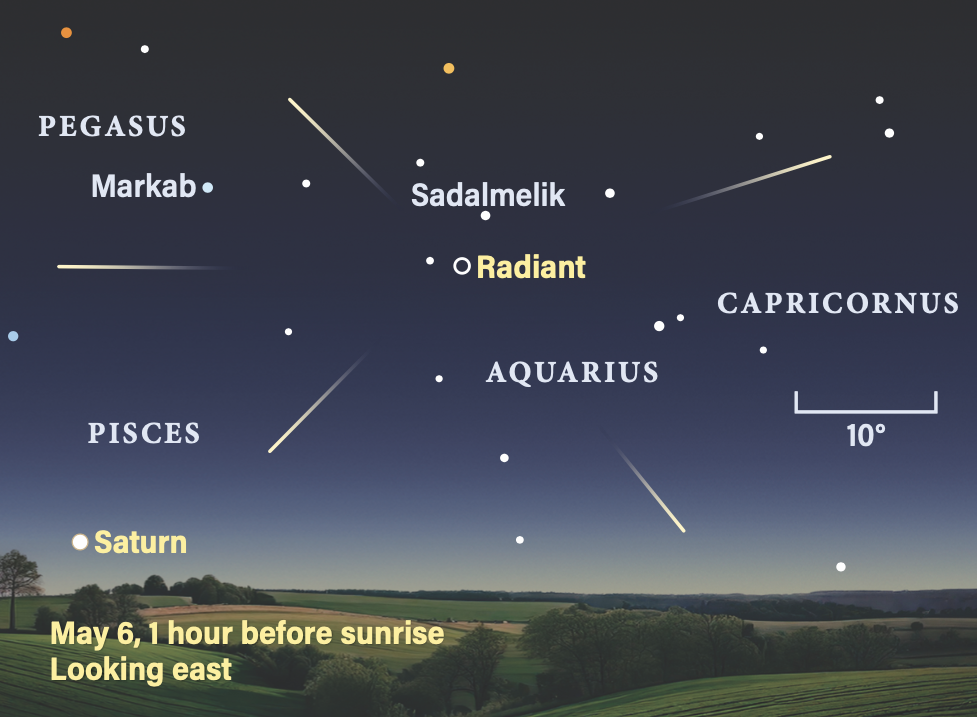 Although the Moon will interfere, look east in the hour before dawn for bright Eta Aquariid meteors. Neptune is above the horizon but a challenge even with optical aid, so not shown here. / Astronomy: Roen Kelly
Wednesday, May 6
The Eta Aquariid meteor shower peaks this morning, unfortunately with a gibbous Moon in the sky. But even though moonlight will interfere, if the weather is mild and you’re able to get up early, it’s worth stepping outside to see if you can clock a few of the shower’s brighter streaks.
Early morning is the best time to look for meteors, as at that time your location on Earth is turning into the stream. An hour before sunrise, the shower’s radiant in northern Aquarius is more than 20° high in the east. Under dark skies, up to 50 meteors per hour are expected, but with the Moon’s interference, that number will drop. Nonetheless, the brightest meteors should still be visible. The Eta Aquariid shower is known for its fast-moving meteors, with some dust particles streaking through the atmosphere at speeds of 40 miles per second (65 km/s).
Generated by debris left behind by the world-famous Halley’s Comet, The Eta Aquariids have a sibling shower in October: the Orionids, also produced by Halley’s debris. Unfortunately, the Orionids won’t offer a better show, as the Moon will exhibit roughly the same illumination, albeit waxing rather than waning, when that shower peaks later this year.
Sunrise: 5:54 A.M.
Sunset: 8:00 P.M.
Moonrise: 12:12 A.M.
Moonset: 9:01 A.M.
Moon Phase: Waning gibbous (76%)
Thursday, May 7
Io, the most volcanic body in the solar system, transits its parent planet Jupiter this evening, beginning just before midnight EDT tonight. Its shadow follows, offering an intriguing sight for telescopic observers.
Jupiter starts the evening in the west, the brightest point of light in the constellation Gemini the Twins, above brighter Venus in Taurus. Because Jupiter sets less than an hour after local midnight, different parts of the U.S. will get to view different phases of the transit.
Lucky East Coast observers might catch Ganymede and Europa swapping places far east of Jupiter early in the evening. Around 8:35 P.M. EDT, the two moons stand in a north-south line, with Europa north of Ganymede. Prior to this time, Ganymede is farther from Jupiter than Europa. After this time, Europa is farther from the planet.
Much closer to Jupiter but still to the east is Io, closing in for its transit. Callisto lies alone to Jupiter’s west. Io reaches the eastern limb and begins to transit at 11:48 P.M. EDT. The planet will set for East Coast observers before the moon’s shadow can appear, which occurs at 11:56 P.M. CDT, visible from the Central, Mountain, and Pacific time zones only. After this, the two transit the disk together, with the planet setting across the Central time zone before Io can leave the western limb — this occurs at 12:04 A.M. MDT (now minutes into the 8th in this time zone), as the planet is getting low for those on Mountain time. Only West Coast observers will catch the shadow’s egress to close out the event, around midnight in this time zone.
Sunrise: 5:52 A.M.
Sunset: 8:02 P.M.
Moonrise: 1:30 A.M.
Moonset: 11:05 A.M.
Moon Phase: Waning gibbous (67%)
Friday, May 8
Pluto is stationary at 7 A.M. EDT. Located in Capricornus, the dwarf planet is very faint and requires large optics to see. However, the Moon is also nearby today, so it’s not an ideal date to go hunting for it.
Instead, let’s take advantage of the moonless early-evening sky to enjoy two lovely face-on spiral galaxies. We’ll start at the brighter, easier option: M51, also known as the Whirlpool Galaxy. And it’s easy to find — it lies just 3.5° southwest of Alkaid (Eta Ursae Majoris), the star at the very end of the Big Dipper’s handle. At magnitude 8.4, this 11’-wide spiral is visible as a circular fuzz even in small scopes, though the larger your aperture, the better. Scopes 6 inches or larger will start to show more detail. Look for a small, brighter center surrounded by a faint halo — that’s the galaxy’s nucleus and spiral arms, respectively. You may also notice a compact, bright spot nearby. This is NGC 5195, a smaller companion galaxy.
Now let’s try hard mode: Go back to Alkaid, and this time move your scope 5.7° northeast. There you’ll find M101. Glowing at 8th magnitude and spanning more than 20’, this galaxy is challenging despite its similar brightness to the Whirlpool because it is so much larger. That means its glow is spread over a larger area, making it appear artificially dimmer (giving it what astronomers call low surface brightness). A large scope of 10-12 inches is recommended for the best view of this galaxy’s bright center and faint spiral arms.
Sunrise: 5:54 A.M.
Sunset: 8:00 P.M.
Moonrise: 12:12 A.M.
Moonset: 9:01 A.M.
Moon Phase: Waning gibbous (58%)

The sky, May 3-8: Early morning meteor shower from Halley Comet debris added by Cosmic1 on
View all posts by Cosmic1 →
You must be logged in to post a comment Login