

Special to CosmicTribune.com, May 24, 2026
Excerpts from weekly Astronomy.com report.
Sunday, May 24
Moving through vast Virgo, 11th-magnitude asteroid 13 Egeria is passing near some stationary background stars tonight, offering an excellent chance to chart its motion over the course of a few hours.
You can begin looking for the main-belt world as soon as it’s nice and dark, as Virgo is already high in the sky. Two hours after sunset, Virgo’s brightest star, Spica, stands nearly 40° high in the south. From this bright star, slide your telescope slowly upward (north) 5°. Now you’re in Egeria’s realm.
Egeria is near a smattering of 9th- and 10th-magnitude suns; early in the evening, it’s roughly 10’ northwest of a magnitude 8.2 star and about 25’ southeast of a magnitude 8.5 star. There’s also a 10th-magnitude star about 6’ to Egeria’s southeast.
Take a photo or sketch out the pattern you see, and then take some time to check out the other sky wonders on your list. Come back in a few hours — say, three — and snap another photo or make another sketch. Has one of the dots here moved just slightly? That’s Egeria, sliding slowly to the southwest relative to the stationary background stars.
Sunrise: 5:38 A.M.
Sunset: 8:17 P.M.
Moonrise: 2:01 P.M.
Moonset: 2:09 A.M.
Moon Phase: Waxing gibbous (67%)
Monday, May 25
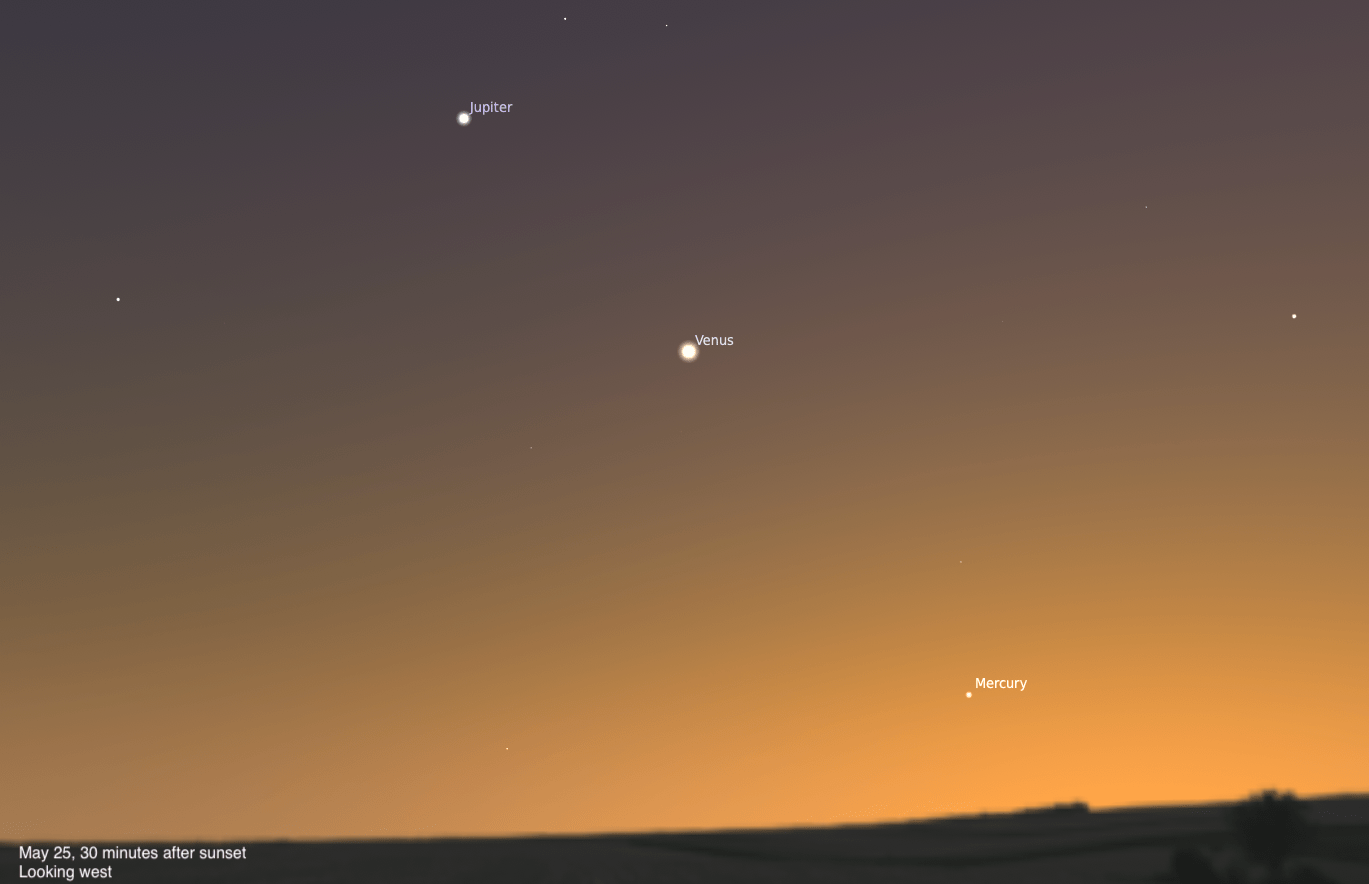
After reaching superior conjunction midmonth, Mercury is increasing in visibility and should be easily identifiable now in the evening sky. Just half an hour after sunset, step outside to see if you can spot the solar system’s smallest world, now shining at a respectable magnitude –1.1. It should be 6° above the western horizon.
You will, of course, also spot brighter Venus and Jupiter. Jupiter is highest in the sky, now in eastern Gemini and shining at magnitude –1.9. Venus, a little lower, sits closer to the Twins’ feet and lies between Jupiter and Mercury, shining at magnitude –3.9. If you have trouble spotting Mercury, simply draw a line from Jupiter down through Venus and continue it toward the horizon. Mercury lies along that line.
Through a telescope, compare the sizes and illuminated extents of Venus and Mercury. The former now appears some 13” across, with 81 percent of its visible disk (cloud tops) lit. Mercury is a slightly more illuminated at 84 percent lit, but it’s less than half the size of Venus, stretching only 6” wide in our sky.
Sunrise: 5:37 A.M.
Sunset: 8:17 P.M.
Moonrise: 3:05 P.M.
Moonset: 2:30 A.M.
Moon Phase: Waxing gibbous (76%)
Tuesday, May 26
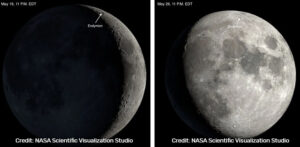
Tonight, let’s compare the appearance of the Moon to that of a week ago to see the effects of lunar libration, the “nodding” motion caused by the tilt of the Moon’s orbit around Earth.
High in the south shortly after sunset, the waxing Moon is in Virgo, not far from the bright star Spica, which has starred in several entries this week. With much of its face now illuminated, look in the center of the lunar northern hemisphere for Mare Serenitatis. North and just slightly east of this ancient lava plain is a crater normally situated much closer to the limb: Endymion. Shallow and flat-bottomed, Endymion typically appears oval-shaped due to foreshortening, but tonight it should look more circular, as it appears farther from the limb thanks to libration. Stretching some 76 miles (122 km) across, Endymion is some 3.9 billion years old.
Compare the images below, showing the location of Endymion tonight and a week ago, on the 19th. Together, they illustrate the magnitude of change libration can bring.
Sunrise: 5:37 A.M.
Sunset: 8:18 P.M.
Moonrise: 4:08 P.M.
Moonset: 2:51 A.M.
Moon Phase: Waxing gibbous (84%)
Wednesday, May 27
Ready for a ruby-red target? Let’s visit the star Y Canum Venaticorum, also famously known as La Superba, “the superb one.”
As soon as it’s dark, look for the constellation Canes Venatici high overhead. Don’t know where it is? It’s quite easy to locate: You’ll find its two bright stars nestled just beneath the curve of the Big Dipper’s handle. The star we’re after, La Superba, is located some 10.6° south-southwest of 2nd-magnitude Alioth (Epsilon [ε] Ursa Majoris), the third star from the end of the Big Dipper’s handle. Alternatively, you can find La Superba just over 7° north-northwest of Cor Caroli, Canes Venatici’s 3rd-magnitude alpha star.
La Superba is a variable star, meaning it glows anywhere from magnitude 4.8 to 6.3. Currently it is near that minimum, with recent reports from the American Association of Variable Star Observers placing the star around 6th magnitude. Binoculars or a small telescope should show it easily, and you’ll know it by its deep red color. La Superba shines with this hue because it is a carbon star, whose atmosphere (which is abundant in carbon) absorbs blue wavelengths while letting the red shine through, so the latter is what reaches our eyes.
Sunrise: 5:36 A.M.
Sunset: 8:19 P.M.
Moonrise: 5:10 P.M.
Moonset: 3:13 A.M.
Moon Phase: Waxing gibbous (91%)
Thursday, May 28
Today’s target sits near the head and claws of Scorpius the Scorpion, highest in the south shortly after midnight. M80 is a lovely, tightly-packed globular cluster of ancient stars located about 4.5° northwest of Antares, the heart of the Scorpion.
Visible in binoculars or any small scope, M80 glows at magnitude 7.3. It spans just 10’, making it quite compact. Although small instruments will easily pick it up, you’ll see the cluster through them as a bright, small fuzzy ball. If you want to begin resolving M80’s stars, try for a bigger scope and bump up the magnification. Many observers note that because it is so compact, the cluster looks a bit like a cometary nucleus without a tail.
M80 sits some 32,600 light-years away and contains hundreds of thousands of stars packed into a region of space about 95 light-years in diameter.
Sunrise: 5:35 A.M.
Sunset: 8:20 P.M.
Moonrise: 6:13 P.M.
Moonset: 3:37 A.M.
Moon Phase: Waxing gibbous (95%)
Friday, May 29
High in the northeast this evening, located within the head of Draco the Dragon, is one of the sky’s most famous and easy-to-split double stars. Nu (ν) Draconis appears to shine as a single 4th-magnitude star to the unaided eye. In truth, it comprises two 5th-magnitude components spaced so widely apart (62”, or a little over an arcminute) that you can spot both in binoculars or even your telescope’s finder scope. They appear nearly identical, each glowing with a soft white light. Both are roughly nine times as bright as the Sun and about 1.7 times as massive as our star. They circle each other every 44,000 years.
Nu1 is the western component, while Nu2 is the eastern star of the pair. According to the late stellar expert Jim Kaler, perhaps the largest difference between them is that Nu2 is itself a double, with a much smaller secondary that orbits the primary in less than 40 days. However, perhaps they aren’t so different after all: Kaler notes that astronomers suspect Nu1 may also be a double, but this has not yet been confirmed.
Sunrise: 5:35 A.M.
Sunset: 8:21 P.M.
Moonrise: 7:17 P.M.
Moonset: 4:04 A.M.
Moon Phase: Waxing gibbous (98%)

The sky, May 24-29: Observing lunar libration added by Cosmic1 on
View all posts by Cosmic1 →
You must be logged in to post a comment Login