

Special to CosmicTribune.com, June 14, 2026
Excerpts from weekly Sky&Telescope report.
SUNDAY, JUNE 14
■ Bright Arcturus, shining very high toward the south these evenings, and Spica, about three fists at arm’s length below it and a bit right, form an almost perfect equilateral triangle with dimmer Denebola, Leo’s 2nd-magnitude tail tip, off to their right. All three sides of the triangle are close to 35° long (35.3°, 35.1°, and 32.8°).
■ New Moon (exact at 10:54 p.m. EDT).
MONDAY, JUNE 15
■ After nightfall, look for the Big Dipper hanging straight down by its handle high in the northwest. Its bottom two stars, the Pointers, point right or lower right toward modest Polaris, the end of the Little Dipper’s handle.
This is the time of year when, at the end of twilight, the Little Dipper floats straight upward from Polaris — perhaps like a helium balloon on a curving string escaped into the night from a prom party. Through light pollution, however, all you may see of the Little Dipper are Polaris at its bottom and Kochab, the lip of the Little Dipper’s bowl, at the top. Both are 2nd magnitude. The rest of its stars are fairly dim at 3rd to 5th magnitude.
TUESDAY, JUNE 16
■ Venus, Jupiter, and Mercury now form an equally spaced line in twilight, 7° from planet to planet. The thin crescent Moon joins them, hanging between Jupiter and Mercury as shown below.
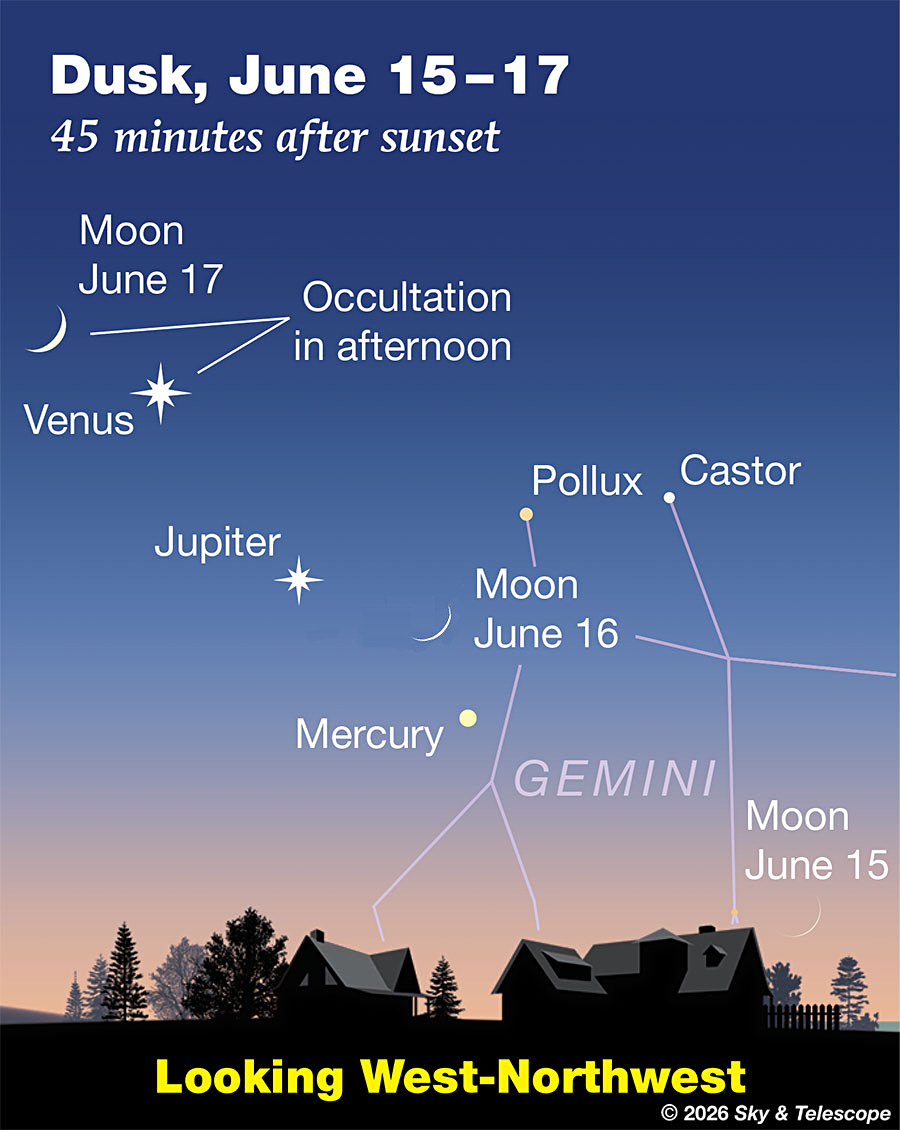 The hair-thin Moon will be very difficult to catch just above the horizon on Monday June 15th. It stands out better when it’s with the planets on Tuesday and Wednesday.
WEDNESDAY, JUNE 17
■ Today’s daylight occultation of Venus by the Moon’s dark limb, if you have a clear blue sky at the time, will be visible with a telescope or possibly even binoculars. See the June Sky & Telescope, page 48, for a timetable and details. Nearly everyone in North America gets a chance, sky permitting.
■ During dusk the crescent Moon decorates the top of the Venus-Jupiter-Mercury line. It shines just 2° or 3° upper left of Venus (for North America).
THURSDAY, JUNE 18
■ And now we have a diagonal lineup of five objects in the western dusk 1st-magnitude or brighter. From upper left, spot Regulus, the Moon, Venus, Jupiter, and Mercury. The whole line is 44° long along the ecliptic.
FRIDAY, JUNE 19
The Moon is a thick crescent in the west, left of Regulus. A telescope this evening shows the Moon’s terminator crossing, from north to south, Mare Frigoris, Lacus Somniorum, Mare Tranquillitatis, and Mare Nectaris, as shown below. On the south edge of Nectaris is the standout flooded crater Fracastorius, always a landmark when the Moon is near this phase. Just south of Fracastorius, shadows fill the similar-sized craters Piccolomini and more ragged Stiborius.
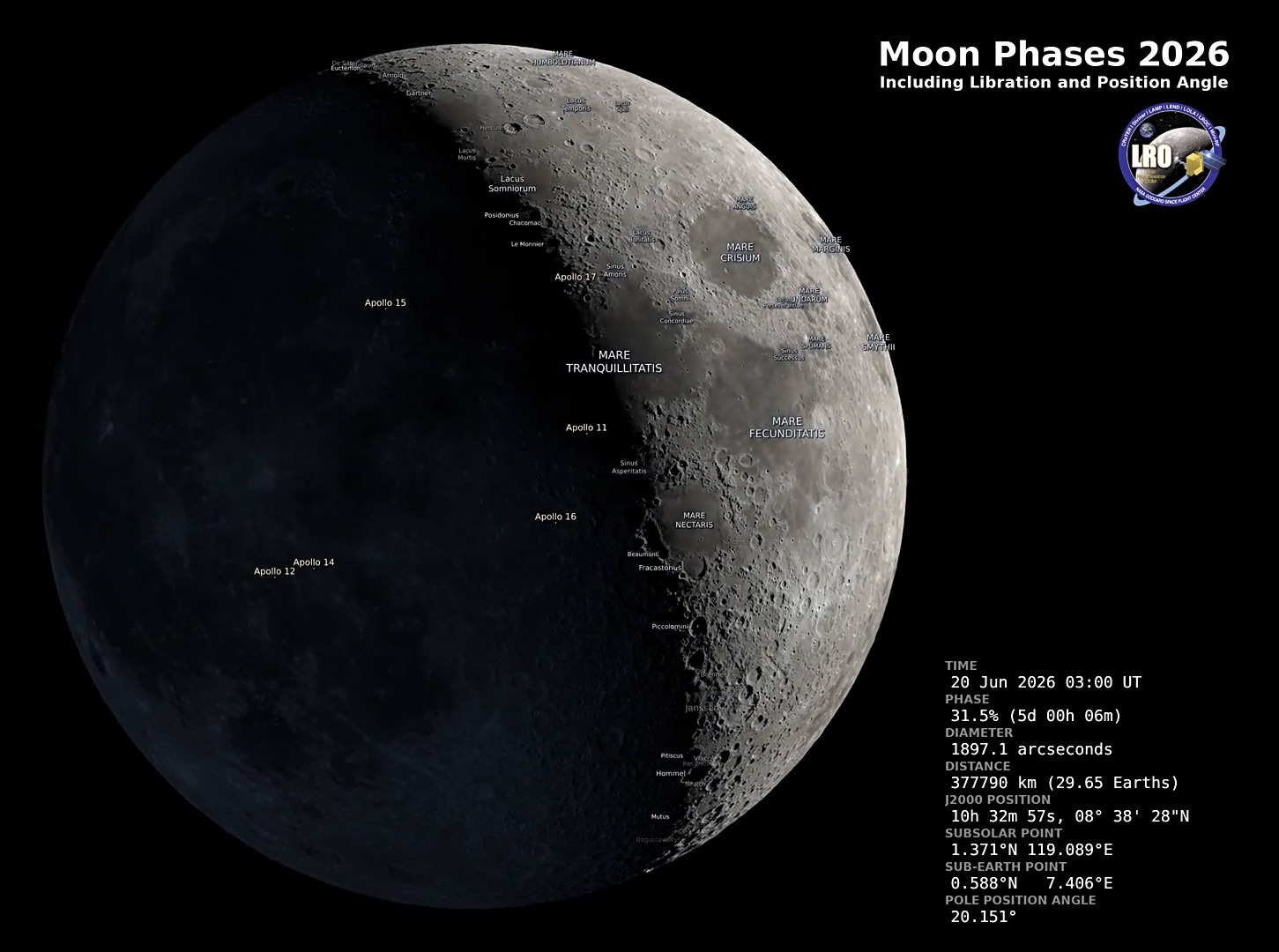 North is up in this precise rendition of the Moon for 10 p.m. EDT June 19th by NASA’s Scientific Visualization Studio. Libration is included. For higher resolution, right-click and open the image in a new tab or window.
SATURDAY, JUNE 20
■ On this final evening of spring, look very low in the north-northwest in late twilight for wintry Capella twinkling far out of season. The farther north you are the longer Capella hangs in. For the South it’s well and truly gone, but if you’re as far north as Montreal or either of the Portlands (Oregon or Maine), Capella is actually circumpolar.
SUNDAY, JUNE 21
■ This is the longest day of the year for the Northern Hemisphere, and the official start of summer. The summer solstice comes at 4:25 a.m. EDT, when the Sun ends its northward journey for the season and begins its six-month return south. The Sun today crosses the highest it can ever be in your sky (if you’re in the North Temperate Zone), so this is when your shadow becomes the shortest it can ever be at your location. It happens at local apparent noon (“solar time”), which at your location is probably rather far removed from noon by the clock.
This is also the day when the Sun rises and sets farthest north on your horizon. Though the difference is extremely slight for several days before and after.
■ First-quarter Moon (exact at 5:55 p.m. EDT). After dusk, look for 1st-magnitude Spica about two fists to the Moon’s left or upper left, and 2nd-magnitude Denebola, tail star of Leo, the same distance to the Moon’s upper right. Corvus is on its way to setting to the Moon’s lower left.
The Moon’s straight terminator has now unveiled all of Tranquillitatis and Serenitatis.

The sky, June 14-21: Planets lined up with crescent Moon on June 16 added by Cosmic1 on
View all posts by Cosmic1 →
You must be logged in to post a comment Login