

Special to CosmicTribune.com, July 12, 2026
Excerpts from weekly Astronomy.com report.
Sunday, July 12
Let’s look back to Saturn this morning to catch Titan, its largest and brightest moon, now close to the planet as it passes south of its parent world. Shining at mid-8th magnitude, Titan is easy to spot in any telescope. Check it out this morning just southwest of Saturn in the few hours before sunrise.
Around 3:30 A.M. local daylight time, Saturn will be some 35° high in the east. Taurus the Bull will have just risen and lies low along the horizon — Saturn is to this constellation’s upper right, the brightest point of light in an otherwise relatively unremarkable region of sky.
Through a telescope, Saturn’s rings are of course the standout feature, now stretching 40” across and surrounding the planet’s 18”-wide disk. Along with Titan, several other fainter, 10th-magnitude moons cluster closer to the planet, including Dione, which is now west of the planet, roughly in line with the rings. Tethys and Rhea, also 10th magnitude, lie to Saturn’s east. Other fainter moons are also close to the gas giant, but they will be difficult to pick up in most scopes.
Mercury reaches inferior conjunction with the Sun tonight at 9 P.M. EDT. Although we can’t spot the small planet right now, it will become visible in the morning sky before the end of the month.
Sunrise: 5:42 A.M.
Sunset: 8:29 P.M.
Moonrise: 3:13 A.M.
Moonset: 7:26 P.M.
Moon Phase: Waning crescent (3%)
Monday, July 13
The Moon reaches perigee, the closest point to Earth in its orbit, at 3:57 A.M. EDT. At that time, our satellite will be 223,142 miles (359,112 kilometers) away.
Tonight’s target is already high in the east an hour or two after sunset: M29, an open cluster in Cygnus the Swan. It’s easy to find, just under 8° south of Gamma (γ) Cygni, the star that marks the central point where the two “arms” of the cross-shaped constellation meet. Spanning about 7’ and glowing at 7th magnitude, it’s a great object to observe in any optics. In fact, it should be brighter, but abundant dust in this region of the sky has dimmed its stars such that they require optical aid to view. Through those optics, M29 appears as a loose group of some 50 to 80 suns.
Residing about 4,000 light-years away, this cluster is quite young, around 10 million years old.
Sunrise: 5:43 A.M.
Sunset: 8:29 P.M.
Moonrise: 4:22 A.M.
Moonset: 8:22 P.M.
Moon Phase: New
Tuesday, July 14
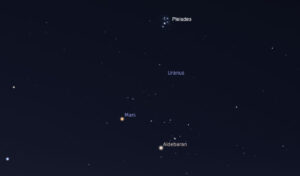
Mars passes 5° north of the red giant star Aldebaran in Taurus the Bull this morning at 3 A.M. EDT. The best time to view this lovely pairing will be just over an hour before sunrise, when the region is well above the eastern horizon but the sky has not grown too bright with the oncoming dawn.
Mars glows at magnitude 1.3, fainter than magnitude 0.9 Aldebaran below it. Regardless of their differing magnitudes, however, consider their colors. Both should appear orangey-red, albeit for different reasons. The Red Planet is covered in what is essentially rust (iron oxide), which has an orangey hue, and is apparent when sunlight reflects off the planet’s surface.
Meanwhile, Aldebaran’s color comes from its temperature — it is generating its own light, but this star burns at a lower temperature than our yellow-hued Sun.
Also visible in the early-morning sky is the Pleiades star cluster (M45), to the pair’s far upper right. The planet Uranus hangs below the Pleiades, technically visible to the naked eye under dark conditions and easy to pick up with any optics regardless of your site.
New Moon occurs at 5:44 A.M. EDT. Late this evening, the Moon passes 2° north of Jupiter at 11 P.M. EDT, although neither is visible at that time.
Sunrise: 5:43 A.M.
Sunset: 8:28 P.M.
Moonrise: 5:41 A.M.
Moonset: 9:07 P.M.
Moon Phase: Waxing crescent (1%)
Wednesday, July 15
Now that summer is in full swing, let’s check in with the season’s most famous asterism: the Summer Triangle. By late evening, this celestial shape is high in the southeast, bounded by the bright stars Deneb, Vega, and Altair.
Magnitude 0.0 Vega in Lyra is the brightest, followed by magnitude 0.8 Altair in Aquila and magnitude 1.3 Deneb in Cygnus. Parts of Sagitta the Arrow and Vulpecula the Fox also fall within the Summer Triangle’s boundaries, which encompass some 415 square degrees, or more than 2,000 times the area of the Full Moon. If you can get to a viewing site with dark skies, you should see the plane of the galaxy flowing through this asterism. The Cygnus Star Cloud, one of the brighter regions along the Milky Way’s plane, also lies within the Summer Triangle.
The Summer Triangle is named for this season because it is high overhead in the middle of short summer nights. Even if you’re in a relatively light-polluted area, you should be able to see its three anchoring stars and much of their constellations as well. Give it a try tonight!
Sunrise: 5:44 A.M.
Sunset: 8:28 P.M.
Moonrise: 7:01 A.M.
Moonset: 9:42 P.M.
Moon Phase: Waxing crescent (4%)
Thursday, July 16
The nearly three-day-old Moon passes 0.5° south of Regulus, the heart of Leo the Lion, at 9 P.M. EDT. Just after sunset, you’ll be able to spot the delicate crescent Moon in the west, with bright Venus to its upper left, some 8° east of the Moon. As the sky starts to grow dark, watch just to the Moon’s upper right, where magnitude 1.4 Regulus will appear. Follow the Moon and star as long as you can — this region sets within two hours of sunset.
Venus remains visible a little longer, setting just over two hours after the Sun. Take some time to focus on the planet with a telescope, and you’ll see that its 18”-wide disk is roughly 62% lit. Unlike, say, Mars, we’re not seeing down to the surface of Venus when we observe this planet in the sky. Instead, we’re seeing sunlight bouncing off its opaque cloud tops, which hide our view of the surface beneath. Images of that surface come only from radar, which can penetrate the thick shroud, or the few probes we have sent to land on the planet.
Sunrise: 5:45 A.M.
Sunset: 8:27 P.M.
Moonrise: 8:18 A.M.
Moonset: 10:11 P.M.
Moon Phase: Waxing crescent (10%)
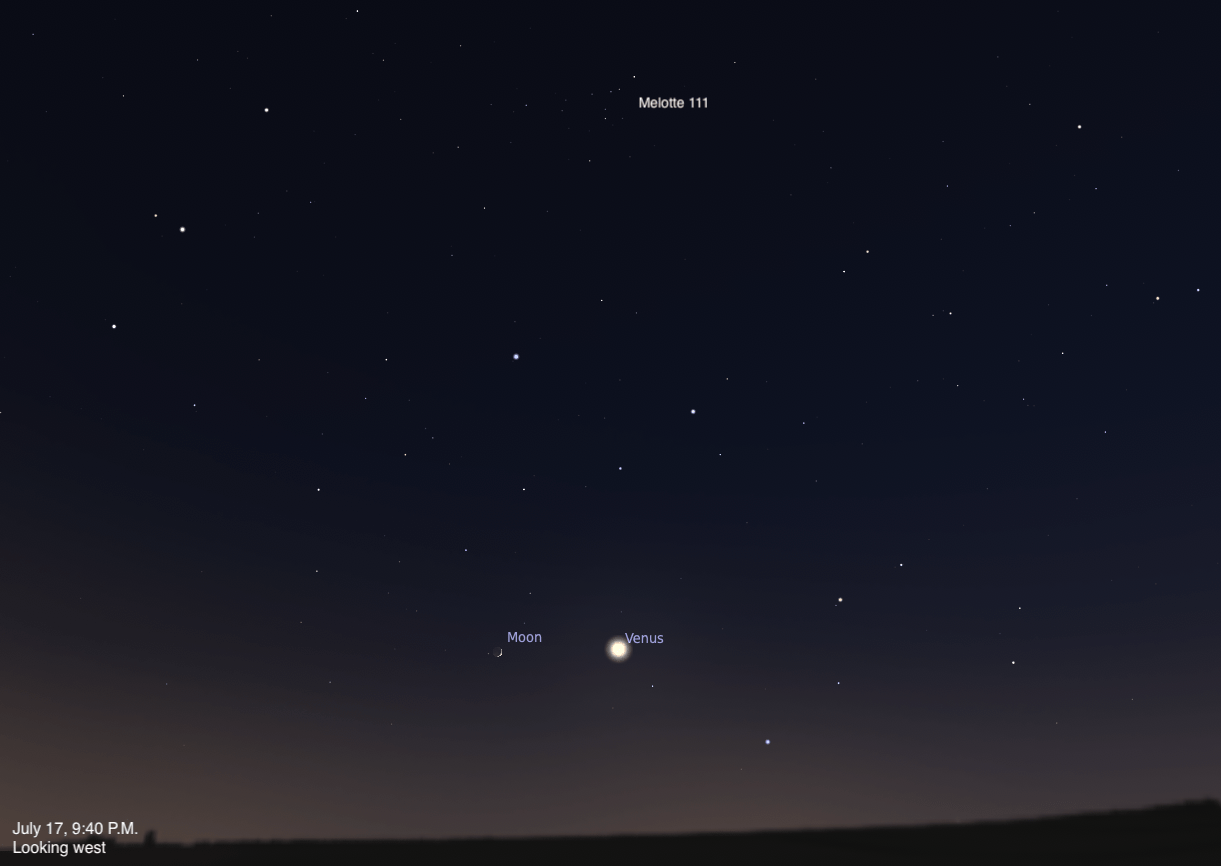 Catch the Moon and Venus sinking toward the western horizon after sunset on July 17, with the Coma Star Cluster (Melotte 111) coming into view above them as the sky darkens. /Stellarium / USGS / Celestia / Clementine
Friday, July 17
The Moon passes 2° south of Venus at 1 P.M. EDT. By this evening, they are roughly 6° apart, with the Moon to Venus’ lower left in the sky tonight, instead of the lower right (as it appeared yesterday). The crescent Moon and Venus sink toward the horizon together at roughly the same altitude, side by side in the growing twilight.
Above them is the hind end of Leo the Lion, and above that is the constellation Coma Berenices, or Berenice’s Hair. This constellation contains an easy-to-spot naked-eye star cluster, called (perhaps unsurprisingly) the Coma Star Cluster. Covering some 4° of the sky, the cluster’s stars glow collectively at magnitude 1.8, and roughly a dozen are visible to the naked eye. If you opt to observe it with binoculars or a telescope, you’ll pull out at least two dozen more suns.
Sunrise: 5:46 A.M.
Sunset: 8:26 P.M.
Moonrise: 9:32 A.M.
Moonset: 10:35 P.M.
Moon Phase: Waxing crescent (18%)

The sky, July 12-17: The summer triangle shines high in the southeast added by Cosmic1 on
View all posts by Cosmic1 →
You must be logged in to post a comment Login