

Special to CosmicTribune.com, July 16, 2026
By Richard Fisher
The video showed the big rocket’s first stage in recovery, then a huge crowd of people erupt in cheers — it was all very SpaceX-like — but only this video was of the China Aerospace Science and Technology Corporation’s (CASC) July 10 first launch and first-time first-stage recovery for its new Long March-10B space launch vehicle (SLV).
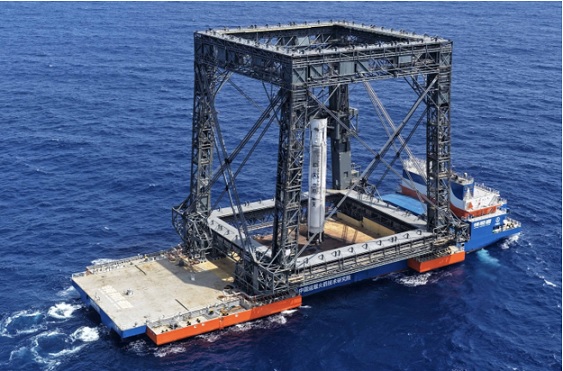
After the Feb. 11 launch of its Long March-10A, that only simulated a very nearby recovery of its first stage near CASC’s unique “cage” first-stage recovery ship, 12-minutes after the July 10 launch of the Long March-10B, its first stage was for the first time successfully captured on the same large cage recovery ship.
The main mission of the Long March-10 is to support China’s manned Moon Base program by developing a tri-core SLV that will be used, in two missions, to take the new manned Mengzhou spaceship and the Lanyue lunar landing vehicles to the Moon, but derivatives are being developed along the way that will all feed into improving the manned SLVs.
Long March-10A is a single stack SLV that primarily will be used to ferry crew and cargo to China’s Tiangong Space Station, while Long March-10B will support the development of “commercial” SLVs that will benefit from launch-price reducing power of the reusable first stage.
CASC has opted for a unique reusability architecture that relies less on the use of heavy deployable landing “legs,” but opts for reducing the SLV’s weight, allowing for the carriage of more fuel or payload, by employing a ship with a large “cage,” with the first stage descending into the cage, to be caught by rapidly moving cables.
While the opening at the top of the cage is not large, it does give the descending first stage more leeway than the fixed, stationary landing tower system used by SpaceX for its much larger Starship SLV.
And while the Long March-10A/B use a ship for a “downrange” recovery, that also like the SpaceX Falcon-9, allows the Long March-10A/B to use more of its fuel to launch its payload — and the “cage” system can be used with more safety in a rougher sea state that might threaten a tall Falcon-9 first stage fuselage fixed to the recovery ship with landing legs.
The Long March-10A and Long March-10B are 5-meter diameter SLVs that can lift 16-tons to Low Earth Orbit (LEO), both use kerosene-oxygen fueled first stages while the Long March-10B has a lighter methane-oxygen powered second stage.
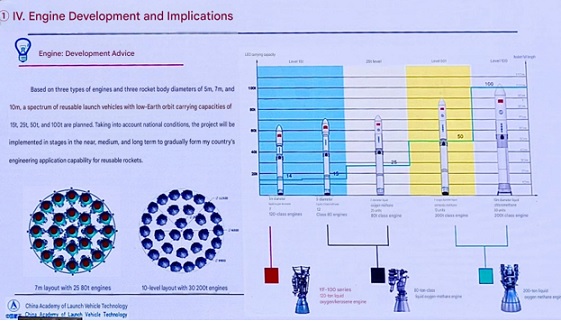
A 5-meter diameter but longer first-stage reusable Long March-10C reportedly will have a 25-ton to LEO capacity and both stages will be methane-oxygen fueled; this version could become a successor to the Long March-5 series single-use heavy SLV.
However, a power point slide revealed in 2023, from the China Academy of Launch Vehicle Technology, part of CASC, revealed plans for a new 7-meter diameter first-stage reusable SLV that could be powered by new 200-ton thrust class ammonia-menthane engines, and capable of lifting 50 tons to LEO — about the same as the tri-core Long March-10.
Such an SLV could then offer China a new less risky “single stack” successor for the tri-core Long March-10 for manned and unmanned lunar missions — with the lower launch price benefits of the reusable first stage.
It is not clear when this new 7-meter reusable first stage SLV will make its appearance, but its engine technology development would then benefit the reusable first-stage 100-ton to LEO Long March-9, that reportedly could begin testing by 2030 or soon thereafter.
Full Text . . . . Current Edition . . . . Subscription Information

Long March-10B joins the reusable SLV club added by Cosmic1 on
View all posts by Cosmic1 →
You must be logged in to post a comment Login