

Special to CosmicTribune.com, September 17, 2026
By Richard Fisher
Oxon Hill, MD — In Sept. 15 remarks before the Air Cyber Space Conference of the United States Air Force Association, National Aeronautics and Space Administration (NASA) Administrator Jared Isaacman described aspects of the lunar space race with China and the importance for the U.S. to win it.
To stress the political-military importance to the United States of winning this “second” race to the Moon, Isaacman drew from the Cold War period, saying the race to the Moon was “certainly part of the war,” and “it was a battle of ideology. Whose team do you want to be on the Soviet communist team or the free US team?”
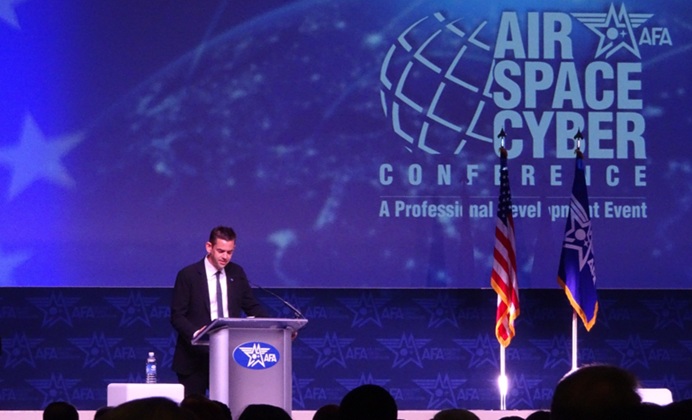
He also stressed the implications of prevailing in this second Moon race for American leadership:
“Our allies and adversaries are watching. So is every nation deciding whose technology to buy, whose standards to adopt, whose security relationships to deepen, and whose vision of the future to follow. And perhaps most importantly, our children will be watching, and the hopes and dreams of a generation inspired by these kind of Apollo 11-like moments is really on the line.”
He also stressed that unlike the first Cold War, China presents a far more credible challenge than did the Soviet Union:
“China will accomplish what the Soviets never could. They have an achievable to launch architecture to put their Taikonauts [astronauts] on the moon. They have demonstrated reusability with their rockets. They have the expertise, and history has shown they could even be early, and we could easily be late. They, too, seek to build a moon base alongside the Russians and put a nuclear reactor right in one of the limited parking spots on the lunar south pole, and success in this endeavor will be measured in months, not years.”
He later stressed again, “I mean, you know, China has had this plan dialed in for some time, and, frankly, in a lot of ways it’s a more achievable plan.”
The Chinese lunar architecture is much lighter than the one envisioned by NASA, and therefore, requires less powerful, lighter and less expensive space launch vehicles.
He noted, “They have reusability built into their, you know, long March 10 strategy. We do not in SLS [Space Launch System].”
Indeed, on July 10, 2026 China demonstrated the first state recovery of its Long March-10B space launch vehicle (SLV), a smaller version of the Long March-10 that will be used to send — in two simultaneous missions — the Mengzhou manned space ship and the Lanyue lunar landing vehicle to the Moon.
China has long announced that it intends to start sending its astronauts to the Moon by 2030 but in previous statements Isaacman has noted the Chinese could arrive in 2029, and conduct a circumlunar mission, or manned Mengzhou trip around the Moon by 2027.
In addition, Isaacman stressed the U.S. is also in a race with China to secure the most advantageous real estate on the Moon, noting until the recent delay of its launch, that the Chinese “Chenge’-7 [unmanned lunar lander], that, you know, was scheduled to launch to one of the two most desirable parking spots in the South Pole. The Shackleton crater.”
Full Text . . . . Current Edition . . . . Subscription Information

NASA chief gets real on space race challenge: China is doing ‘what Soviets never could’ added by Cosmic1 on
View all posts by Cosmic1 →
You must be logged in to post a comment Login