

Special to CosmicTribune.com, October 14, 2026
By Richard Fisher
On Sept. 14, U.S. Air Force Secretary Troy Meink told the annual conference of the U.S. Air and Space Association:
“Today, we continue to ensure we remain ready to meet the challenges of evolving threats wherever they exist. This is why the United States now has on-orbit space control weapons capable of defending the Joint Force against hostile adversary action.”
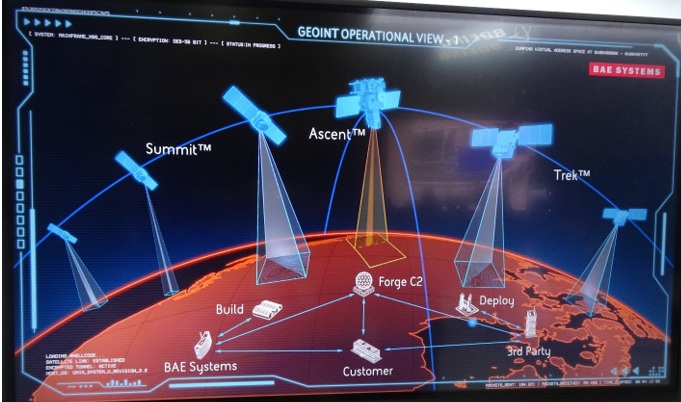
And then on Oct. 12 at the annual conference of the Association of the United States Army (AUSA), prime defense contractor BAE Systems put on display its “Elevation” satellite product line, to include a model of its “Ascent” maneuvering optical space surveillance satellite that could have potential combat capability.
A BAE Systems brochure explained that Ascent “is designed to support the needs of dynamic space operations (DSO), with capabilities such as refuellability, high-thrust propulsion and rideshare payloads. These features enable sustained maneuver, orbit raising and mobility, logistics, and exploration missions to Medium Earth Orbit, Geostationary Orbit, and beyond.”
This same brochure notes Ascent is able to maneuver at speeds more than “1800 m/s” or meters per second and its first version could be launched in 2027.
This same brochure notes Ascent is able to maneuver at speeds more than “1800 m/s” or meters per second.
A unique feature of the 2,200-kilogram Ascent satellite is its ability to carry and launch four small microsatellites, called “ride share” satellites by BAE Systems, that could perform multiple tasks.
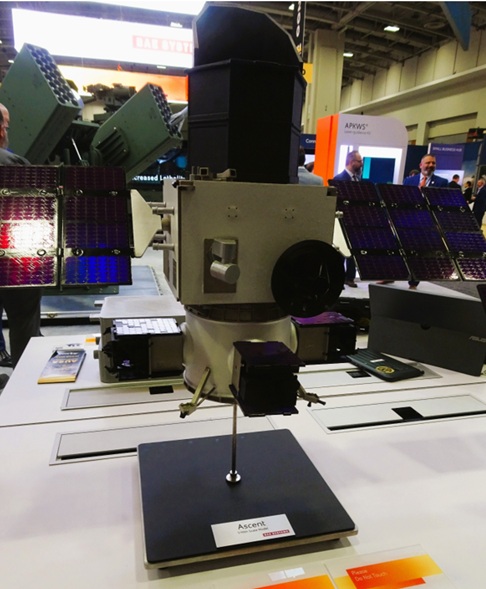
Initially these small “ride share” satellites will enable the Ascent satellite to refuel, extending its ability to perform its primary mission, the optical surveillance of Low Earth Orbit or deeper into cislunar space,
However, a BAE Systems official noted that ride share microsatellite could perform other missions as desired by the “customer.”
As such, it is conceivable these could potentially include defensive missions.
The Ascent satellite would cooperate with BAE Systems’ “Trek” satellite, equipped with a radar surveillance system that compliments the optical surveillance system on the Ascent satellite, and the “Summit Bus,” a platform that can carry multiple payloads.
If the American admission of weapons in space has achieved anything so far, it has certainly forced China and Russia to engage the issue of space militarization at the United Nations.
While it did not rate significant coverage in the media, on Oct. 8 in the First Committee of the United Nations, which deals with international security and disarmament issues, there was a sharp clash of opinions over weapons in outer space by China, Russia and the United States — which was criticized by the former two for its Sept. 14 admission of having weapons in outer space.
Full Text . . . . Current Edition . . . . Subscription Information

U.S. is focus of space war clash at UN; BAE Systems reveals combat-capable ‘Ascent’ satellite added by Cosmic1 on
View all posts by Cosmic1 →
You must be logged in to post a comment Login