

Special to CosmicTribune.com, October 18, 2026
Excerpts from weekly Sky & Telescope.com report.
SUNDAY, OCTOBER 18
■ First-quarter Moon (exact at 12:13 p.m. EDT). The Moon shines in the south-southwest this evening. It’s just a day past apogee; can you reliably detect that it’s just a bit smaller than average?
■ Spot Altair about three fists at arm’s length to the Moon’s upper right. Spot Fomalhaut roughly the same distance to the Moon’s left. Both are 1st-magnitude white stars that are quite nearby as stars go: 17 and 25 light-years away, respectively.
MONDAY, OCTOBER 19
■ Deneb, the head of the Northern Cross, has now completely displaced Vega as the zenith star at nightfall. It’s at its closest to straight up as soon as twilight ends. The shaft of the Northern Cross, two fists long, points from Deneb toward the southwest.
But Deneb doesn’t pass exactly straight up unless you live at 45° north latitude: near the latitudes of Portland, Minneapolis, Montreal, central Maine, southern France, northern Italy, Odesa, Mikolaiv, Kherson. Mariupol.
TUESDAY, OCTOBER 20
■ The Great Square of Pegasus is high in the east-southeast at nightfall — still, for now, almost balanced on one corner (for the world’s mid-northern latitudes). Saturn shines brighter below it. But by about 10 p.m. the Square moves higher to the south and turns level like a box, with Saturn now shining to its lower left.
WEDNESDAY, OCTOBER 21
■ After dark, look two fists below the Moon for Fomalhaut and three fists left of the Moon for Saturn.
■ The Orionid meteor shower should be near the middle of its several-day peak in the early-morning hours tonight. The bright Moon sets about two hours before dawn begins Thursday morning, so that dark-sky window is the best time to try. It’s from about four hours to two hours before your local sunrise time.
Good luck. The Orionids are only a middling shower, producing maybe 15 or 20 meteors visible per hour even in an excellent, moonless black sky.
THURSDAY, OCTOBER 22
■ Draw a line from Altair, the brightest star very high in the southwest after dark, toward the right to Vega in the west, a bit higher and brighter. Continue the line onward by half as far, and you hit the Lozenge: the pointy-nosed head of Draco, the Dragon. Its brightest star is orange Eltanin, the 2nd-magnitude tip of the Dragon’s nose, always sniffing toward Vega.
FRIDAY, OCTOBER 23
■ Saturn shines lower left of the Moon at dusk, as shown below. By about midnight, Saturn appears directly left of the Moon.
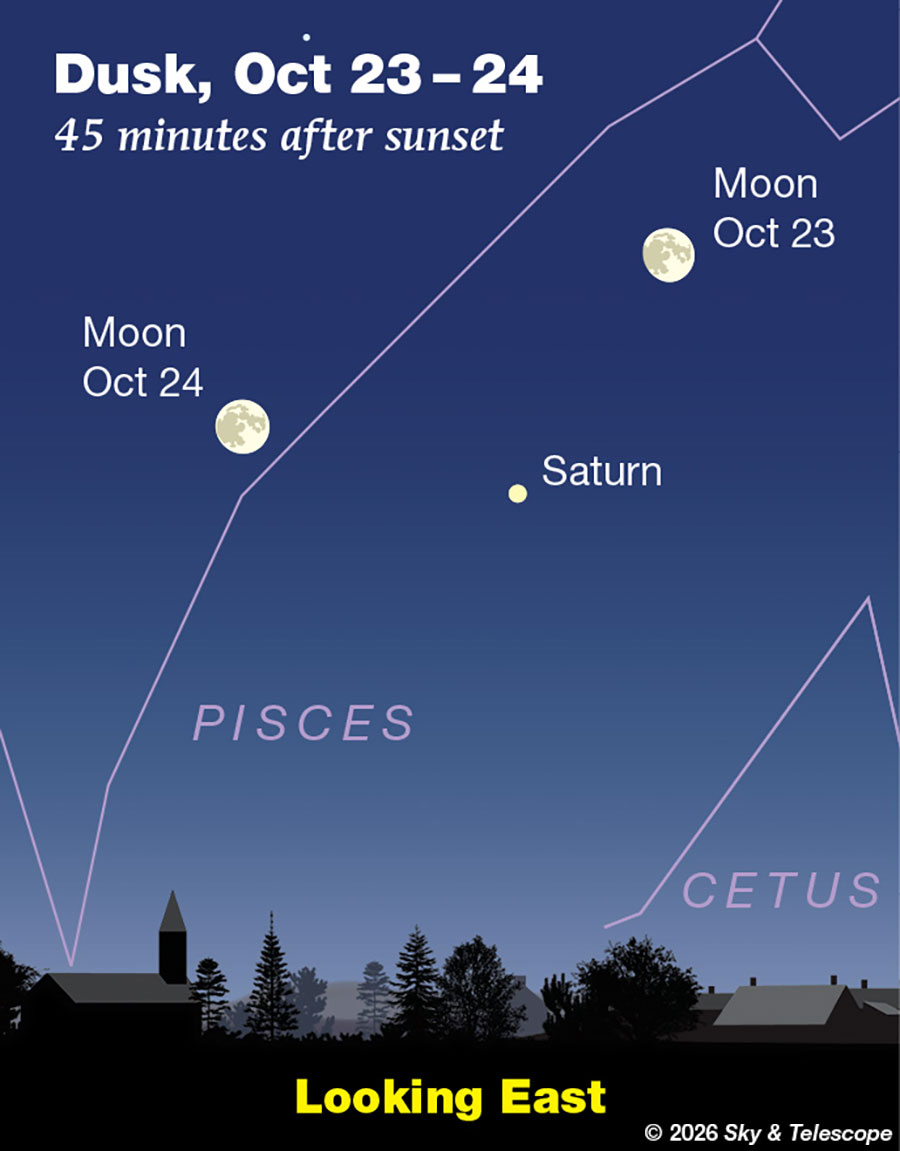 Saturn is a little past opposition now, so the Moon shining with it is a little before its own opposition (full Moon). This is always how it goes for the Moon and its background stars and planets.
■ This is the time of year when the Big Dipper lies down horizontal low in the north-northwest after dark. And the farther south you are the lower. Seen from latitude 40° north (New York, Denver) even its bottom stars twinkle nearly ten degrees high. But at Miami (26° N) the entire Dipper will skim along out of sight just below the northern horizon.

The sky, Oct. 18-23: Orionid meteor shower Wednesday added by Cosmic1 on
View all posts by Cosmic1 →
You must be logged in to post a comment Login