

Special to CosmicTribune.com, January 29, 2026
By Richard Fisher
In the twenty years since its founding in June 2006, New Zealand-born space engineer and entrepreneur Sir Peter Beck has turned his Rocket Lab company into a world-class competitive and innovative space launch provider, meeting civil and military requirements for economical medium-lift capability.
An American company since 2013, based in Huntington Beach, CA, Rocket Lab is now located in six U.S. states, and launches out of the National Aeronautics and Space Administration (NASA) Mid-Atlantic Regional Spaceport (MARS) at Wallops Island, Virginia.
Rocket Lab has advanced innovation by developing carbon composite rocket fuselage materials that are lighter and stronger than standard aluminum fuselage materials, as it has also been the first rocket engine developer to use lower-cost 3D-printed major components, and electric pump-fuel feeding for finer throttling control.
Furthermore, Rocket Lab has targeted the market for medium weight payloads, or generally smaller rockets than those built by SpaceX and Blue Origin, with less cost and logistic support requirements, meaning it can derive savings that are passed on to the customer that often does not require or want to pay for the larger payload rocket.
In 2025 Rocket Lab achieved its greatest number of 21 space launches — all successful — expanded its civil and military space launch business, and in 2026 is planning the first test launch of its fully reusable first stage, 13-ton payload to Low Earth Orbit (LEO) Neutron space launch vehicle (SLV).
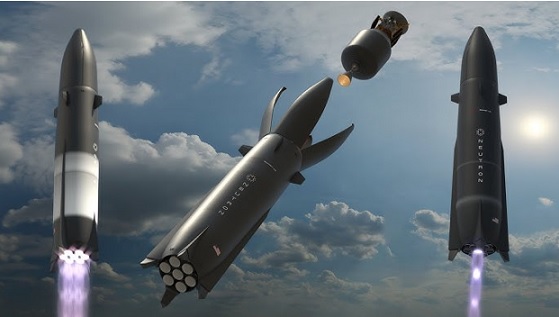
Announced in March 2021, the Neutron will be Rocket Lab’s second “new” rocket and first first-stage-fully-reusable rocket, that leverages the company’s experience with carbon composite materials, 3D-printed electric pump rocket engines and very lean rocket design, gained over 80 launches of its first-generation Electron single-use SLV.
One of Neutron’s main innovations is that it does not lose its fairing (nose cone) in the course of launch, instead using a retractable clam-shell nose, called “Hungry Hippo,” that reforms after payload launch, greatly simplifying and speeding relaunch — a smaller non-reusable boost engine departs from the main stage for payload placement.
Neutron has a 5-meter diameter fuselage and is designed to lift up to 13 tons, in order to transport astronauts to Low Earth Orbit, but it targets what Rocket Labs regards as the far more average 5-ton payload that does not require the 17-ton lift of a SpaceX Falcon-9 reusable SLV.
One interesting question is whether Rocket Lab will develop a unique manned space capsule compatible with its Neutron SLV, which would be well placed to serve a growing market of new and commercial LEO space stations.
Full Text . . . . Current Edition . . . . Subscription Information

Rocket Lab advances with low-cost, innovative ‘Neutron’ SLV added by Cosmic1 on
View all posts by Cosmic1 →
You must be logged in to post a comment Login