

Special to CosmicTribune.com, August 2, 2026
Excerpts from weekly Astronomy.com report.
Sunday, August 2
Mercury reaches its greatest western elongation at 4 A.M. EDT, standing 19° from the Sun. The tiny planet reaches an altitude of almost 5° above the eastern horizon an hour before sunrise, glowing at magnitude 0.2. Over to the far right of Mercury is the familiar hourglass shape of Orion the Hunter, his three-star belt standing vertically in the sky just above the horizon.
Through a telescope, Mercury’s disk stretches 8” across. It shows off a crescent phase that is 39% lit; you may be able to spot the phase visually if you’ve got good seeing and steady air near the horizon. Follow the planet as long as you can in the brightening sky, but make sure to put away any optics well ahead of sunrise from your location, which may differ from the time given below.
Comet 10P/Tempel (also called Tempel 2) reaches perihelion today, passing through the closest point to the Sun in its orbit. Unfortunately, the bright Moon nearby will make spotting it difficult, but you can try for the comet around 3 A.M. local daylight time, located in the southeastern corner of Capricornus, about 8.7° due south of 3rd-magnitude Deneb Algedi (Delta [δ] Capricorni). Recent observations have recorded the comet at 9th magnitude and holding steady, but it may have brightened even further by this time.
Sunrise: 5:59 A.M.
Sunset: 8:12 P.M.
Moonrise: 10:08 P.M.
Moonset: 10:03 A.M.
Moon Phase: Waning gibbous (80%)
Monday, August 3
The Moon passes 5° north of Neptune at 4 A.M. EDT, with Saturn standing nearby. The best time to catch the trio is early in the morning around 4:30 A.M. local daylight time, when they are highest in the southern sky.
The bright Moon is unmissable, anchoring the apex of the triangle. To its left is magnitude 0.5 Saturn, the brightest point of light in this part of the sky, outshining any of the surrounding stars. Below and just right of the Moon is Neptune, but the distant ice giant is not visible to the naked eye. You can try finding it with binoculars or a telescope, 4.8° south of the Moon and 10.5° southwest of Saturn. From its great distance, the planet’s disk appears just 2” wide in the sky, and may have a bluish or grayish hue compared to any background stars.
By contrast, Saturn’s disk stretches 18” across in a telescope, with its rings just over twice that diameter. Its brightest moon, Titan, is about 2.5’ to the planet’s east, while several fainter 10th-magnitude moons cluster closer. You may have a hard time spotting these, however, in the moonlight.
The Moon will pass 7° due north of Saturn at midnight EDT tonight. We’ll return to the ringed planet with a telescope later in the week to catch one of its more elusive moons, Iapetus.
Sunrise: 6:00 A.M.
Sunset: 8:11 P.M.
Moonrise: 10:31 P.M.
Moonset: 11:09 A.M.
Moon Phase: Waning gibbous (71%)
Tuesday, August 4
Rising around sunset and standing highest around midnight, asteroid 324 Bamberga is visible in a small scope this evening, moving against the background stars of Capricornus. Look for it in the south around local midnight, about 5° west of 4th-magnitude Omega (ω) Capricorni, in the Sea Goat’s southwestern region. You’ll want a telescope with an aperture of 4 inches or larger, especially from the suburbs.
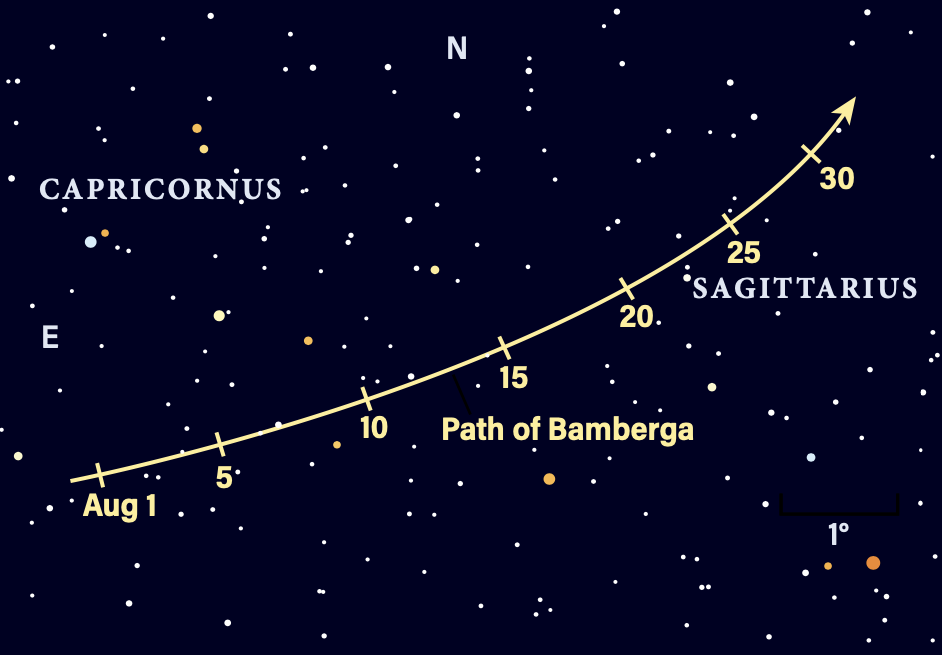
Check the chart above and note the position of the nearby background stars. You may spot one of the “stars” in your eyepiece subtly moving throughout the night, especially if you take a photo or make a sketch every hour or two. If you come back tomorrow night at the same time, you should definitely notice one of those points has shifted — that’s our asteroid.
Bamberga may have a high number of 324, but it’s one of the main belt’s largest worlds, cracking the top 20. It was so hard to catch because it spends a lot of time far from the Sun, and isn’t often brighter than 9th magnitude, which it glows at now.
Sunrise: 6:01 A.M.
Sunset: 8:10 P.M.
Moonrise: 10:58 P.M.
Moonset: 12:18 P.M.
Moon Phase: Waning gibbous (61%)
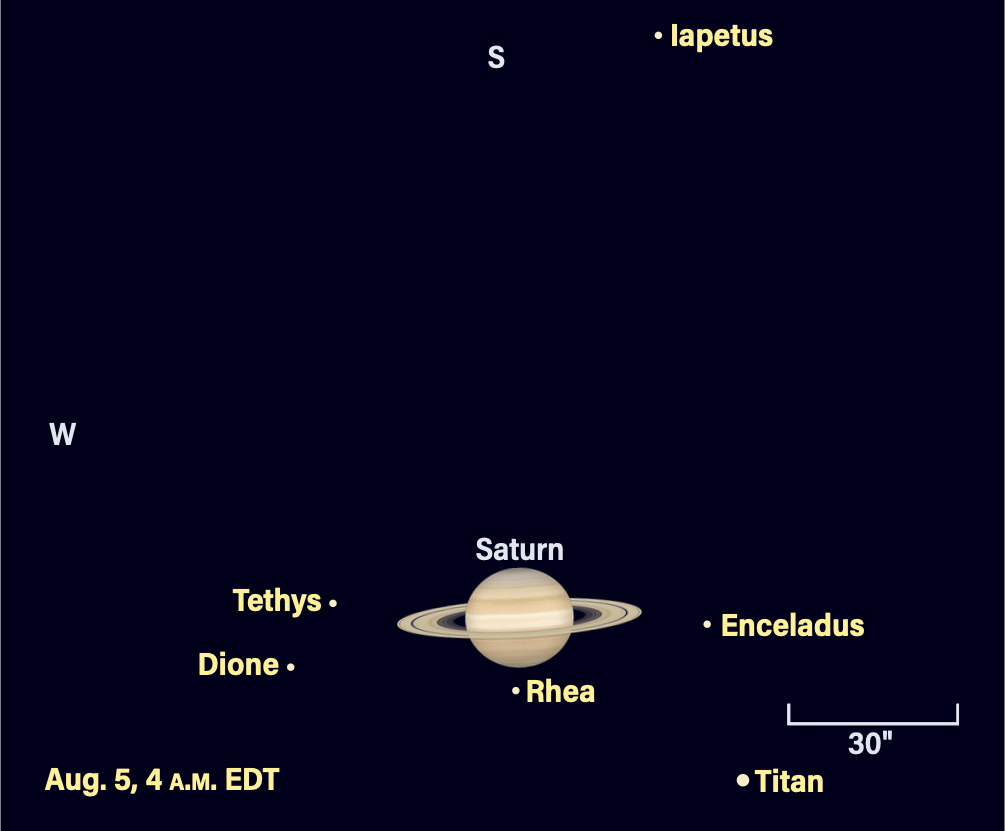 Iapetus is south of Saturn on Aug. 5, at its brightest (11th magnitude) for the month. Note that only moons brighter than 12th magnitude are shown. / Roen Kelly
Wednesday, August 5
Titan has now moved in closer to its parent planet, Saturn, while the elusive moon Iapetus passes through superior conjunction and also sits close to the ringed world. It’s a great opportunity to view the latter, whose brightness can vary by some two magnitudes, depending on which portion of its surface is turned earthward.
Saturn rises just before 11 P.M. local daylight time and is best viewed in the early morning, around 4 A.M. At that time, turn south and look for the brightest object in this region, about 50° high — that’s the ringed planet. Through a telescope, you’ll spot several moons, starting with mid-8th-magnitude Titan just northeast of Saturn. Tenth-magnitude Rhea, Tethys, and Dione are closer to the planet; their relative positions change quickly, so they may not appear in exactly the same locations as on the chart above. You may or may not see Enceladus, which is roughly 12th magnitude, so don’t be concerned if you can’t find it, even with the chart.
The crowning achievement is Iapetus, which now sits just under 2’ south of Saturn, glowing at magnitude 11. By the time it reaches eastern elongation later this month, it will be over 9’ from Saturn and have dropped by a magnitude to roughly the same brightness as Enceladus, making it a real challenge to spot.
Last Quarter Moon occurs at 10:21 P.M. EDT tonight, shortly before Mercury passes 8° south of the star Pollux in Gemini at midnight EDT. We’ll check out that scene early tomorrow morning.
Sunrise: 6:02 A.M.
Sunset: 8:09 P.M.
Moonrise: 11:30 P.M.
Moonset: 1:30 P.M.
Moon Phase: Last Quarter
Thursday, August 6
As Gemini rises shortly before the Sun this morning, the planet Mercury is just over 7° due south of the constellation’s beta star, Pollux. An hour before sunrise, nearly all of Gemini has cleared the eastern horizon, and Mercury shines at magnitude –0.3 nearly 5° high. You’ll spot it to the lower right of Pollux, which is the brightest star in the Twins and sits closer to the horizon than Castor (Alpha [α] Geminorum), which is a tad fainter and stands about 4.5° directly above Pollux as the constellation rises.
If you’ve got a telescope, you’ll note that Mercury has changed in appearance from earlier this week. Its disk now spans 7” but is more than half lit, showing off a 54%-illuminated gibbous phase. Again, you’ll need steady seeing to clearly make out the phase, but you may get lucky if you spend some time with it as the sky slowly lightens. As always, make sure to put away optics several minutes before sunrise from your location to protect your eyes.
Early this morning is also great time to visualize the ecliptic — the plane of our solar system. Once you spot Mercury above the horizon, look to its far upper right for fainter magnitude 1.3 Mars in Taurus, near the tip of one of the Bull’s horns. Draw a line from the horizon up through Mercury and extend it through Mars — that’s the ecliptic, along which all the major planets lie.
Sunrise: 6:03 A.M.
Sunset: 8:08 P.M.
Moonrise: —
Moonset: 2:45 P.M.
Moon Phase: Waning crescent (39%)
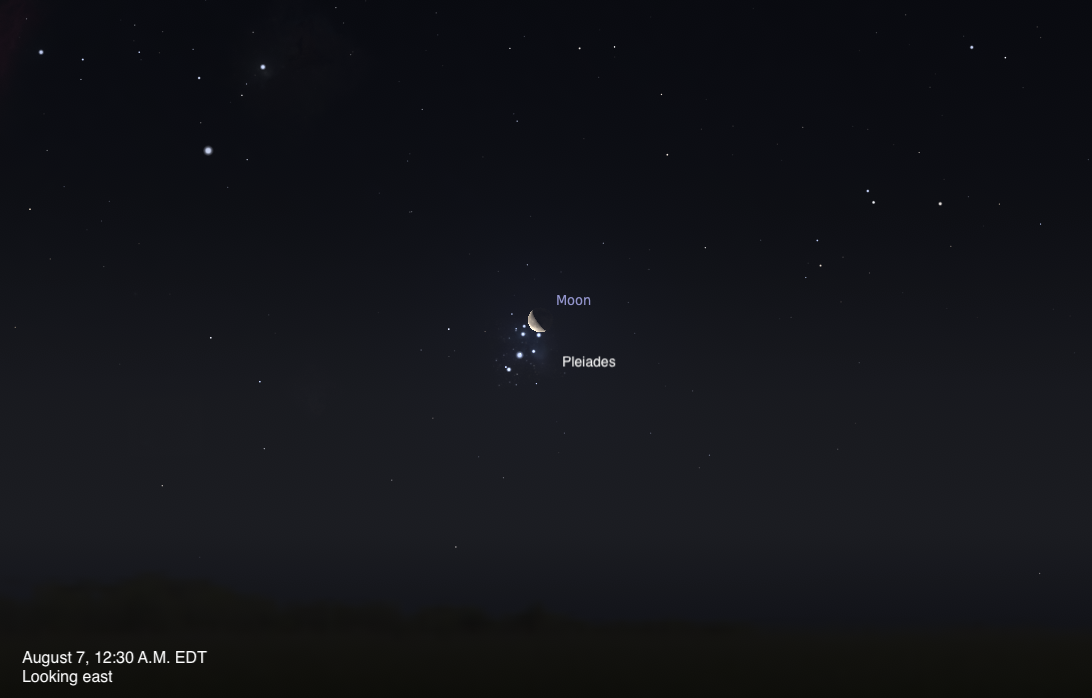 Observers in the Eastern time zone can catch the Moon passing in front of the Pleiades star cluster shortly after moonrise early on August 7th. Note this chart is specifically for the Boston area — those farther west in the U.S. may see the Moon rising as the occultation finishes or is already over, with our satellite moving east of the cluster. / Stellarium / USGS / Celestia / Clementine
Friday, August 7
The Moon passes 5° north of Uranus in Taurus at 1 P.M. EDT. The pair is visible earlier in the morning, with the Moon rising shortly before midnight on the 6th along with the Pleiades star cluster (M45).
In fact, the Moon crosses in front of the Pleiades starting around midnight EST in an event called an occultation, visible largely to observers along the U.S. East Coast shortly after moonrise, although the region will be quite low. For the best view, get to a location with a clear, dark eastern horizon, ideally at an altitude above your surroundings. Even then the greater amount of air we must look through at the horizon may muddy the view early on.
For those in the western two-thirds of the U.S., the occultation will either be underway (in the Midwest) or over by the time the Moon rises, although you can still watch our satellite pull away, bit by bit, from the bright star cluster.
For those with a view of the event, it begins just minutes after midnight EST on the 6th (so, a few minutes into the 7th), as the crescent Moon plows through the northern region of the cluster. Our satellite will temporarily block stars that may include Electra, Celaeno, Taygeta, Maia, and Sterope — exactly which stars will be blotted out depends on your location. The timing is also heavily location dependent — you can find a table of occultation timings for 40 cities in North America on the website of the International Occultation Timing Association here. If your location will see the occultation, it will be listed by date. The duration of each occultation also depends on location, but will generally last a little less than an hour before a given star reappears at the trailing dark limb of the Moon.
Later in the morning, an hour or two before sunrise, turn your attention to finding Uranus, some 6.2° southeast of the Pleiades and 2° southeast of magnitude 4.4 37 Tauri. You’ll need binoculars or a telescope to spot the planet, whose grayish disk spans 4” on the sky.
Sunrise: 6:04 A.M.
Sunset: 8:07 P.M.
Moonrise: 12:09 A.M.
Moonset: 3:59 P.M.
Moon Phase: Waning crescent (28%)

The sky, August 3-7: Saturn high in the South before dawn added by Cosmic1 on
View all posts by Cosmic1 →
You must be logged in to post a comment Login