

Special to CosmicTribune.com, December 15, 2025
Excerpts from weekly Astronomy.com report.
Sunday, December 14
The Geminid meteor shower peaks today with a waning Moon in the sky. Widely regarded as the best meteor shower of the year, the Geminids will produce more than 100 meteors per hour during its peak. Although you may not see quite this many, you can still expect to see a good show if you’re willing to brave the cold and step outside.
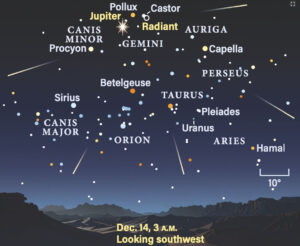
The Geminids’ radiant is located near the bright star Castor in Gemini the Twins. Jupiter is also nearby this year, shining at magnitude –2.6. The best time to watch for shower meteors is early in the morning in the hours before dawn; at this time, you’ll be standing on the leading edge of Earth as it rotates, moving into the stream of debris that produces the meteors we see. That debris was left behind by the near-Earth asteroid 3200 Phaethon, whose 1.4-year orbit is much like that of a more traditional comet and brings it within the orbit of Earth, sometimes passing close to our planet.
The heads of Gemini stand nearly 75° high in the southwest around 3 A.M. local time, with Jupiter to their left. Castor is on the right as you look up at the sky at this time, with the Geminids’ radiant just to the lower right of this star. Once you’ve found the radiant’s location, start scanning the sky some 40°–60° on either side of this region — this is where you’ll see meteors with the longest trains as they streak away from Gemini and shoot across the sky.
Although morning will be the best time to watch for meteors, evening observers will likely catch some of the show as well. Because Gemini rises around 6 P.M. in the evening, the radiant has climbed above 40° in the east by 10 P.M. local time, now with Gemini lying on its side and Castor above Pollux in the sky. Meteor rates should be high both the evening of the 13th and 14th, and without any Moon in the sky at all.
Sunrise: 7:14 A.M.
Sunset: 4:35 P.M.
Moonrise: 2:14 A.M.
Moonset: 1:10 P.M.
Moon Phase: Waning crescent (20%)
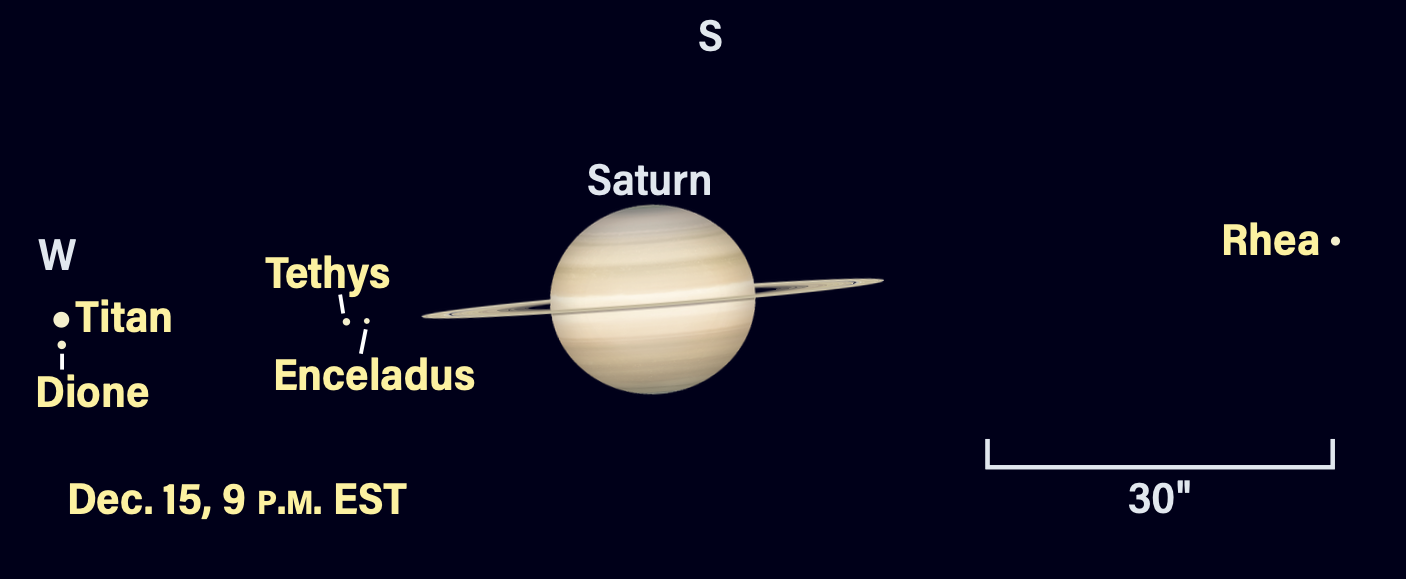 Dione stands due north of Titan the evening of Dec. 15. The pair will be close to the resolution limit of small scopes. / Roen Kelly
Monday, December 15
Saturn’s many moons offer an excellent chance to watch orbital dynamics in motion tonight. The ringed planet is visible above the southern horizon as soon as darkness falls. By 10 P.M. local time, it is still 20° high in the west, a bright point of light located between the Circlet of Pisces and the 2nd-magnitude star Diphda in Cetus the Whale. Glowing at 1st magnitude, Saturn is the brightest light here.
Zoom in on the ringed world with a telescope to spot several of its moons. Brightest is mid-8th-magnitude Titan, located west of the planet. Near Titan and slightly to its northeast early in the evening is 10th-magnitude Dione — this is the pair we’ll want to watch later on. Closer to Saturn on the west is 10th-magnitude Tethys, while similarly bright Rhea is visible alone to Saturn’s east.
Now let’s turn our attention back to Dione and Titan. Early in the evening, Titan is farther from Saturn than Dione. Around 9 P.M. EST, Titan slides to sit just 2” due south of Dione — depending on your optics, you may see the two moons appear to merge. After this, Titan starts to move closer to Saturn — but this configuration is short-lived.
Saturn will set for the eastern half of the country (around local midnight) with Titan slightly east of Dione. But observers in the western U.S. may spot Dione catch up with Titan around 10:35 P.M. PST, when the two moons again stand in a north-south line with Titan just a few scant arcseconds south of Dione. After this, Dione will pull ahead, moving closer to Saturn than Titan as the ringed planet sets for the West Coast.
Sunrise: 7:15 A.M.
Sunset: 4:36 P.M.
Moonrise: 3:16 A.M.
Moonset: 1:33 P.M.
Moon Phase: Waning crescent (13%)
Tuesday, December 16
We’re back at Saturn tonight for more moon action, starting with Titan reappearing from occultation in an event visible to observers in Europe and the U.K. The large moon appears at the southeastern limb (south of the rings) around 21:56 UT (4:56 P.M. EST) — this is very shortly after sunset on the U.S. East Coast and will likely be difficult or impossible to watch from this location in the still-bright sky.
Shortly after sunset, Saturn will appear some 45° high in the southern sky, the brightest light in this region and easy to center in a telescope.
U.S. observers will be able to catch 10th-magnitude Tethys and mid-8th-magnitude Titan passing each other near the eastern edge of the rings just after 9 P.M. EST. Prior to this time, Titan is south of the rings and moving east, while fainter Tethys is approaching the planet, nearly in line with the edge-on ring system. Shortly after 9 P.M. EST, the two moons are 2” apart as Titan slides south of Tethys. As with the meetings of Dione and Titan last night, this will be at the resolution limit of some telescopes and observers might see the two moons appear to merge rather than pass.
After this time, Tethys will likely be lost as it moves in front of the rings and prepares to transit Saturn, while Titan will continue pulling away to the east.
Sunrise: 7:16 A.M.
Sunset: 4:36 P.M.
Moonrise: 4:17 A.M.
Moonset: 2:01 P.M.
Moon Phase: Waning crescent (8%)
Wednesday, December 17
Asteroid 3 Juno is in conjunction with the Sun at 1 A.M. EST. Shortly after, the Moon reaches apogee, the farthest point from Earth in its orbit, at 1:09 A.M. EST. At that time, our satellite will be 252,477 miles (406,322 kilometers) away.
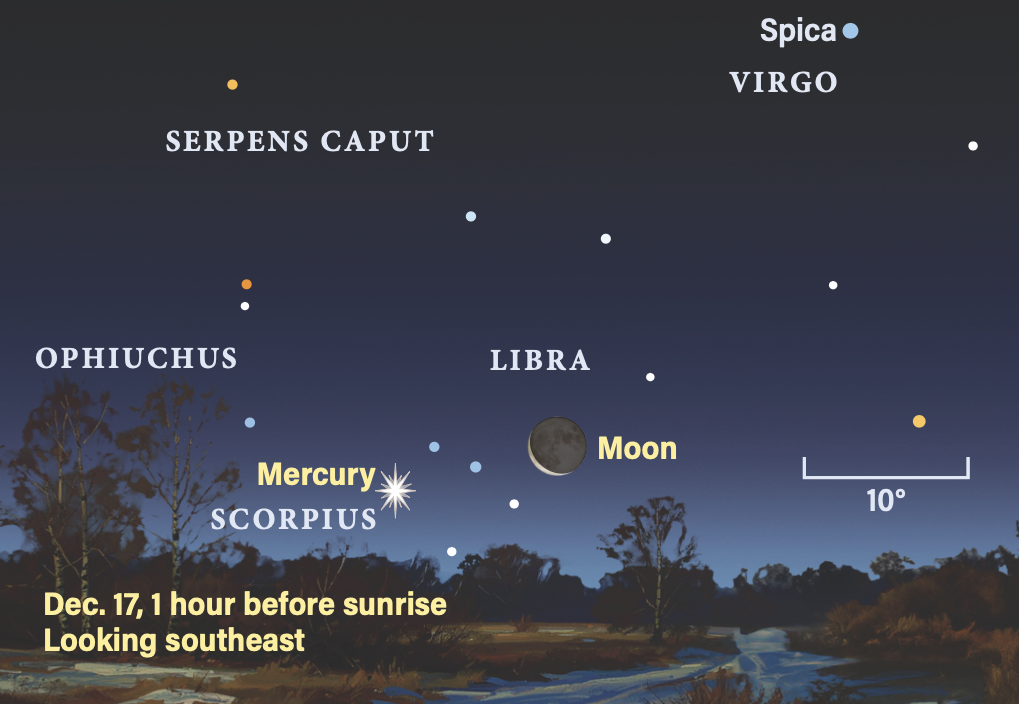
The morning sky brings a lovely scene as the crescent Moon joins bright Mercury in the southeast before sunrise. The pair stands 10° apart in the predawn sky, about 9° above the horizon by 6:45 A.M. local time. The Moon is in southeast Libra, visible as a 6-percent-lit waning crescent at this time with only a sliver of its western limb illuminated. Our satellite sits to the upper right of Mercury; the planet is in far eastern Scorpius, preparing to move into Ophiuchus (where it will reside by tomorrow morning). For now, the claws of Scorpius sit between the Moon and Mercury.
Through a telescope, magnitude –0.5 Mercury appears 6” wide and is 82 percent illuminated. If you have a clear southeastern horizon, keep an eye out for Antares, Scorpius’ 1st-magnitude alpha star, as it rises around 6:30 A.M. some 6.5° to Mercury’s lower right.
The Moon will pass south of Mercury and Antares tomorrow morning, a few hours before Mercury passes north of Antares during the daytime.
Sunrise: 7:14 A.M.
Sunset: 4:35 P.M.
Moonrise: 2:14 A.M.
Moonset: 1:10 P.M.
Moon Phase: Waning crescent (3%)
Thursday, December 18
The Moon passes 6° south of Mercury at 7 A.M. EST, then passes 0.4° south of Antares at 8 A.M. EST. Later today, Mercury passes 6° north of Antares at 4 P.M. EST.
Revisit the morning sky to compare it with yesterday and see just how dynamic our solar system can be. Mercury rises this morning around 6 A.M. local time, with the Moon following later around 6:20 A.M., just after Scorpius’ heart, the red-hued star Antares.
The Moon is now just 2 percent lit — potentially a challenge to view with the naked eye, but its slim crescent should look lovely though binoculars or a telescope. Look for earthshine lighting up the darkened regions of the nearside, as sunlight bounces off Earth and illuminates the portions of the Moon already experiencing night.
Magnitude –0.5 Mercury is now nearly 7° to the Moon’s upper left, in far southwestern Ophiuchus. The planet is now 84 percent lit; a small change from yesterday.
Sunrise: 7:17 A.M.
Sunset: 4:37 P.M.
Moonrise: 6:21 A.M.
Moonset: 3:14 P.M.
Moon Phase: Waning crescent (1%)
Friday, December 19
New Moon occurs at 8:43 P.M. EST. This is the best time to view deep-sky objects, so let’s set our sights on the lovely spiral galaxy M33, also known as the Triangulum Galaxy.
Highest in the sky around 8 P.M. local time, you’ll find M33 80° high in the south at this time. The 6th-magnitude galaxy is located in western Triangulum; the nearest bright star is 2nd-magnitude Mirach in Andromeda. From this star, the galaxy lies just 7° to the southeast.
Although M33 shines at 6th magnitude, its surface brightness is relatively low. The best way to find it is to search with binoculars or a wide-field scope, locating it first before zooming in with higher magnifications to look for structure, such as its brighter core and fainter spiral arms. Located some 2.7 million light-years away, M33 spans about 70’ by 45’ on the sky. It is a member of our Local Group of galaxies, along with the Andromeda Galaxy and numerous smaller members.
Observers with larger scopes can look for NGC 604, a bright star-forming region within M33, located northeast of its nucleus.
Sunrise: 7:18 A.M.
Sunset: 4:37 P.M.
Moonrise: 7:19 A.M.
Moonset: 4:01 P.M.
Moon Phase: New

The sky, Dec. 14-19: Geminid meteor shower peaks added by Cosmic1 on
View all posts by Cosmic1 →
You must be logged in to post a comment Login