

Special to CosmicTribune.com, February 1, 2026
Excerpts from weekly Astronomy.com report.
Sunday, February 1
Full Moon occurs at 5:09 P.M. EST, bringing the light of the February Snow Moon to our nighttime skies. This name may seem particularly apt, given the weather much of the U.S. has been experiencing as of late! The Snow Moon gains its name from Native American cultures, whose land was similarly likely under a blanket of snow at this time of year. According to the Royal Museums Greenwich, the February Full Moon may also be called the Storm Moon or Hunger Moon.
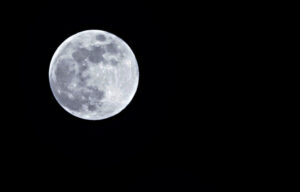
When the Moon is Full, it rises roughly opposite the setting Sun at dusk and sets opposite the rising Sun and dawn. Its bright light floods the sky all night, reducing the number of stars we can see with our eyes from thousands to hundreds. The Full Moon’s magnitude is about –12.7. Compared with Sirius, the brightest star in the sky, whose magnitude is –1.4, the Full Moon is more than 250,000 times brighter. Observing the Full Moon with binoculars or a telescope can be fun, although you may need to wear sunglasses to keep from squinting!
Sunrise: 7:08 A.M.
Sunset: 5:20 P.M.
Moonrise: 5:13 P.M.
Moonset: 7:11 A.M.
Moon Phase: Full
Monday, February 2
The waning gibbous Moon passes 0.4° due north of Regulus in Leo at 10 P.M. EST this evening. The pairing is visible across the U.S., as the region housing them rises in the east around 6:45 P.M. local time.
Western Africa and much of the U.S. and Canada will see the Moon either pass fully or extremely close to Regulus in an event called an occultation (or a grazing occultation, in the latter case). The timing and visibility of the event will depend heavily on your location. In the U.S., the occultation will occur from about 8:40 P.M. EST to 10:05 P.M. EST. You can find a map of regions that will see the occultation and more details about the event — including the view from your location — at In-The-Sky.org.
Regulus is Leo’s alpha star, shining at magnitude 1.4. It sits very close to the ecliptic, the path the planets and the Moon follow in our sky, which is why it is frequently occulted. It lies roughly 79 light-years away and is a hot, B-type star.
Sunrise: 7:07 A.M.
Sunset: 5:21 P.M.
Moonrise: 6:27 P.M.
Moonset: 7:43 A.M.
Moon Phase: Waning gibbous (98%)
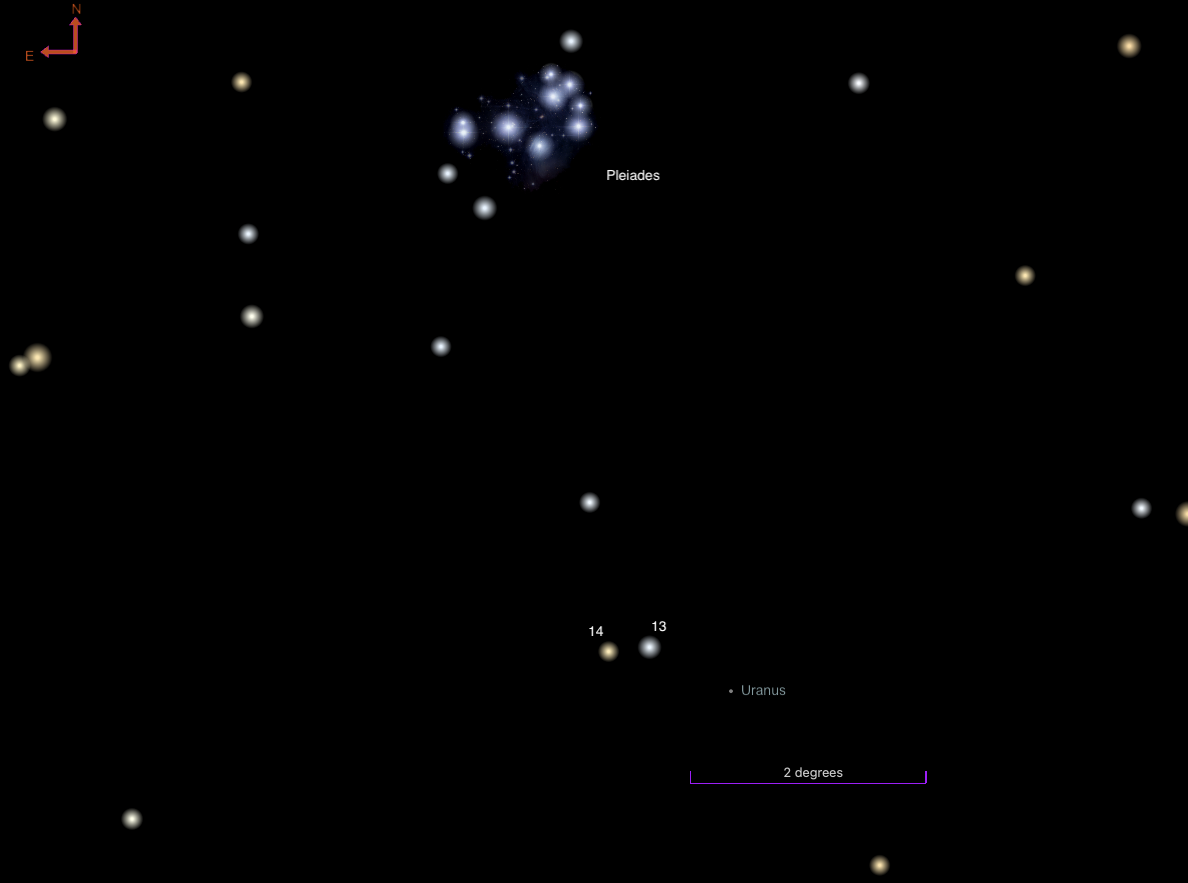 Uranus comes to a standstill just south of the Pleiades in Taurus on February 3. Credit: Alison Klesman (via TheSkyX)
Tuesday, February 3
Uranus stands stationary at midnight EST. Located in the constellation Taurus, the ice giant is visible after sunset and sets around 2 A.M. local time.
Shining at magnitude 5.7, Uranus generally requires binoculars or a telescope to spot. Around 9 P.M. local time, Uranus is still 50° high, located in the west and hanging below the readily visible Pleiades open cluster (M45). From this cluster, drop your optics about 5° south-southwest and look for a line of two stars: 13 and 14 Tauri, shining at magnitudes 5.7 and 6.1, respectively. The two stars sit in an east-west line, with 13 Tau on the western end. Uranus is located just 0.8° southwest of 13 Tau. Its disk is slightly larger than Neptune’s, appearing 4” across, which may be apparent in your eyepiece. Uranus typically shows off a grayish color and won’t look quite the same as any nearby background, pinpoint stars.
Uranus has been moving retrograde, or westward, against the background sky. After today’s standstill, it will begin tracking eastward, or prograde.
Sunrise: 7:06 A.M.
Sunset: 5:22 P.M.
Moonrise: 7:37 P.M.
Moonset: 8:08 A.M.
Moon Phase: Waning gibbous (94%)
Wednesday, February 4
Io and its shadow transit Jupiter this evening, beginning shortly after 10 P.M. EST.
By the time the transit starts, the planet is above the horizon for the entire U.S. In the Midwest, it is high in the south, hanging to the lower right of the stars Castor and Pollux in Gemini the Twins. The gas giant shines at magnitude–2.6, far brighter than either of these stars, dominating the middle of the constellation.
Through a telescope, you’ll see that prior to the transit, Ganymede is alone to Jupiter’s west. On the eastern side of the planet, Io is closest, followed by Europa and then Callisto. Io reaches Jupiter’s southeastern limb at 10:20 P.M. EST and begins to move across the face of the planet. Its shadow appears 35 minutes later, following the moon across as both move from east to west.
Io slips off the disk shortly before 12:40 A.M. EST (now the 5th in the Eastern time zone only), joining Ganymede on the planet’s western side. The shadow continues alone after that, disappearing around 1:15 A.M. EST (now the 5th in the eastern half of the U.S.).
Sunrise: 7:05 A.M.
Sunset: 5:23 P.M.
Moonrise: 8:43 P.M.
Moonset: 8:31 A.M.
Moon Phase: Waning gibbous (88%)
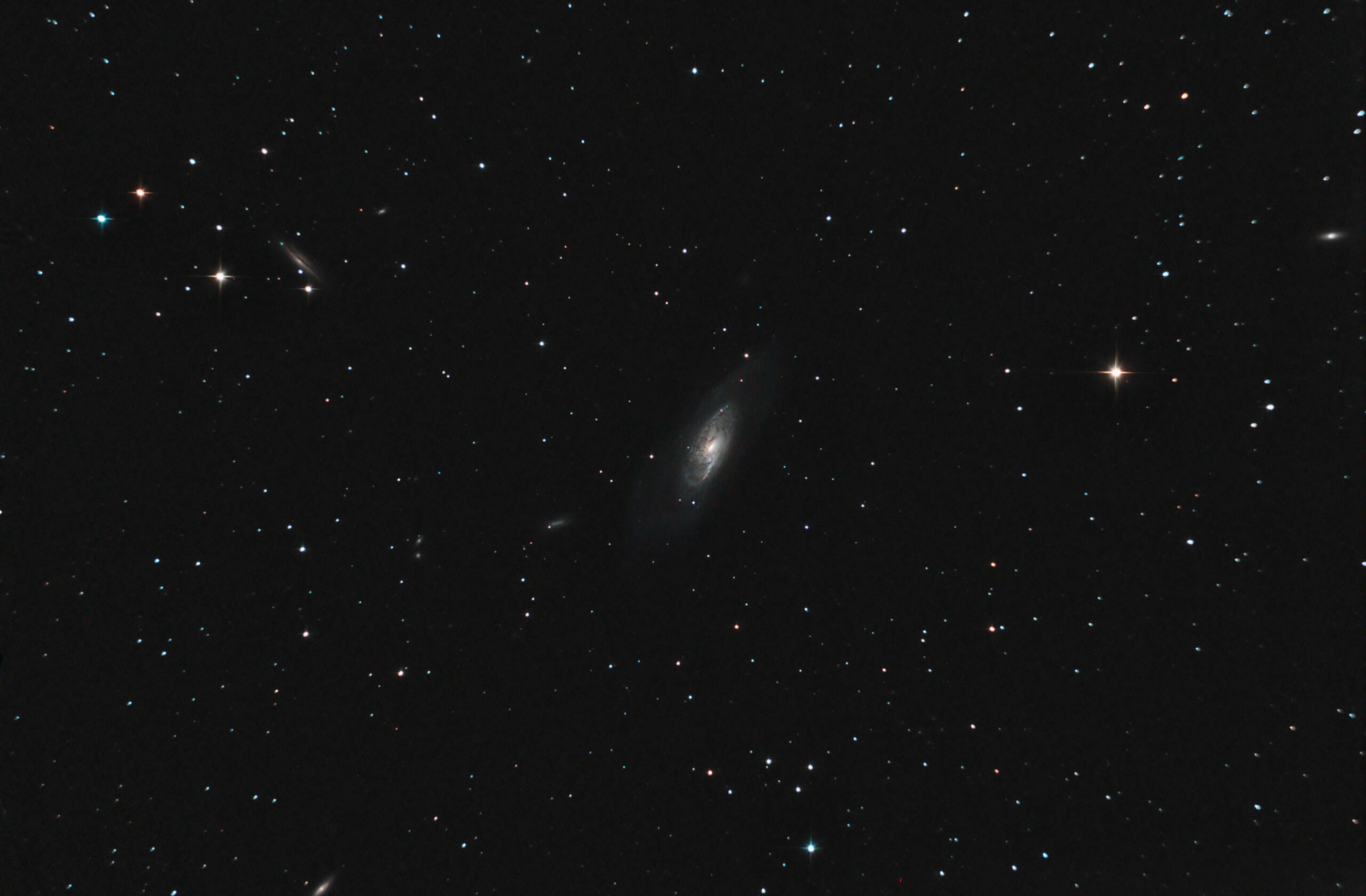 M106 is a spiral galaxy similar to the Andromeda Galaxy, with sweeping arms and a bright center. Credit: zAmb0ni (Flickr, CC BY-NC-SA 2.0)
Thursday, February 5
With the waning Moon rising later and later, there’s a dark window between sunset and moonrise to get in some deep-sky observing. Tonight we’re seeking out M106, a great galaxy to observe with your telescope, particularly if you can bump up the aperture. Larger scopes will show more detail, but this target is no slouch even in small or medium scopes under dark skies.
Shining at magnitude 8.4, you’ll find M106 in the north in the constellation Canes Venatici. Early this evening, it lies far to the right of the North Star and to the lower right of the cup of the Big Dipper. To reach the galaxy, just move your scope 5.5° east of magnitude 3.7 Chi (χ) Ursae Majoris, or start at brighter magnitude 2.4 Phecda (Gamma [γ] UMa) and move 7.5° southeast.
Measuring some 20’ by 8’, M106 is a lovely spiral galaxy tilted slightly to our line of sight, much like the Andromeda Galaxy (M31). Like M31, it has a bright core and fainter spiral arms, and may look like a glowing, oval-shaped fuzz in smaller scopes. M106 also has prominent dust lanes and a pronounced northern arm that stands out far better than its southern one.
Sunrise: 7:04 A.M.
Sunset: 5:24 P.M.
Moonrise: 9:48 P.M.
Moonset: 8:53 A.M.
Moon Phase: Waning gibbous (81%)
Friday, February 6
M44 is famously known as the Beehive Cluster in Cancer, but the Crab has a second stellar offering that is often overlooked: M67. Located southeast of M44, this 6th-magnitude group of stars is a similarly great target for beginners with small scopes.
After you’ve enjoyed M44 in central Cancer, it’s just an 8.3° slide south-southeast of M44 to land on M67. (Or, you can move 1.7° due west of 4th-magnitude Alpha Cancri.) At some 3.2 billion years old, M67 is more ancient than many open clusters. It has some 200 white dwarfs, the cooling remnants of Sun-like stars.
M67 covers nearly the same area as the Full Moon on the sky, and at least two dozen of its stars are visible in small scopes. Larger scopes will bring out even more stars, so observers with bigger instruments shouldn’t skip this one!
Sunrise: 7:03 A.M.
Sunset: 5:26 P.M.
Moonrise: 10:51 P.M.
Moonset: 9:14 A.M.
Moon Phase: Waning gibbous (72%)

The sky, Feb. 1-6: Full Snow Moon on Feb. 1 added by Cosmic1 on
View all posts by Cosmic1 →
You must be logged in to post a comment Login