

Special to CosmicTribune.com, February 23, 2026
Excerpts from weekly Astronomy.com report.
Sunday, February 22
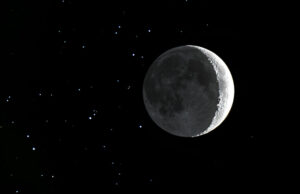
A lovely crescent Moon is visible nearly all evening, setting around local midnight. If you’ve got a telescope, tonight is a great opportunity to view a famous trio of craters just south of the lunar equator and a bit west of Mare Nectaris, whose round, dark floor lies near the terminator separating lunar night from day.
Using the chart here to guide you, look first for the sharp-walled, round crater Theophilus, whose clear central peak should give it away. This is the youngest of our trio, as evidenced by those sharp walls, which stand in stark comparison to the slumped rim of Cyrillus, immediately to Theophilus’ southwest. In fact, Theophilus clearly overlaps Cyrillus, another testament to the fact that the latter came first.
Cyrillus, too, has a central peak; compare it to the one within Theophilus. Then, finally, move south of Cyrillus to Catharina, the oldest crater of the three. Although it once had a central peak like the others, it has been worn away by impacts over time. Catharina’s walls, too, have suffered the same fate, appearing softer and more slumped than those of its companions.
Sunrise: 6:43 A.M.
Sunset: 5:44 P.M.
Moonrise: 9:05 A.M.
Moonset: —
Moon Phase: Waxing crescent (35%)
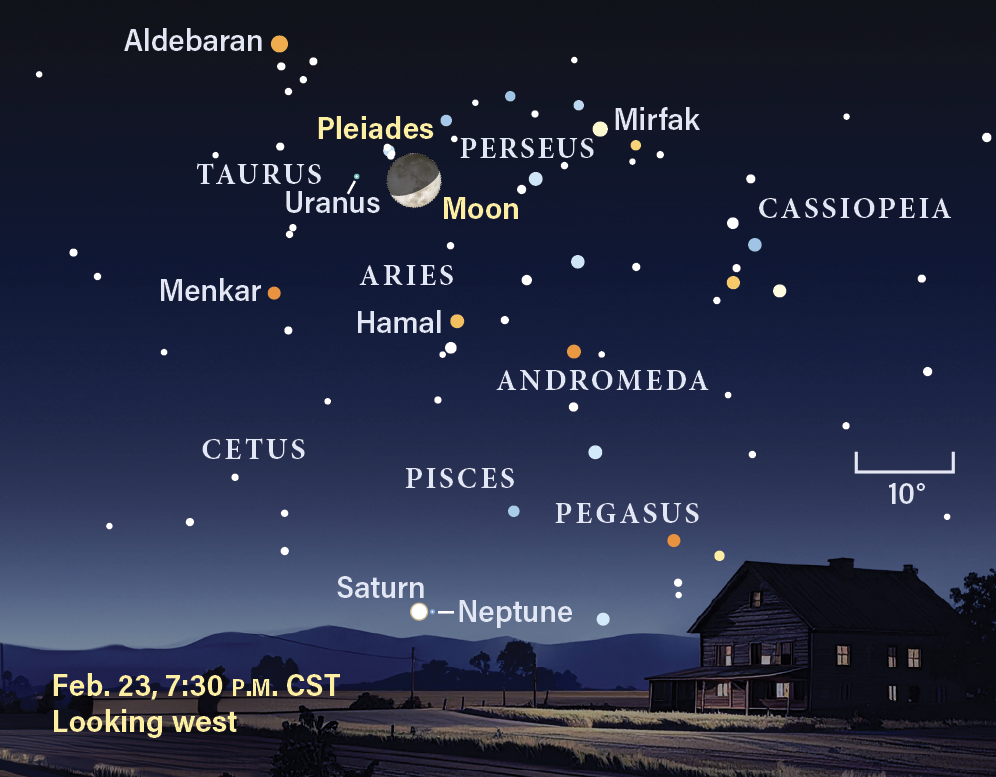 By 7:30 p.m. CST on Feb. 23, the Moon is preparing to pass in front of a portion of the Pleiades. Uranus — which will require optical aid — is also in Taurus. You will need magnification to spot Neptune, near Saturn, as well. / Roen Kelly
Monday, February 23
Uranus, the seventh planet from the Sun, is currently in Taurus, located roughly 5° south-southwest of the Pleiades star cluster (M45). Glowing at magnitude 5.8, the ice giant requires binoculars or a telescope to spot.
The Moon passes 6° north of Uranus at 8 P.M. EST; around the same time, our satellite grazes the stars of the Pleiades, passing just north of the main cluster. For about four hours, from 9 P.M. to 1 A.M. EST (moonset along the East Coast), the Moon is quite close to the Pleiades’ stars, occulting some of the fainter members in the group’s northern reaches during this timeframe. If you focus on the Moon’s leading (dark) edge with binoculars or a telescope and watch closely, you may be able to see some of the cluster’s stars wink out as they are covered by our satellite. Their reappearance at the brighter, illuminated trailing limb will be much harder to catch.
Which stars disappear and the time of their disappearance depends heavily on your location — for example, 6th-magnitude 18 Tauri will disappear around 9:15 P.M. CST from Springfield, Illinois. The International Occultation Timing Association has more details on this and other upcoming occultations, or you can chart the event from your specific location using your favorite planetarium program.
Sunrise: 6:42 A.M.
Sunset: 5:46 P.M.
Moonrise: 9:40 A.M.
Moonset: 12:01 A.M.
Moon Phase: Waxing crescent (46%)
Tuesday, February 24
First Quarter Moon occurs at 7:28 A.M. EST. The Moon then reaches perigee, the closest point to Earth in its orbit, at 6:14 P.M. EST. At that time, our satellite will be 229,991 miles (370,135 kilometers) away.
The Moon is still in Taurus, following its brush with the Pleiades yesterday. The region is setting after dark, slowly sinking toward the western horizon. In the east, the constellation Coma Berenices is rising higher. By 10:30 P.M. local time, it is some 40° above the horizon, ready for targeting with your telescope.
Tonight we’re after the Coma Cluster of galaxies, also cataloged as Abell 1656. This massive conglomeration sits some 330 million light-years away and contains thousands of galaxies. It’s a target for large scopes: 12 inches or more. If you’ve got one at your disposal, point it first to magnitude 4.2 Beta (β) Comae Berenices, then slide just under 3° west to find the cluster’s core, which covers about half a degree (the entire cluster spans about 4° on the sky).
The Coma’s brightest galaxies are NGC 4889 (11.4), NGC 4793 (11.7), and NGC 4874 (11.9). NGC 4889 is a huge elliptical galaxy sometimes also cataloged as NGC 4884. NGC 4874 is a similarly large elliptical. These types of galaxies are older objects, largely devoid of gas and dust and no longer forming stars. By contrast, NGC 4793 is a spiral galaxy rife with star formation.
Sunrise: 6:40 A.M.
Sunset: 5:47 P.M.
Moonrise: 10:24 A.M.
Moonset: 1:17 A.M.
Moon Phase: Waxing gibbous (58%)
Wednesday, February 25
Mercury stands stationary against the stars of Pisces at noon EST. You can spot the planet in the western sky for a short time after sunset, to the upper right of much brighter Venus. Mercury sets around 7 P.M. local time.
The solar system’s smallest planet passes due north of Venus tomorrow, so we’ll check back in with it then.
Already high in the east as darkness falls, Jupiter still dominates the constellation Gemini. The gas giant’s large moon Ganymede transits the disk this evening, with its shadow following a few hours later. You’ll be able to catch the event through a telescope.
Ganymede’s transit begins at 8:55 P.M. EST, with the moon moving in front of the disk from the east. Also east of the planet are the three other Galilean moons (in order of distance): Io, Europa, and Callisto.
Ganymede moves east to west across Jupiter, reaching halfway around 10:30 P.M. EST. It slips away from the southwestern limb around 12:10 A.M. EST on the 26th (in Eastern time only), with its shadow still yet to appear. That shadow finally makes its way onto the cloud tops near the southeastern limb around midnight CST, four hours after Ganymede’s transit began and with Ganymede now well away from the southwestern limb. The shadow takes more than three hours to transit, disappearing around 2:20 A.M. MST, with Jupiter getting quite low in the Midwest.
Sunrise: 6:39 A.M.
Sunset: 5:48 P.M.
Moonrise: 11:19 A.M.
Moonset: 2:29 A.M.
Moon Phase: Waxing gibbous (69%)
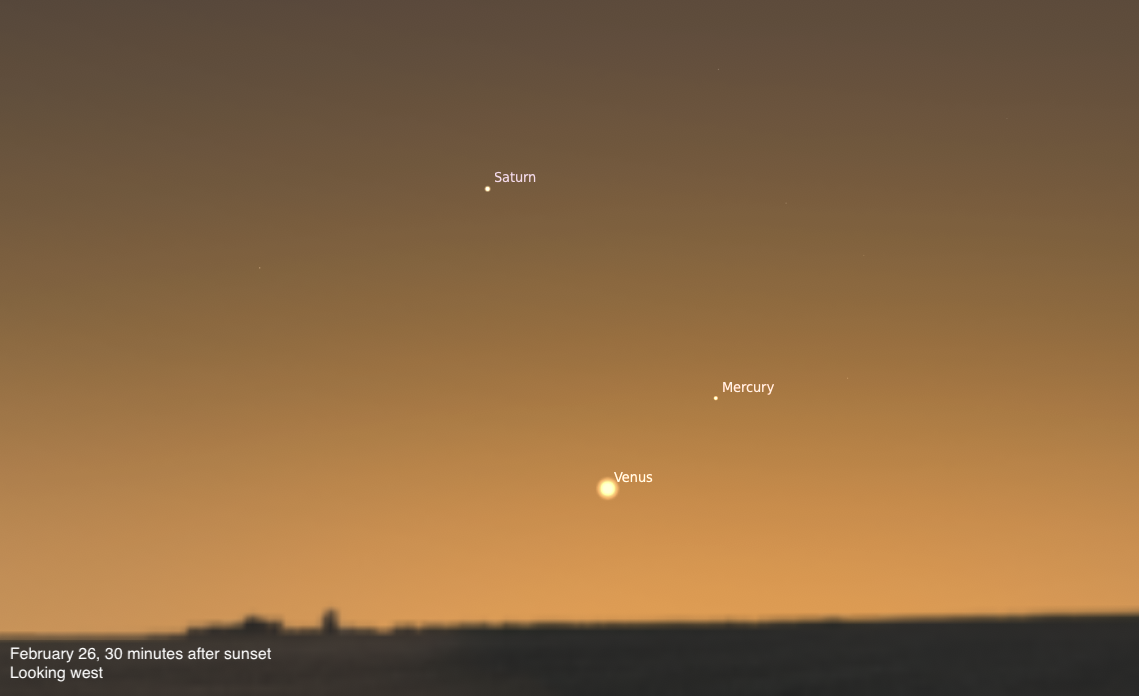 For a short time after sunset, Venus and Mercury are visible above the western horizon. Above them, Saturn will also glow in the twilit sky. / Stellarium
Thursday, February 26
Mercury passes 5° north of Venus at 6 P.M. EST. The pair is visible together briefly in the evening sky after sunset, although the two planets set soon after the Sun.
Half an hour after sunset, the pair is some 6° high in the west. Venus is easy to find, blazing at magnitude –3.9, while Mercury is a dimmer point of light to Venus’ upper right, shining at magnitude 0.8. Above them (10° west of Mercury) is 1st-magnitude Saturn, which should also become visible as twilight grows.
Through a telescope — make sure to wait until the Sun is fully below the horizon — take a look at both Venus and Mercury and compare their appearances. Venus’ disk stretches 10” across and is nearly fully lit, 98 percent illuminated. Mercury, by contrast, is only 17 percent lit, displaying a lovely crescent that is nearly the same size: 9” across. Although Mercury is physically much smaller than Venus, it is currently much closer to Earth, based on the three planets’ orbits. Mercury is now only 0.75 astronomical unit from Earth, where 1 astronomical unit, or AU, is the average Earth-Sun distance of 93 million miles (150 million km). Venus is 1.66 AU from Earth, on the far side of the Sun from Earth as seen from above the plane of the solar system.
As darkness falls further, swing your telescope up to Saturn to view its lovely rings, now tilted by about 3.5° and showing off their southern side. The planet’s brightest moon, Titan, lies just northwest of the planet’s 16”-wide disk this evening.
Sunrise: 6:37 A.M.
Sunset: 5:49 P.M.
Moonrise: 12:24 P.M.
Moonset: 3:33 A.M.
Moon Phase: Waxing gibbous (79%)
Friday, February 27
The Moon passes 4° north of Jupiter at 1 A.M. EST. Both are located in Gemini, now sinking slowly in the west.
At 1 A.M. local time, the region is still 30° high, with the 80-percent-lit Moon standing to the upper right of Jupiter. Both hang below the two brightest stars in Gemini, Castor and Pollux, which mark the Twins’ heads. Castor is the rightmost star, burning with a slightly blue-white hue. This multi-star system can be split into two in any telescope, showing a pair of A-type stars.
Pollux is located to Castor’s left as Gemini sets; a few tenths of a magnitude brighter than Castor, Pollux’s hue is more orangey-yellow. This is because Pollux is a cooler K-type giant star; it lies much closer to Earth (34 light-years) than Castor, which is 51 light-years away.
Zoom in on Jupiter and, depending on the time, you will see three or four of its Galilean moons. Throughout the morning, Ganymede and Europa lie to the planet’s west, while Callisto is off to its east. Io passes behind the planet’s disk in an occultation around midnight CST on the 26th (1 A.M. EST on the 27th in the Eastern time zone) and spends a little over two hours behind the huge world. When it emerges from behind the eastern limb, however, it is in Jupiter’s long, dark shadow, and remains invisible until about 2:20 A.M. MST (on the 27th), as Jupiter is getting quite low in the Midwest. When it reappears, Io is already some 20” east of Jupiter’s limb, showing the extent of the planet’s shadow in space.
Asteroid 7 Iris reaches opposition at 1 P.M. EST. We’ll return to view this main-belt world in next week’s column.
Sunrise: 6:36 A.M.
Sunset: 5:50 P.M.
Moonrise: 1:37 P.M.
Moonset: 4:25 A.M.
Moon Phase: Waxing gibbous (87%)

The sky, Feb. 22-27: Moon and the Pleiades added by Cosmic1 on
View all posts by Cosmic1 →
You must be logged in to post a comment Login