

Special to CosmicTribune.com, January 25, 2026
Excerpts from weekly Astronomy.com report.
Sunday, January 25
The Moon reaches First Quarter phase at 11:47 P.M. EST this evening, showing off a face that appears halfway lit as sunrise creeps across the lunar nearside.
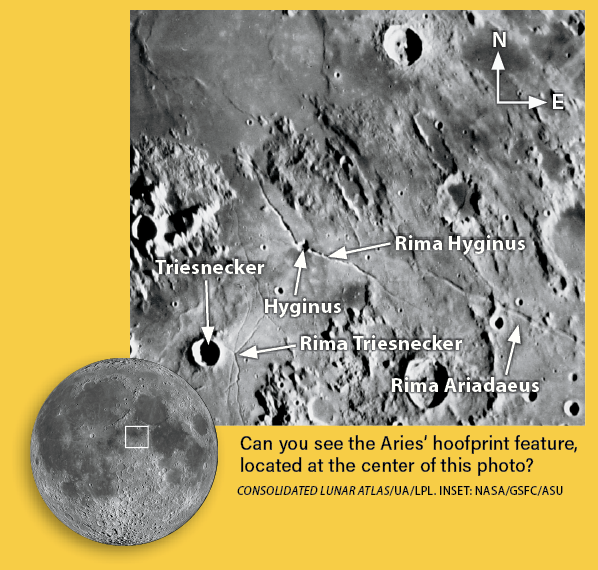
The Moon is now located in Aries — fitting, given our telescopic target for tonight is a feature Astronomy contributor Alister Ling calls Aries’ Hoofprint.
First, find Mare Serenitatis — the Sea of Serenity — in the northern hemisphere of the Moon, just outside the shadow of night. Just beyond Serenity’s southwestern rim is the round crater Manilius, which lies within Mare Vaporum. Continue moving in the same southwestern direction, closer to the terminator dividing night and day, and you’ll find another round crater: Triesnecker. Aries’ Hoofprint is a curved feature that lies just northeast of this pockmark — check out the accompanying photo to orient yourself at the eyepiece. Between Triesnecker and the hoofprint is Rima Hyginus, a volcanic rille that is itself split by the small crater Hyginus — a collapse pit within the linear feature.
Sunrise: 7:14 A.M.
Sunset: 5:11 P.M.
Moonrise: 10:31 A.M.
Moonset: —
Moon Phase: First Quarter
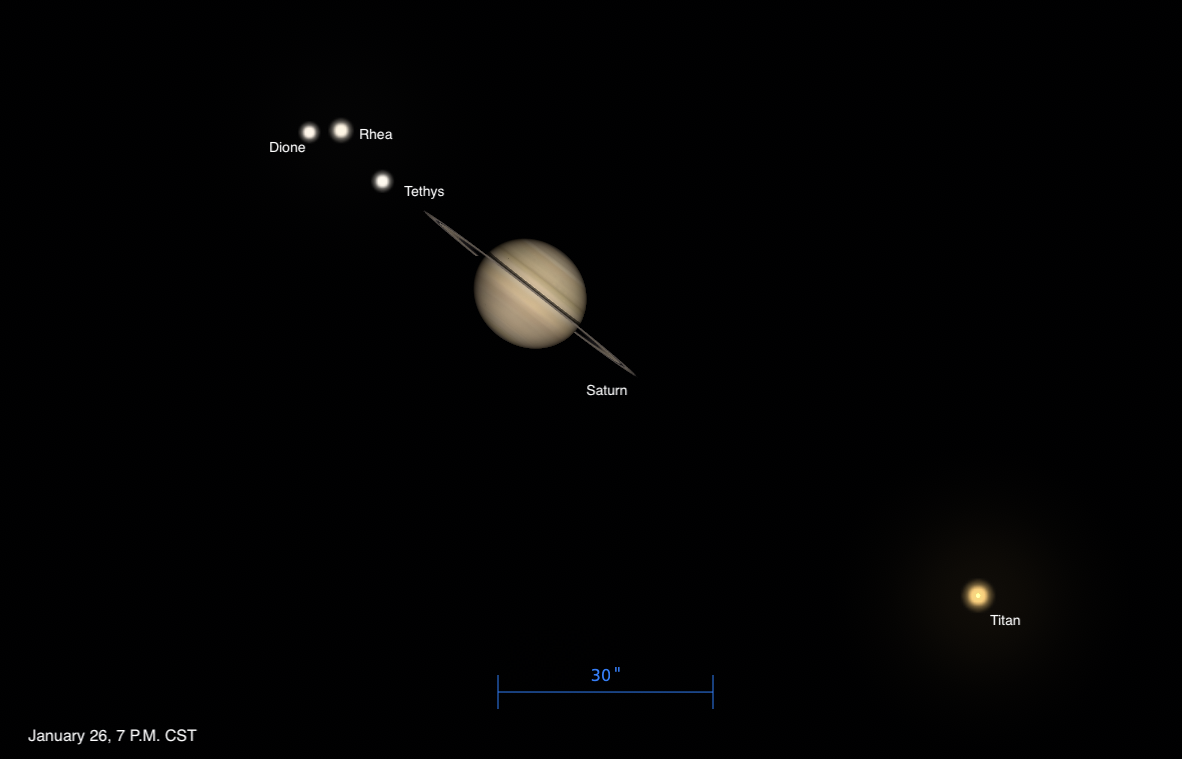 Saturn’s moons line up — and jockey for position — the evening of January 26. Moons fainter than 11th magnitude are not shown. / Stellarium/Oleg Pluton
Monday, January 26
Saturn’s four brightest moons are lined up for ideal viewing this evening. You can catch the ringed planet for a few hours after sunset, as it slowly sinks toward the western horizon.
Around 7 P.M. local time, Saturn is still some 25° high in the west. It shines at 1st magnitude — easy to find because nothing else is as bright in this region of the sky. Zoom in on Saturn with a telescope and you should easily see the moon Titan, shining around magnitude 8.5 and sitting due west of the planet. It will remain there all night.
On the eastern side of Saturn and its rings, three smaller, fainter moons may also be visible: 10th-magnitude Dione, Rhea, and Tethys. These are closer to the planet and change position quickly, so their orientation will depend on the time you view them. At 7 P.M. EST, Tethys is just off the eastern edge of the rings. Dione is next, with Rhea close by, but farther east. An hour later, Dione is now farther from Saturn than Rhea, as the two moons have swapped positions. Rhea then approaches Tethys, which is moving east as Rhea tracks west; the two moons seem to blend together around 7 P.M. MST. By 7 P.M. PST, the three fainter moons are lined up again east of Saturn, now with Rhea closest to the rings, then Tethys, and Dione farthest east.
Sunrise: 7:14 A.M.
Sunset: 5:12 P.M.
Moonrise: 11:02 A.M.
Moonset: 12:55 A.M.
Moon Phase: Waxing gibbous (61%)
Tuesday, January 27
The gibbous Moon passes 5° north of Uranus at 2 P.M. EST. Tonight, you’ll find our satellite just northeast of the Pleiades star cluster in Taurus, with Uranus to their southwest.
Many areas in Europe will see the Moon occult the Pleiades, passing in front of several of the cluster’s stars. By the time night falls in North America, however, the Moon will have cleared the cluster’s outer regions and sits well away from its stars, although the two will still make for a lovely sight in the deepening twilight.
Wait until full dark to go looking for Uranus. The ice giant shines at magnitude 5.7; with the bright Moon so close, you’ll need optical aid to spot it. Start by centering your view on the Pleiades, then drop about 4.6° south-southwest to land on a pair of stars in an east-west line: 13 and 14 Tauri. The brighter of the two is 13 Tau, which also shines at magnitude 5.7 and is the westernmost star. Uranus is about 45’ southwest of this star. Look for a small, “flat” star of the same brightness as 13 Tau in this region. Uranus’ tiny disk is only 4” across, thanks to its vast distance from Earth.
Sunrise: 7:13 A.M.
Sunset: 5:13 P.M.
Moonrise: 11:40 A.M.
Moonset: 2:11 A.M.
Moon Phase: Waxing gibbous (72%)
Wednesday, January 28
There’s plenty to view in the early-morning sky, especially with no Moon visible before dawn.
Although anchored by the bright star Arcturus, the constellation Boötes is relatively devoid of bright deep-sky treasures. Nonetheless, without the Moon to cast its light over the sky, the brightest of its deep-sky trove — globular cluster NGC 5466 — is within reach.
Shining at magnitude 9.1, this ancient ball of stars is quite compact, spanning just 11’. You can find it about 9.6° north-northwest of Arcturus, near Boötes’ border with neighboring Canes Venatici. Discovered in 1784, NGC 5466 is some 53,000 light-years distant. Astronomy contributor and longtime columnist Phil Harrington recommends looking for the cluster as a dim, gray glow just west of a slightly brighter, 7th-magnitude field star. He recommends seeking out the darkest (least light-polluted) skies you can, especially if you’re trying to net this one with binoculars. Telescopic observers will have an easier time, although dark skies are still advantageous, bringing out more of the cluster’s stars.
Asteroid 4 Vesta reaches conjunction with the Sun at 3 P.M. EST, rendering it invisible in our skies.
Sunrise: 7:12 A.M.
Sunset: 5:15 P.M.
Moonrise: 12:28 P.M.
Moonset: 3:28 A.M.
Moon Phase: Waxing gibbous (82%)
Thursday, January 29
The Moon reaches perigee, the closest point to Earth in its orbit, at 4:46 P.M. EST. At that time, our satellite will sit 227,341 miles (365,870 kilometers) away.
 Although the Moon is growing brighter, there’s still plenty to see in the evening sky. Astronomy contributor Phil Harrington calls the shape formed by the bright stars Betelgeuse, Sirius, and Procyon the Winter Triangle.
Largely framing the constellation Monoceros, this asterism holds within it several deep-sky delights, including M50, an open cluster that sits to the upper left of the bright star Sirius in the early-evening sky. To find it, first center your binoculars or telescope on Sirius, then skim northeast. M50 sits about 9.4° northeast of Sirius, in southern Monoceros the Unicorn.
Spanning about 16’, M50’s brightest star shines around 8th magnitude and stands out among its fainter suns, which form a hazy glow at lower magnifications. Together, the cluster’s stars shine with a combined magnitude of about 6. Astronomers believe this cluster is about 3,200 light-years away and about 78 million years old.
Sunrise: 7:11 A.M.
Sunset: 5:16 P.M.
Moonrise: 1:29 P.M.
Moonset: 4:39 A.M.
Moon Phase: Waxing gibbous (90%)
Friday, January 30
The Moon passes 4° north of Jupiter at 9 P.M. EST. The pair shares the central regions of Gemini this evening, with the Moon appearing to the upper left of Jupiter, and framed on the left by the Twins’ bright stars Castor and Pollux.
Despite the bright moonlight, Jupiter should still look excellent through a telescope. Its disk stretches 46” and will show off detail such as alternating light and dark cloud bands. For much of the evening, all four Galilean moons are visible west of the planet. Callisto is farthest west, with Ganymede to its east. Much closer to Jupiter, Io and Europa jockey for position, with Europa passing due north of Io shortly after 8:30 P.M. EST. Prior to this time, Europa is farther west than Io. Afterward, Europa is closer to Jupiter and closing in — the icy moon disappears behind the planet’s northwestern limb in an occultation shortly after 12:30 A.M. EST (now the 31st in the Eastern time zone only, still late on the 30th farther west).
While you’re in this region of the sky, also take the opportunity to split the multiple star Castor with your telescope, revealing two roughly equally bright stars just a few arcseconds apart. Next, look about 1.2’ to this pair’s south — there’s a third star in the system, much fainter than the initial pair (these are 2nd and 3rd magnitude, while the fainter component is 9th magnitude). Each of these three stars is also a double, though none of them can be split with a scope.
Sunrise: 7:10 A.M.
Sunset: 5:17 P.M.
Moonrise: 2:39 P.M.
Moonset: 5:41 A.M.
Moon Phase: Waxing gibbous (96%)

The sky, Jan. 25-30: The Moon and Jupiter stand out on Jan. 30 added by Cosmic1 on
View all posts by Cosmic1 →
You must be logged in to post a comment Login