

Special to CosmicTribune.com, March 30, 2026
Excerpts from weekly Astronomy.com report.
Sunday, March 29
The Moon passes 0.3° north of Leo’s alpha star, Regulus, at 4 P.M. EDT. By the time darkness falls, our satellite stands about 3.5° east of this bright star.
Shining at magnitude 1.4, Regulus sits nearly on the ecliptic — the imaginary line on the sky along which the planets, Sun, and Moon travel. In fact, draw a line between Regulus and the waxing Moon this evening, and you are tracing the ecliptic almost exactly.
Regulus serves as the base of the Sickle of Leo, an asterism shaped like a backward question mark and meant to trace out the shape of its eponymous farm implement in the sky. The top of the Sickle’s handle is marked by magnitude 3.5 Eta (η) Leonis, 4.8° due north of Regulus. The next several stars trace out the blade: magnitude 2.0 Gamma Leo, 4.3° northeast of Eta; magnitude 3.4 Zeta (ζ) Leo, 3.7° north of Gamma; magnitude 3.9 Mu (μ) Leo, 6° northwest of Zeta; and magnitude 3.0 Epsilon Leo, 2.7° southwest of Mu. Epsilon marks the tip of the blade.
Many observers also picture the Sickle’s outline as the Lion’s head, complete with fluffy mane, seen in profile. The figure of Leo is typically drawn with its nose facing west, hindquarters and tail to the east.
Sunrise: 6:49 A.M.
Sunset: 7:22 P.M.
Moonrise: 4:03 P.M.
Moonset: 5:12 A.M.
Moon Phase: Waxing gibbous (91%)
Monday, March 30
By local midnight, a familiar summertime friend has finally arrived on the scene: The stunning star Vega in Lyra. Cataloged as Alpha Lyrae, this magnitude 0.0 star is the fifth-brightest sun in the sky. It forms one point of the famous Summer Triangle asterism, which flies high overhead late on summer nights and is anchored at its other two points by Deneb in Cygnus and Altair in Aquila.
You can find Vega more than 10° above the northeastern horizon around local midnight, rising higher into the early-morning hours. It’s the brightest star in this region of the sky, and will rise earlier each day as spring progresses into summer.
Vega is about twice as massive as our Sun and nearly 40 times as luminous. Despite the fact that it is much younger than our Sun — 400 million years, versus our star’s 4.5 billion — both stars are roughly halfway through their normal (main sequence) hydrogen-burning lifetimes, thanks to Vega’s higher mass. Stars with more mass evolve more swiftly and live shorter lives.
Vega is particularly unusual in that it is oriented in space such that its pole is pointed nearly directly toward Earth, so we see it spinning on its side. As it rotates, its shape becomes slightly out of round, so that it is very slightly wider at the equator than the poles. This causes the poles to glow hotter and brighter than the equator, which results in so-called gravity darkening. On Vega, because it is tilted toward us, the outer edges (limb) of the star appear darker than the center (the pole).
Sunrise: 6:47 A.M.
Sunset: 7:23 P.M.
Moonrise: 5:11 P.M.
Moonset: 5:37 A.M.
Moon Phase: Waxing gibbous (96%)
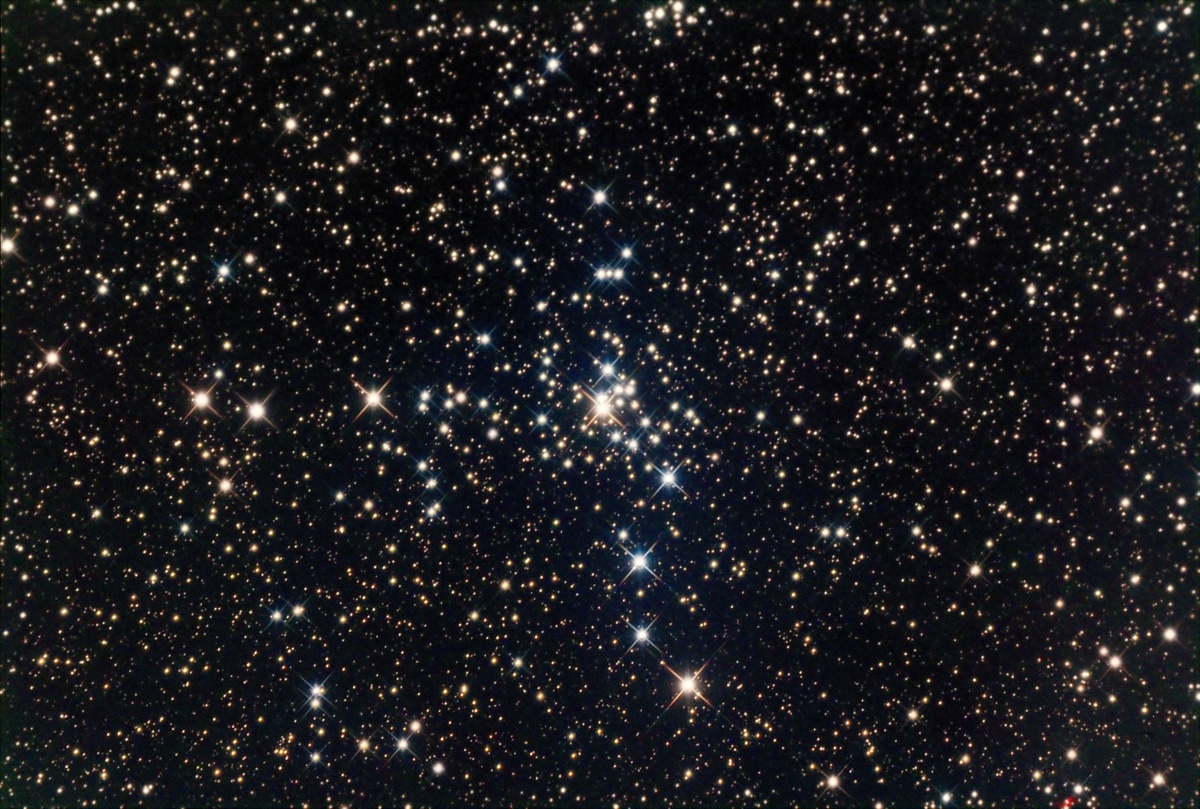 NGC 2301’s smattering of stars has entranced many observers. Astronomy contributor Phil Harrington sees a bird in flight. Credit: Anthony Ayiomamitis
Tuesday, March 31
As the familiar wintertime constellations begin setting earlier each evening, it’s our last chance to catch some of the deep-sky treasures they contain.
The constellation Monoceros lies east of better-known Orion the Hunter in the sky, now sinking in the southwest after dark. You can find it to the upper left of Orion’s Belt around 9 P.M. local daylight time. Shining at 6th magnitude, NGC 2301 is an open cluster of young stars located just less than 16° southeast of Betelgeuse in Orion, and about 5.1° northwest of 4th-magnitude Delta (δ) Monocerotis in central Monoceros.
Spanning about 12’, NGC 2301 is also known as the Great Bird Cluster (or, more fully, the Great Bird of the Galaxy Cluster). It was given this nickname by Astronomy contributor Phil Harrington, who imagines the cluster as a bird in flight. Visible in binoculars or any small scope, NGC 2301 contains about 80 members of varying brightness.
Sunrise: 6:45 A.M.
Sunset: 7:24 P.M.
Moonrise: 6:16 P.M.
Moonset: 5:59 A.M.
Moon Phase: Waxing gibbous (99%)
Wednesday, April 1
April’s evenings kick off with a Full Moon, which occurs at 10:12 P.M. EDT tonight. The April Full Moon is also called the Pink Moon, after the wildflowers that begin to run rampant as spring begins.
When the Moon is Full, deep-sky observing becomes difficult — but not impossible. Double stars still make excellent targets even in bright moonlight. Tonight, we’re looking just northeast of the Moon, which lies in Virgo, toward the heart of Boötes the Herdsman.
Boötes’ brightest star is the well-known Arcturus (Alpha Boötis), which shines at magnitude –0.1. We’re traveling northeast of this star about 10.3° to find 2nd-magnitude Izar (Epsilon Boo). This sun splits into two stars roughly 3” apart through a telescope — it can be challenging through a smaller scope, but doable. Larger scopes will make it even easier. The two resulting stars are 3rd and 5th magnitude and have stunningly contrasting colors. Most observers see them as gold and blue. Some, however, think they appear more gold and green — note this is a trick of the eye, as there are no green stars.
This pair was considered so lovely by the astronomer Friedrich Georg Wilhelm von Struve that he called it Pulcherrima —“the most beautiful” in Latin. What do you think?
Sunrise: 6:44 A.M.
Sunset: 7:25 P.M.
Moonrise: 7:21 P.M.
Moonset: 6:20 A.M.
Moon Phase: Full
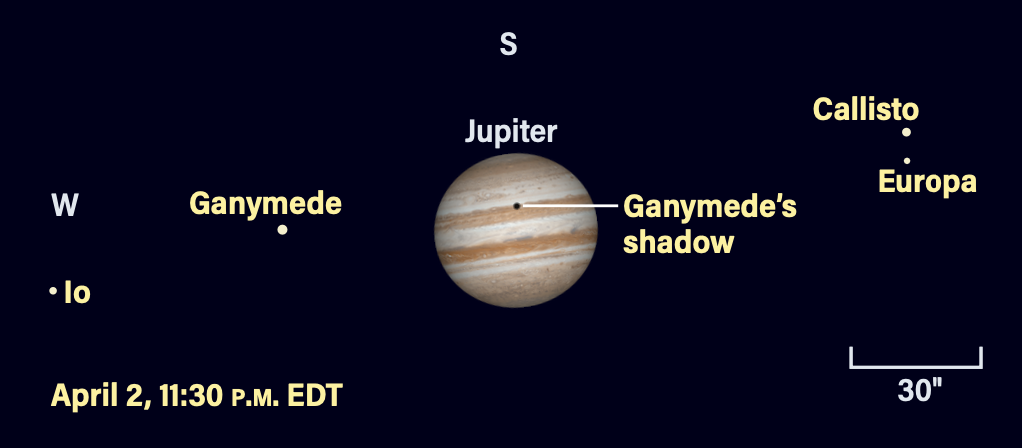 Late on April 2, catch all four Galilean moons as Europa passes north of Callisto and Ganymede casts its shadow on Jupiter. Credit: Astronomy: Roen Kelly
Thursday, April 2
You’ll want eyes on Jupiter this evening as Europa passes north of Callisto while Ganymede’s large shadow transits the gas giant’s cloud tops. Start observing by 11 P.M. EDT, as the bright planet hangs in the west beneath the heads of Gemini the Twins: Castor and Pollux.
At that time, Ganymede’s shadow is already crossing the cloud tops, having begun its journey an hour before (so feel free to start watching then, if you’re able!). Ganymede itself lies west of the planet, with Io farther west. On the eastern side of Jupiter, Europa and Callisto are close to each other, with Europa just east of Callisto. This is where you’ll want to watch: Both are moving westward, toward the planet, but Europa is moving faster. At 11:30 P.M. EDT, the smaller moon moves due north of Callisto, with the two 7” apart. After that, Europa will overtake its fellow moon, moving closer to Jupiter as Callisto falls behind.
Ganymede’s shadow transit continues as well, ending shortly after 1:22 A.M. EDT, now April 3 for the eastern half of the U.S. — where the view is also diminished due to Jupiter’s low position. The western half of the U.S. gets the better view as Ganymede’s shadow reaches Jupiter’s western limb and disappears.
Sunrise: 6:42 A.M.
Sunset: 7:26 P.M.
Moonrise: 8:24 P.M.
Moonset: 6:41 A.M.
Moon Phase: Waning gibbous (99%)
Friday, April 3
Mercury reaches greatest western elongation, standing 28° from the Sun at 7 P.M. EDT this evening.
Now visible in the morning sky, the small planet glows at magnitude 0.4 and rises around 5:45 A.M. local daylight time. That doesn’t afford much time to see it, but early risers can spot it some 4° above the eastern horizon about half an hour before the Sun rises. Mercury is now in Aquarius and currently tracking eastward, or prograde, against the background stars.
Through a telescope, the planet’s disk spans 8” on the sky. It is roughly half-lit (49 percent) and its illumination will increase in the coming days as Mercury remains at roughly the same altitude above the horizon, while Mars and Saturn slowly rise to meet it in the morning sky. Currently, Mars is above the horizon half an hour before sunrise, but just barely — the Red Planet stands just 1° high at this time and is very faint at magnitude 1.3. You can try looking for it in binoculars or a telescope 9.1° northeast of Mercury (to Mercury’s lower left), but you will need a very clear horizon free of trees or buildings. Take care to put away any optics well before sunrise from your location, which may differ from the time given below.
Sunrise: 6:40 A.M.
Sunset: 7:27 P.M.
Moonrise: 9:29 P.M.
Moonset: 7:05 A.M.
Moon Phase: Waning gibbous (96%)

The sky, March 30-April 3: NGC 2301, ‘Great Bird Cluster’ added by Cosmic1 on
View all posts by Cosmic1 →
You must be logged in to post a comment Login