

Special to CosmicTribune.com, April 8, 2026
By Richard Fisher
An old Ronald Reagan Cold War joke about the Soviet Union helps to explain the current United States-China information dynamic over their respective space programs.
Reagan’s joke, paraphrased, went like this:
“An American tells a Russian that the U.S. is free because he can stand in front of the White House and shout ‘Down with Ronald Reagan!’ The Russian responds, ‘That’s nothing. I can go to Red Square and shout ‘Down with Ronald Reagan!’ too.”
Chinese coverage of the U.S. National Aeronautics and Space Administration’s (NASA) Artemis Moon program can vary at different levels of the Chinese state media-sphere.
Second-level state media like Global Times can be respectful and even factual while repeating some U.S.-source criticisms, while third-level state media like Guancha can revel in the U.S. policy shifts, Moon program architecture shifts and the litany of technical issues that NASA dutifully shares with the U.S. and Western media.
For example, on April 2 in a 1,200-word article, Global Times wrote that on its April 1 liftoff the Artemis-II spacecraft, would be “carrying four astronauts on the first crewed flight around the Moon since 1972… and set a record for the farthest distance ever traveled from Earth: 252,000 miles.”
Global Times also noted that on Chinese social media Weibo, there was commentary that was complimentary of the U.S., but it also cited Kang Guohua, a senior member of the Chinese Society of Astronautics and a professor of Aerospace Engineering at Nanjing University of Aeronautics and Astronautics, saying the Artemis mission was being driven by a “space race” mentality.
In contrast, according to Kang, “China, for its part, has made clear that it will not pursue a “Star Wars”-style confrontation or engage in an arms race in space, but will instead advance its lunar program steadily and at its own pace, without rushing in response to outside pressure.”
There has been far more detailed discussion of the Artemis program on third-level state media Guancha, which actively solicits commentary from academics and its own expert pool.
A Guancha article published on April 7 titled, “The United States aims to ‘return to the moon’ after 53 years; “back then, it was eyeing the Soviet Union; now it’s China,’” is a long-winded nearly 3,000-word review of the history and delays and controversies in the Artemis program, citing NASA sources, Bloomberg and CNN.
Regarding the current NASA Artemis Moon base program, Guancha cites U.S. source criticism saying, “influenced by anxiety about space competition with China, the Trump administration and NASA set an overly aggressive timetable for lunar landings, and a large number of technologies that had not been verified by unmanned test flights were hastily planned for use in manned missions.”
With scantly concealed glee, on April 5 Guancha reported on the Orion manned space capsule’s troublesome toilet system, and on April 6 Guancha reported in some detail the seeming contraction between NASA’s expensive ambitions to build Moon bases, while the Trump Administration plans for a reduction in NASA’s fiscal year 2027 budget.
So, while the heavily censored Chinese state media offers significant coverage of the U.S. space program, especially criticism of that program, China’s state media offers far less coverage of the controversies, failings or even the debates that helped shape key decisions regarding China’s space program.
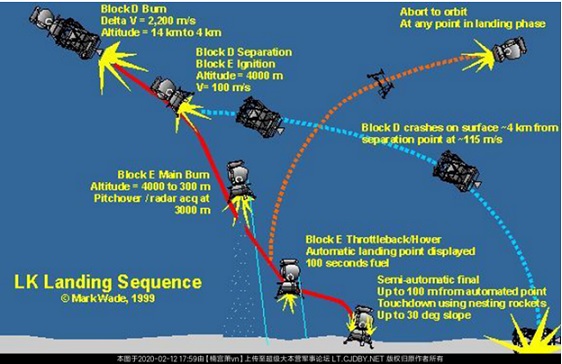
Chinese sources tend to offer little-to-minimum recognition of the impact of Russian technology and consulting help in shaping their space program; no acknowledgement that China’s Tiangong Space Station design was likely stolen from the Russian Energia space concern, or that even that China’s new Lanyue manned Moon landing vehicle is broadly influenced by the unused Russian LK Moon lander.
Full Text . . . . Current Edition . . . . Subscription Information

What state media commentary on U.S. Moon program reveals about China added by Cosmic1 on
View all posts by Cosmic1 →
You must be logged in to post a comment Login