

Special to CosmicTribune.com, November 1, 2026
Excerpts from weekly Sky & Telescope.com report.
SUNDAY, NOVEMBER 1
■ The Moon, half a day past last quarter, rises around 11 or midnight standard time, closely accompanied by Mars. By the beginning of dawn Monday morning in North America, the Moon will be just 1° or 2° from Mars as shown below. Jupiter blazes under them.
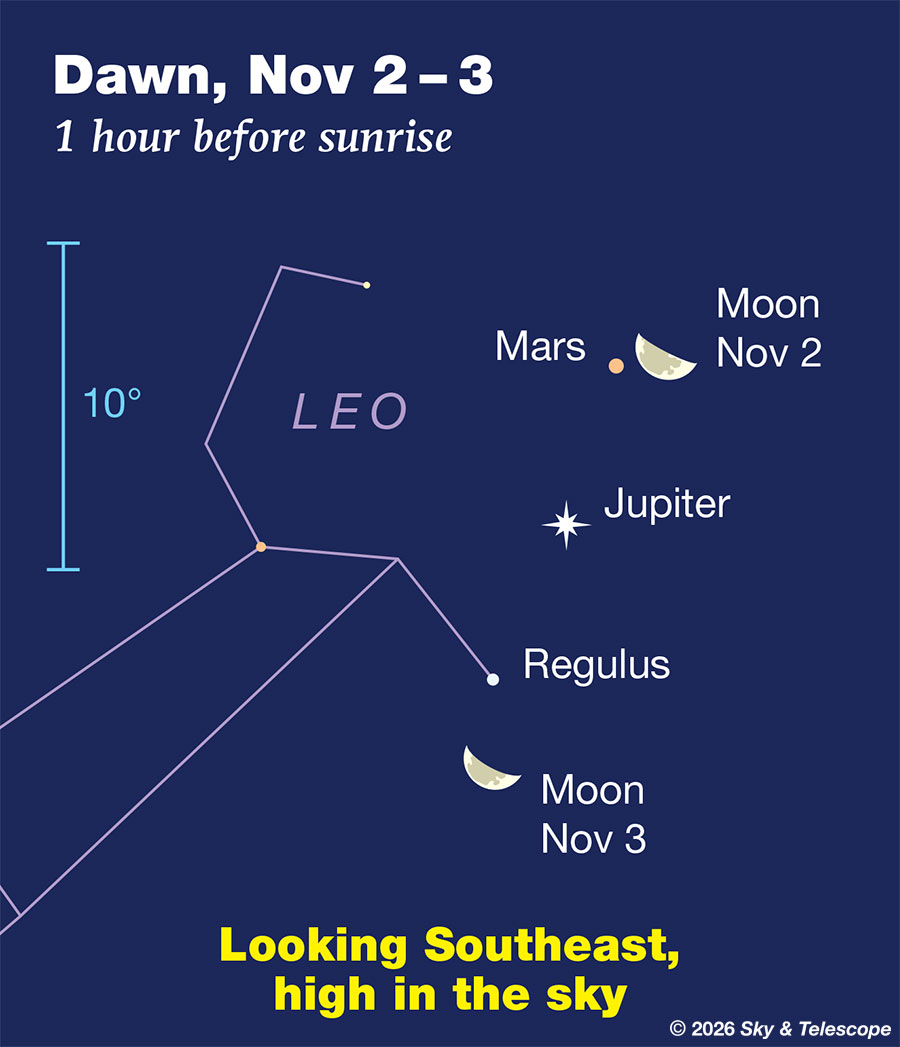 The waning Moon adorns the shrinking Mars-Jupiter-Regulus lineup before and during early dawn on Monday and Tuesday mornings, November 2nd and 3rd. The star-and-planets line is now 11° long and closing.
Note: The Moon here is drawn about three times its actual apparent size. The blue 10° scale is about the width of your fist at arm’s length.
MONDAY, NOVEMBER 2
■ This is the time of year when the Big Dipper lies down horizontal low in the north-northwest after dark. The farther south you are, the lower. Seen from latitude 40° north (New York, Denver) even its bottom stars twinkle nearly ten degrees high. But at Miami (26° N) the entire Dipper will skim along out of sight just below the northern horizon.
■ In the early morning hours of Tuesday the 3rd, catch the waning Moon below the Mars-Jupiter-Regulus lineup as shown above.
TUESDAY, NOVEMBER 3
■ Sometime around 9 p.m., depending on where you live, zero-magnitude Capella will have risen exactly as high in the northeast as zero-magnitude Vega has sunk in the west-northwest. How accurately can you time this event?
The answer, along with judicious use of the stars’ celestial coordinates, a nautical almanac, and some seriously not-simple paperwork, can give your latitude and longitude. This is the kind of thing sailors once did with sextants. But you can do a modern version backwards! Using a planetarium program set for your date and your known location, run the time back and forth until Capella and Vega stand at the same altitude. Read off the time. How well or poorly does your naked-eye estimate match this? Can you get better with practice?
WEDNESDAY, NOVEMBER 4
■ The Summer Triangle Effect. Here it is November, but Deneb still shines right near the zenith as the stars come out. And brighter Vega is still not far from the zenith, toward the west. The third star of the “Summer” Triangle, Altair, remains high in the southwest.
They seem to have stayed there for a couple months! Why have they stalled out?
What you’re seeing is the result of sunset and darkness arriving earlier and earlier during autumn. Which means if you go out and starwatch soon after dark, you’re doing it earlier and earlier. This counteracts the seasonal westward turning of the constellations.
Of course this “Summer Triangle effect” applies to the entire celestial sphere, not just the Summer Triangle. But the apparent stalling of that bright landmark inspired Sky & Telescope to give the effect that name many years ago, and it stuck.
Of course, as always in celestial mechanics, a deficit somewhere gets made up elsewhere. The opposite effect makes the seasonal advance of the constellations seem to speed up in early spring. The spring-sky landmarks of Virgo and Corvus seem to dash away westward from week to week almost before you know it, due to darkness falling later and later. Let’s call this the “Corvus effect.”
■ In the dawns of Thursday and Friday, the bow shape of the thinning crescent Moon aims down as if to shoot an arrow at bright Venus and little Spica. As shown below.
On Saturday morning the 7th, the hairline Moon will pose right with them. By then its face will be only 3% sunlit.
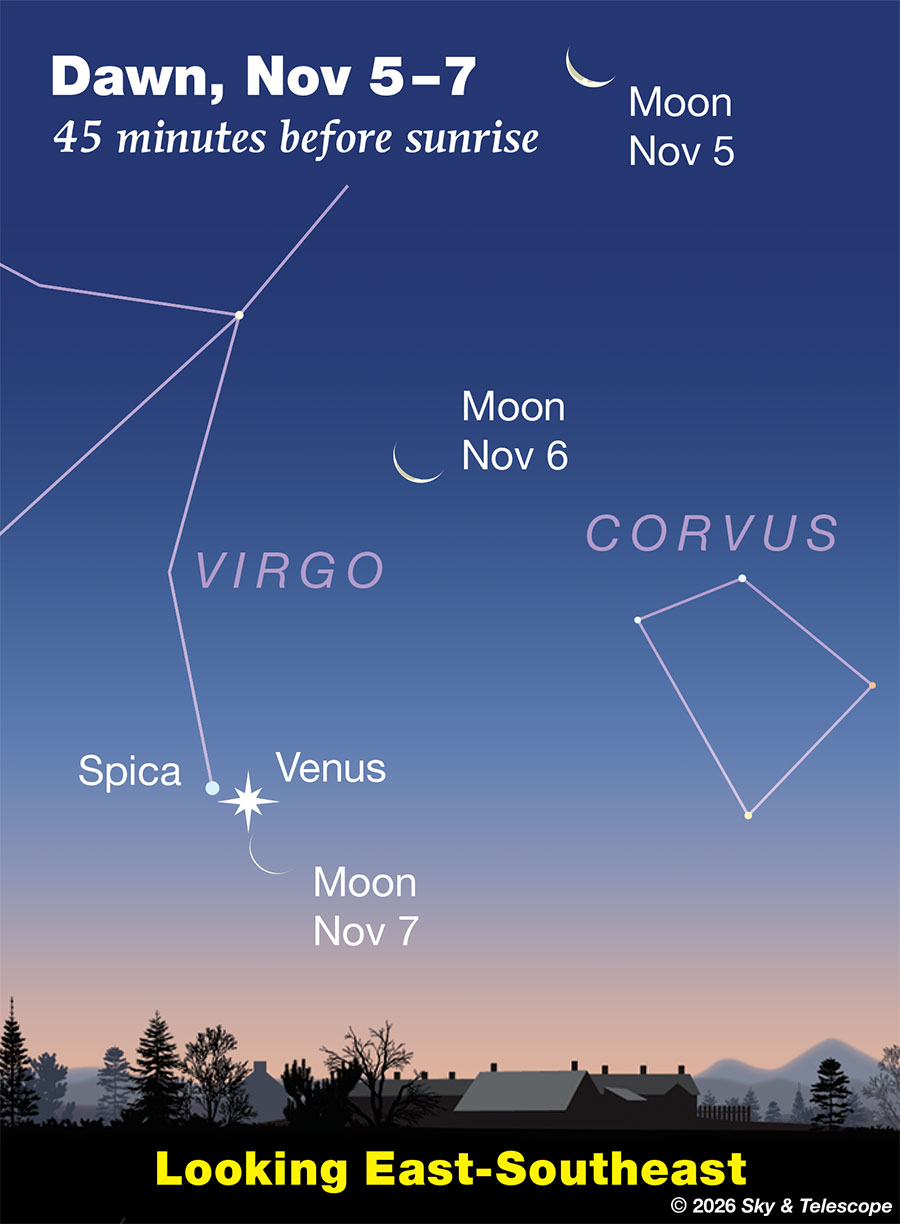 Morning by morning, the thinning crescent Moon steps down the eastern sky to group up with Venus and Spica on Saturday morning the 7th.
THURSDAY, NOVEMBER 5
■ Fireball alert? Maybe. The prolonged Southern and Northern Taurid meteor showers sputter along from mid-October through mid- to late November. This week we’re roughly in their slow, overlapping peaks.
The Taurid showers are weak, typically serving up five or 10 meteors per hour around their poorly defined maximum. Moreover, while both Taurid components include bits of debris shed by Comet 2P/Encke, a recent analysis found that other objects — near-Earth asteroids, collisional fragments, and dormant cometary nuclei — may be creating several overlapping streams of particles.
What makes the Taurids potentially exciting is that they are known for a high proportion of bright fireballs — occasionally, an extremely bright one that rattles the public and makes the news.
 This brilliant Northern Taurid fireball was caught bursting over Skibotn, Norway, in 2020 during evening twilight. Medisilvanus / Wikimedia Commons
The Taurids strike the atmosphere at a relatively slow 19 miles (30 km) per second. That’s because they are catching up with Earth from behind, which means that they streak less quickly than most meteors do. It also means that unlike most meteor showers, they do well in the evening hours.
FRIDAY, NOVEMBER 6
■ Algol should be at its minimum brightness, magnitude 3.4 instead of its usual 2.1, for about two hours centered on 10:34 p.m. EST. Comparison-star chart.
■ As dawn brightens Saturday morning the 7th, look low in the east-southeast for bright Venus. Within 2° of it (depending on your location) are shy Spica and the very thin waning crescent Moon, just two days from new. Bring binoculars to see through the growing light of the approaching day. See the illustration above.


The sky, November 1-6: Moon, Mars and Jupiter put on show early in week added by Cosmic1 on
View all posts by Cosmic1 →
You must be logged in to post a comment Login