

Special to CosmicTribune.com, October 29, 2026
By Richard Fisher
On Oct. 26, 2026, the United States Defense Intelligence Agency (DIA) released the third edition of its report, “Challenges to Security in Space, Congestion, Competition and Cooperation.” Among many noteworthy findings, the report revealed that the United States and Iran had each taken offensive actions against the other’s space systems and capabilities.
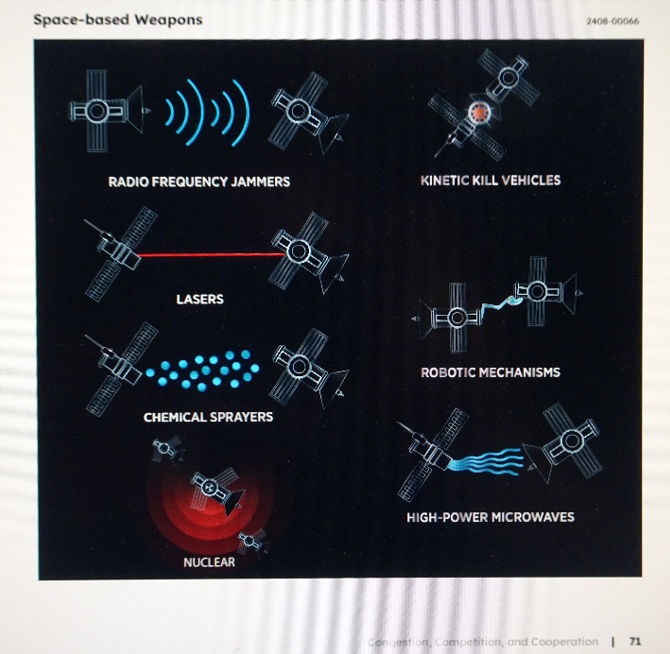
The detailed 129-page report mainly based on open sources, backed by 44 pages of endnotes appears designed to bolster the justification for the Trump Administration’s decisions to increase U.S. space defense programs, illustrated by U.S. Air Force Secretary Troy Meink’s Sept. 14 disclosure that the U.S. had deployed “on-orbit space control weapons.”
As such, the DIA report opens with a succinct threat assessment:
“China, Russia, Iran, and North Korea are developing, testing, deploying, and using space capabilities in a way that threatens the security of all space systems and their associated space benefits. China and Russia are developing a formidable spectrum of offensive capabilities to degrade or destroy space services of other countries, from kinetic destruction to sophisticated jamming and cyber operations. These countries have exhibited behaviors that often run counter to a safe, secure, and sustainable space domain.” (pg. vii)
Regarding China, the DIA assesses:
“Beijing aims to become the preeminent leader in space, to shape international norms to be more supportive of China’s positions on space issues, and exploit other nation’s perceived reliance on space-based systems to deter and counter China’s military operations.” (pg. 7)
To achieve this goal, the Chinese Communist Party (CCP) and its People’s Liberation Army (PLA) control all aspects of China space program:
“The Chinese Communist Party (CCP) Central Military Commission (CMC) directs both the PLA and the CMSA [China Manned Space Agency], and the PLA works closely with the CNSA [China National Space Agency, civil space], ensuring military objectives are met through civil space activities as well.” (pg. 7)
Regarding space combat capabilities, the DIA has offered useful assessments and predictions:
Surveillance satellites: “As of July 2026, China’s ISR satellite fleet contained more than 510 systems, having more than tripled since 2018…China’s growing constellation of LEO satellites can provide images of any location on earth in 30 minutes or less. (pg.20)
Satellite targeting: China’s GEO [Geosynchronous] signals intelligence (SIGINT), EO [Electro optical], and SAR [Synthetic Aperture Radar] satellites provide persistent coverage with no latency. When used with other technologies, these satellites enable an indigenous capability to track objects throughout the entire Indo-Pacific region. These improvements have increased China’s ability to monitor U.S. and allied aircraft carriers, expeditionary strike groups, and deployed air wings throughout the Pacific. (pg.21)
Laser weapons: China has multiple ground-based laser weapons with varying power levels to disrupt, degrade, or damage satellites in LEO; by the late2020s, China may field space-based directed energy systems and higher-powered ground-based directed energy systems capable of threatening satellites in higher orbits. (pg. 26)
Ground based anti-satellite (ASAT) weapons: “To expand the range of its ASAT deterrent, China probably intends to deploy additional ASAT missiles that can destroy satellites in low, medium, and high orbits.” (p.26)
Space orbital weapons: “China is developing space-based technology, including on-orbit counterspace weapons, capable of holding space systems at risk…including the Shijian-17, a satellite with a robotic arm, can be used for grappling other satellites. In January 2022, Shijian-21 moved a derelict BeiDou navigation satellite to a high graveyard orbit above GEO.” (pg. 27)
Space nuclear weapons: “In 2022, a PRC scientist published a report describing the effects of nuclear weapons as an ASAT capability; the study recognized the ability to neutralize multiple targets simultaneously with this type of capability. However, there is no indication that China plans to actively test or develop a nuclear ASAT weapon for use in space.” (pg.27)
Regarding Russia’s space program, the DIA assesses:
“Russia’s space program is more narrowly focused than China’s program, and Moscow’s budget is more limited than Beijing’s because of competing priorities from Russia’s broader military modernization efforts and its war in Ukraine. Over the past decade, both Russia’s civilian and military space programs have faced various obstacles. Pervasive corruption has stalled developments,520 budget cuts and sanctions have delayed projects,521.522.523 and negligible private space investment has stymied growth and innovation.” (pg.29)
There is also an increasing reliance on China:
“Since Russia’s 2022 invasion of Ukraine, the Russian government and military-related organizations have looked to China for space-based support for operations in Ukraine and to maintain space-based capabilities. In July 2022, then-Roscosmos Director Yuri Borisov admitted Western sanctions on electronic components were affecting Russian satellite production. In January 2023, Borisov stated Russia had agreed to purchase space components from China. Meanwhile, Russian private military company Vagner signed contracts with PRC commercial satellite companies in November 2022 to acquire two imagery satellites and obtain imagery from PRC entity CGSTL to support operations in Ukraine and Africa. Spacety, another PRC commercial company, provided Vagner with SAR satellite images of Ukraine.” (pg.34)
Full Text . . . . Current Edition . . . . Subscription Information

DIA lists rogue state space threats that justify U.S. ‘on-orbit’ weapons added by Cosmic1 on
View all posts by Cosmic1 →
You must be logged in to post a comment Login