

Special to CosmicTribune.com, November 20, 2026
Where was North Korea’s Kim Jong-Un?
In what was seen as a summit of the world’s three leading nuclear powers, many analysts had speculated Kim would make an appearance on behalf of his nuclear-armed dynastic, communist state.
Related: North Korean official’s China visit ahead of trilateral summit spurred flurry of speculations, November 10, 2026
“He may come. I don’t know. That’s up to President Xi,” said President Donald Trump before leaving on his Asia tour.
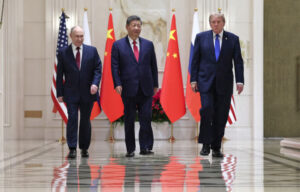
That comment signaled the president knew he was facing a stacked deck in Shenzen as Kim, who had bonded with Trump during his first term in a shock to Beijing had been rapidly transformed into a anti-U.S. strategic asset during the Biden Administration.
Who benefited? China and Russia.
And for all his laudatory comments about Chairman Xi Jinping, Trump has few illusions. Many dependent on legacy media for their news may have been unaware of the president’s sparsely-covered and rare primetime address on July 16.
Trump told the nation he had ordered investigations into a years-long effort by U.S. intelligence officials to conceal evidence of Chinese interference in the 2020 election.
After Trump’s celebrated friendship with Kim during his first term and the disputed 2020 election, the global balance of power shifted. The U.S. lost the strategic Bagram Air Base in its rushed exit from Afghanistan. And North Korea suddenly emerged as a nuclear and missile power aided by China and also subsequently partnered with Russia, sending weapons and soldiers to join it war against Ukraine.
U.S. President Donald Trump, Chinese Communist Party leader Xi Jinping, and Russian leader Vladimir Putin released what they described as a “peace declaration” at the end of a 90-minute meeting on Thursday in Shenzhen, China.
Related: ‘Most secure election’? What China could do with 220 million election files and U.S. voting machines, July 19, 2026
Trump stated that bringing the three leaders together offered an opportunity to address issues that had long divided their countries, with the reduction of nuclear weapons being a primary topic.
“As the world’s three largest nuclear powers by far, the United States, Russia and China are uniquely positioned to discuss how to reduce the number of nuclear weapons on Earth, and also to lessen the risk that those weapons will ever be used,” Trump said at the historic summit which saw the leaders of the three nations meeting together for the first time. “The power is unbelievable.”
“Too often, past leaders avoided talking to nations with whom they had disagreements,” Trump said. “But no problems were ever solved under the old school refusing to talk about them. Together we are choosing a different course.”
Writing for The New York Sun, columnist Donald Kirk noted that Xi was “eager to promote ‘world peace,’ agreed on the need to get rid of nuclear weapons but failed to float a plan to achieve that noble goal. Previously, he had stated that he did not want to negotiate the topic while Russia and America, with more than 5,000 nukes each, were far ahead of China, building up its nuclear stockpile of more than 600 warheads.”
As the conference ended, Kirk noted, “there was no sign of North Korean leader Kim Jong-Un contributing to the drama by suddenly showing up to greet his friend, Trump, along with his ally, Putin, to whom Kim is providing arms and troops for the war against Ukraine. Nor was there a clue as to whether Kim might still see Trump, at another time and place.”
China’s Xinhua News reported that Xi said: “On major sensitive issues concerning one another, it is important to communicate in advance, try to see things from one another’s perspective, act with caution, and in particular, not to challenge the red lines of one another. China, Russia and the United States should be partners and friends.”
Putin emphasized the countries’ shared responsibility for international security, pointing to their status as permanent members of the United Nations Security Council before turning to one of the summit’s most pressing issues: the war in Ukraine.
“Our countries have numerous shared interests in the settlement of regional conflicts, including, obviously, the conflict in Ukraine,” Putin said through a translator.
The Russian president confirmed that Ukraine had been a focus of his earlier bilateral meeting with Trump, saying the discussion took place at the American president’s initiative
The American president as well as Putin hinted some progress may have been made on reaching a deal to end the war between Russia and Ukraine.
“President Putin and I have had a long discussion today for quite a while. That’s what … pretty much what the discussion was about. And I think things are happening,” Trump said. “I think that he and I hope the other side would like to see an end to that war.”
The Russian president confirmed there was an extensive discussion about Ukraine.
“Our countries have numerous shared interests in the settlement of regional conflicts, including, obviously, the conflict in Ukraine. We discussed this yesterday with president of China, and today, at the initiative of the president of the United States of America, we focused on that during our bilateral meeting,” Putin said.
Trump acknowledged a nuclear disarmament deal was a high hurdle to achieve as China, the host country, has been moving to double the number of nuclear missiles it operates.
“I must say, it’s quite frankly a very hard thing to do, because once you have the nuclear weapons, it’s very hard to not have them,” he said. “It’s very hard to give them up as the leader of a country, something that’s very difficult to say because it, it’s the way life works, you know, you have thousands of weapons and you’re supposed to give them up, and yet you have countries in addition to us and much smaller numbers, but they have nuclear weapons also.”
Trump boarded Air Force One soon afterward, “leaving the impression that perhaps he was not overjoyed by the results after saying beforehand that the occasion was ‘historic,’ ” Kirk noted.
“Certainly the summit failed to live up to advance comparisons to the meeting at Yalta, on the Crimean peninsula, part of the Soviet Union, in 1945 when President Roosevelt, Britain’s prime minister, Winston Churchill, and Soviet dictator Joseph Stalin talked about dividing Europe after the impending defeat of Germany.”
The declaration issued following the summit wound up stating that all three participants had “reaffirmed that a nuclear war cannot be won and must not be fought,” vowing to “engage in dialogue on reducing nuclear risks and preventing nuclear proliferation.”
Kirk noted: “But there was no clue as to when, or if, they would meet again, much less begin reducing their nuclear stockpiles. Nor was there an allusion to North Korea’s growing cache of nukes — and the refusal of leader Kim Jong-Un to negotiate denuclearization.
“North Korea — supported by both China and Russia with oil, food, and missile technology — did not seem to have been mentioned at all.”
Freedom Rocks! Until It Is Gone

Surreal summit in Shenzen added by Cosmic1 on
View all posts by Cosmic1 →
You must be logged in to post a comment Login