

Special to CosmicTribune.com, November 22, 2026
Excerpts from weekly Astronomy.com report.
 Sunday, November 22
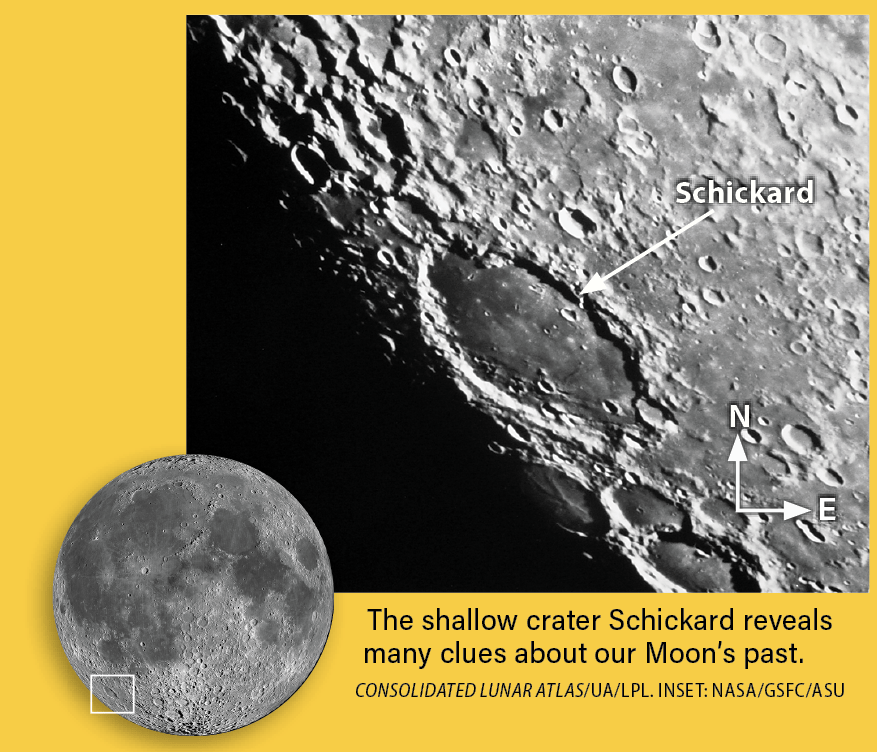
With the Moon not far from Full, its western limb is now coming into view as the Sun rises across the lunar landscape. The large, flat-floored crater Schickard is prominent in the southwest, near the small, circular Mare Humorum. Because the nearly Full Moon is so bright, you may want to use a Moon filter before you turn your telescope toward our satellite tonight for a closer look.
Zoom in on Schickard to discover that its dark floor isn’t perfectly smooth, but pockmarked by smaller craters that came after the initial, larger crater’s formation. Its outer walls are shallow and beaten down, also showing off their age. Look closely at Schickard’s western wall to see how it has slumped, particularly compared to the eastern side of the crater rim. Also compare the texture of the southwestern portion of the crater floor, which appears quite rough, to the rest of the crater, which is smoother. The difference arises because most of the crater was flooded by lava, which didn’t quite reach its southwestern regions.
Stretching about 130 miles (210 kilometers) across, Schickard is roughly 4 billion years old and was formed by a giant impact. Because it sits so near the limb of the Moon, it often looks oblong from our vantage point on Earth — but from above, orbiters have shown it is really quite circular in shape.
Sunrise: 6:53 A.M.
Sunset: 4:39 P.M.
Moonrise: 2:59 P.M.
Moonset: 4:34 A.M.
Moon Phase: Waxing gibbous (97%)
Monday, November 23
A few hours after sunset, the house-shaped constellation Cepheus stands on the point of its roof in the northern sky, above the Little Dipper. Cepheus is home to several lovely double stars, including Xi (ξ) Cephei, also known as Kurhah.
Glowing at magnitude 4.3, Kurhah is not one of the stars in the house’s outline, but lies within the boxy base. You can find it about midway between Alderamin (Alpha [α] Cep) and Iota (ι) Cep, the western and eastern points in the house’s box, respectively. Kurhah’s two components are separated by just under 8” — once you find the star in binoculars or your finder scope, any telescope will split them. The pair consists of a brighter magnitude 4.4 primary, which glows white, and a fainter magnitude 6.5 secondary, which appears to many observers as yellow.
If you happen to have a large telescope, you may want to give a nearby deep-sky treasure a try: planetary nebula NGC 7139 sits just 2° west-southwest of Kurhah, but it requires a large scope (8 inches at least) to spot, as this bubble of gas glows at magnitude 13.3. If available, an Oxygen-III filter will help bring it out by dimming the nearby stars.
Sunrise: 6:54 A.M.
Sunset: 4:38 P.M.
Moonrise: 3:37 P.M.
Moonset: 5:52 A.M.
Moon Phase: Full
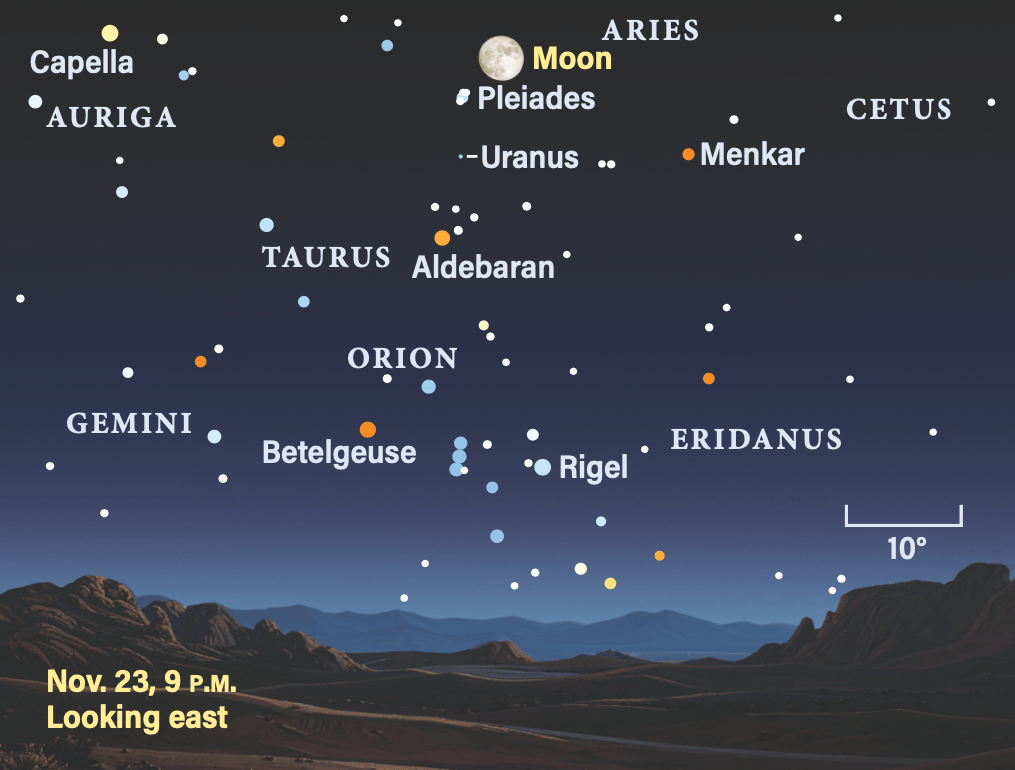 Uranus is in Taurus, easy to find between Aldebaran and the Pleiades. This chart depicts the sky shortly before the Moon occults the cluster on Nov. 24. / Astronomy: Roen Kelly
Tuesday, November 24
Full Moon occurs at 9:54 A.M. EST, bringing us our second Super Moon of the year. A Super Moon occurs when the Moon reaches Full phase close to perigee, its closest point to Earth, making our satellite appear larger and brighter than average. The November Full Moon is also called the Beaver Moon.
A few hours earlier, before dawn, the Full Moon passes through the Pleiades star cluster (M45) in Taurus, occulting several of its bright stars. This is an easy event to watch, visible to the naked eye — or you can get a closer view with binoculars or a telescope (just note that you may want a Moon filter if available, as our satellite is so big and bright). The timing of the event will depend heavily on your location; note that it begins right around sunrise along the East Coast, so observers there may only see the Moon approaching the famous group of stars.
The 5th-magnitude star Celaeno (16 Tauri) disappears behind the Moon’s leading edge just moments before 6 A.M. CST, followed minutes later by 4th-magnitude Taygeta (19 Tau). Next to vanish is 4th-magnitude Maia (20 Tau) just before 6:20 A.M. CST, followed quickly by Sterope (21 Tau) a few minutes later. The latter two may be difficult to catch from the Midwest without optical aid, as sunrise is fast approaching. If you are using binoculars or a telescope in this region, make sure to put them away several minutes ahead of sunrise from your location. Celaeno reappears around 6:40 A.M. CST, 15 minutes or so before sunrise.
For specific timings from your location, visit the International Occultation Timing Association at http://www.lunar-occultations.com/bobgraze/index.html.
The Moon then passes 5° north of Uranus (also in Taurus) at 2 P.M. EST. Over in the constellation Leo, Mars passes 1.8° north of Regulus at 5 P.M. EST.
Sunrise: 6:55 A.M.
Sunset: 4:38 P.M.
Moonrise: 4:24 P.M.
Moonset: 7:10 A.M.
Moon Phase: Waning gibbous (99%)
Wednesday, November 25
The Moon reaches perigee, the closest point to Earth in its orbit, at 4:01 P.M. EST. At that time, our satellite will stand 223,288 miles (359,347 km) away.
The distant ice giant Uranus reaches opposition tonight at 6 P.M. EST. Opposition is the best time to view a planet in our sky, and it’s visible roughly from dusk until dawn. Because Uranus is faint — magnitude 5.6 — you’ll want to give it a few hours after sunset to climb away from both light pollution and turbulent air near the horizon. Around 10 P.M. local time, you’ll find Uranus midway between the bright star Aldebaran and the Pleiades star cluster in Taurus the Bull, about 60° above the southeastern horizon. It sits some 1.5° south of 4th-magnitude 37 Tauri.
Although Uranus can be visible to the naked eye under clear, dark conditions, the bright waning Moon is nearby, so pull out binoculars or a telescope to view the far-off planet tonight. Once you land on its location, look for a “flat,” grayish-colored star. Uranus’ disk spans 4”, so you will likely be able to tell it is circular, rather than a pinpoint of light like any background stars.
Sunrise: 6:56 A.M.
Sunset: 4:37 P.M.
Moonrise: 5:24 P.M.
Moonset: 8:26 A.M.
Moon Phase: Waning gibbous (96%)
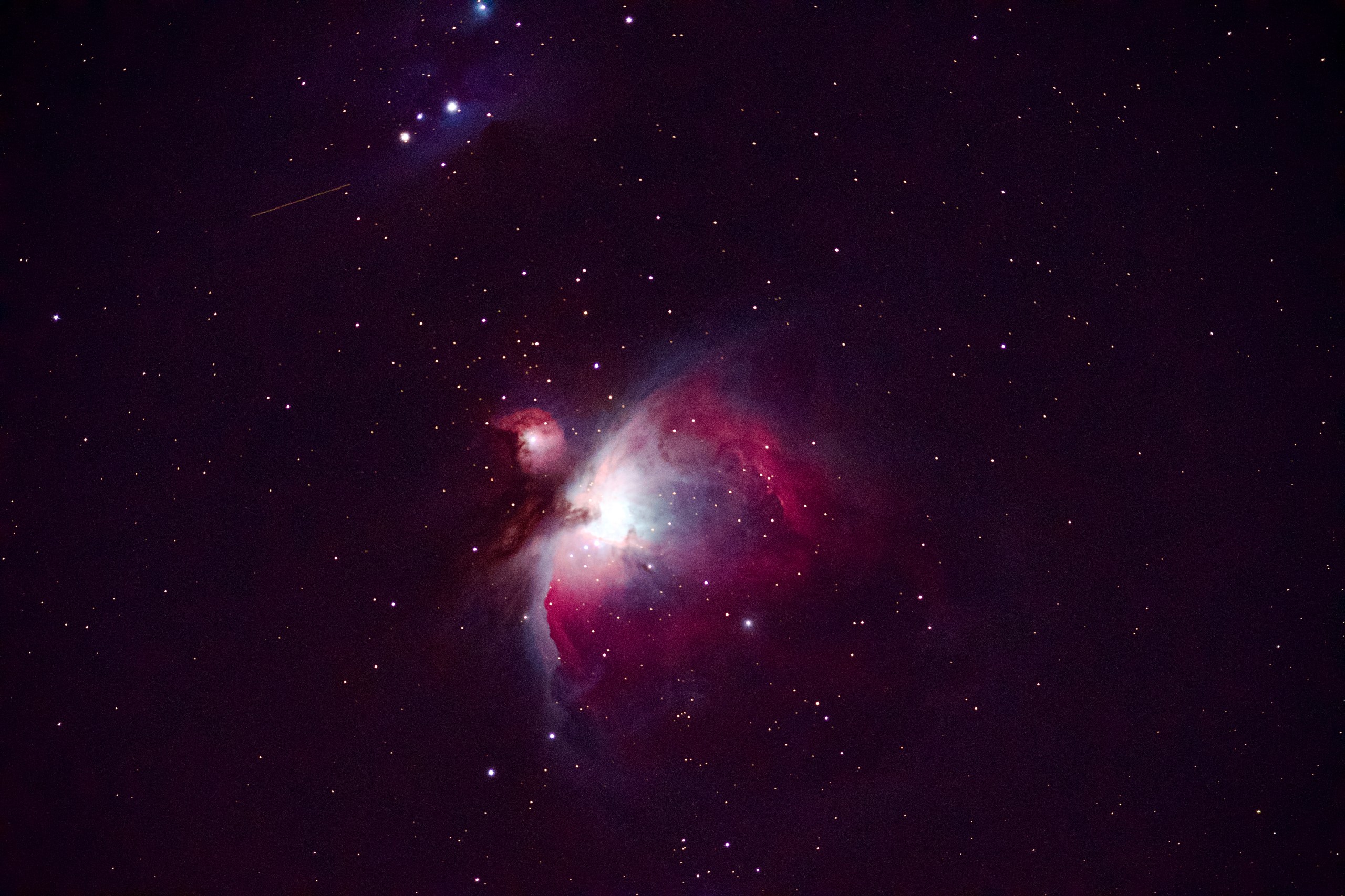 The Orion Nebula is sometimes playfully called the Turkey Nebula because it looks a bit like a turkey in profile. The bird’s head appears at left, facing left, with its body at right. / Kevin Milazzo (Flickr, CC BY-NC-SA 2.0)
Thursday, November 26
Celebrate Thanksgiving with a celestial turkey: The famous Orion Nebula (M42) is also playfully known as the Turkey Nebula because it looks to some like a turkey, particularly in deep astrophotos. But whether you’re a photographer or not, this bright deep-sky treat is easy to enjoy tonight while dinner digests.
By about 9 P.M. local time, Orion the Hunter has risen above the eastern horizon, his recognizable three-star belt standing in a vertical line. The lowest star in that line is Alnitak (Zeta [ζ] Orionis), and the Orion Nebula lies just 3.7° south-southwest of this star, to its lower right on the sky this evening. You might be able to spot its glow without optical aid, although the bright Moon nearby may make that difficult. Binoculars or any telescope will easily show it.
At 4th magnitude and spanning some 85’ by 60’, the Orion Nebula is a huge and bright star-forming region that sits roughly 1,350 light-years from Earth. In the brightest portion of the nebula lies a small grouping of young stars called the Trapezium Cluster. Take your time with this gorgeous sight, scanning around the region to pick out detail in the nebulosity. And if you are an astrophotographer, consider turning the view into a Thanksgiving memory to share for years to come.
Sunrise: 6:58 A.M.
Sunset: 4:37 P.M.
Moonrise: 6:35 P.M.
Moonset: 9:33 A.M.
Moon Phase: Waning gibbous (91%)
Friday, November 27
The Moon-free window for observing Comet 161P/Hartley-IRAS reopens tonight, the same day the comet reaches perihelion, the closest point to the Sun in its 21½-year orbit. It has been a fairly stable 10th to 11th magnitude, and although it has no appreciable tail, the nucleus’ green glow has been notable in recent astrophotos.
You’ll find Hartley-IRAS in the west a few hours after sunset. Around 7 P.M. local time it is still 30° high, well above the turbulent air near the ground that can muddy astronomical views. Tonight the comet is in western Sagitta, about 6.3° north-northeast of 3rd-magnitude Zeta (ζ) Aquilae. Even a small (4-inch) scope will net you a view, but larger apertures will show more detail around the nucleus, allowing you to look for features such as a sharpened southern flank as it flies into the solar headwind.
While you’re in this region, make sure to sweep just 2.1° northeast of the comet’s location to spot the famous Coathanger asterism in Vulpecula. This 1°-long grouping of stars looks just like its namesake, with the hook on the southern side of the hanger’s arms.
Sunrise: 6:59 A.M.
Sunset: 4:36 P.M.
Moonrise: 7:53 P.M.
Moonset: 10:26 A.M.
Moon Phase: Waning gibbous (82%)

The sky, November 22-27: Full Moon passes through the Pleiades on Nov. 24 added by Cosmic1 on
View all posts by Cosmic1 →
You must be logged in to post a comment Login