

Special to CosmicTribune.com, March 8, 2026
Excerpts from weekly Astronomy.com report.
Saturday, March 7
Mercury reaches inferior conjunction with the Sun at 6 A.M. EST, rendering the small planet invisible for now. It will reappear in the morning sky later this month.
Today, however, our focus is on the evening sky as Venus and Saturn sit close together in the west. About 30 minutes after sunset, brilliant Venus should be visible some 7° above the horizon. Tonight, 1st-magnitude Saturn lies to its upper left — use binoculars or any telescope to look roughly 1° southeast of Venus to find the ringed planet.
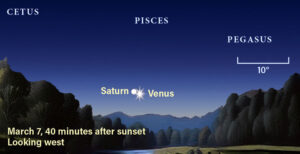 With the two worlds so close, it’s easy to compare them. Venus’ disk spans 10” and has just a sliver in shadow, showing off a 97-percent-lit gibbous. Saturn, though much farther from Earth, is physically much larger than Venus and spans 16”, with rings that stretch some 36” from end to end. It appears fully illuminated, with the southern face of the rings now visible to us.
The pair will set some 70 minutes after the Sun. You can come back and observe them again tomorrow, when the two worlds are still the same distance apart, but now with Saturn south of Venus in the sky, appearing to Venus’ lower left.
Sunrise: 6:24 A.M.
Sunset: 5:59 P.M.
Moonrise: 10:43 P.M.
Moonset: 8:02 A.M.
Moon Phase: Waning gibbous (79%)
Sunday, March 8
Daylight saving time begins this morning at 2 A.M. local time. For regions that observe DST, clocks will “spring forward” from 2 A.M. standard time to 3 A.M. daylight time, meaning the Sun will rise and set an hour later than yesterday.
A few hours after dark — say, 9 or 10 P.M. local daylight time — cast your view north, where the large constellation Lynx sits above the North Star. One of many oft-overlooked deep-sky objects, NGC 2541, lies within the Lynx’s borders, and we’re going to take advantage of the moonless sky tonight to try for it.
Glowing at 12th magnitude from a distance of some 37 million light-years, this galaxy is a challenge because its surface brightness is low. Spanning nearly 7’, its loose, “fluffy” spiral arms surround a bright central core. Astronomers consider this an intermediate spiral galaxy because its core has no bar (an elongated structure, like the core of the Milky Way). Because it’s faint and doesn’t stand out well from the background, opt for as large a telescope as you have available. Long-exposure photography will pick it up and start to show detail as well.
You can find the galaxy by first locating 3rd-magnitude Iota (ι) Ursae Majoris, which marks part of the Great Bear’s front foot. From this star, simply slide about 7.5° east to land on NGC 2541.
Sunrise: 7:22 A.M.
Sunset: 7:00 P.M.
Moonrise: —
Moonset: 9:30 A.M.
Moon Phase: Waning gibbous (71%)
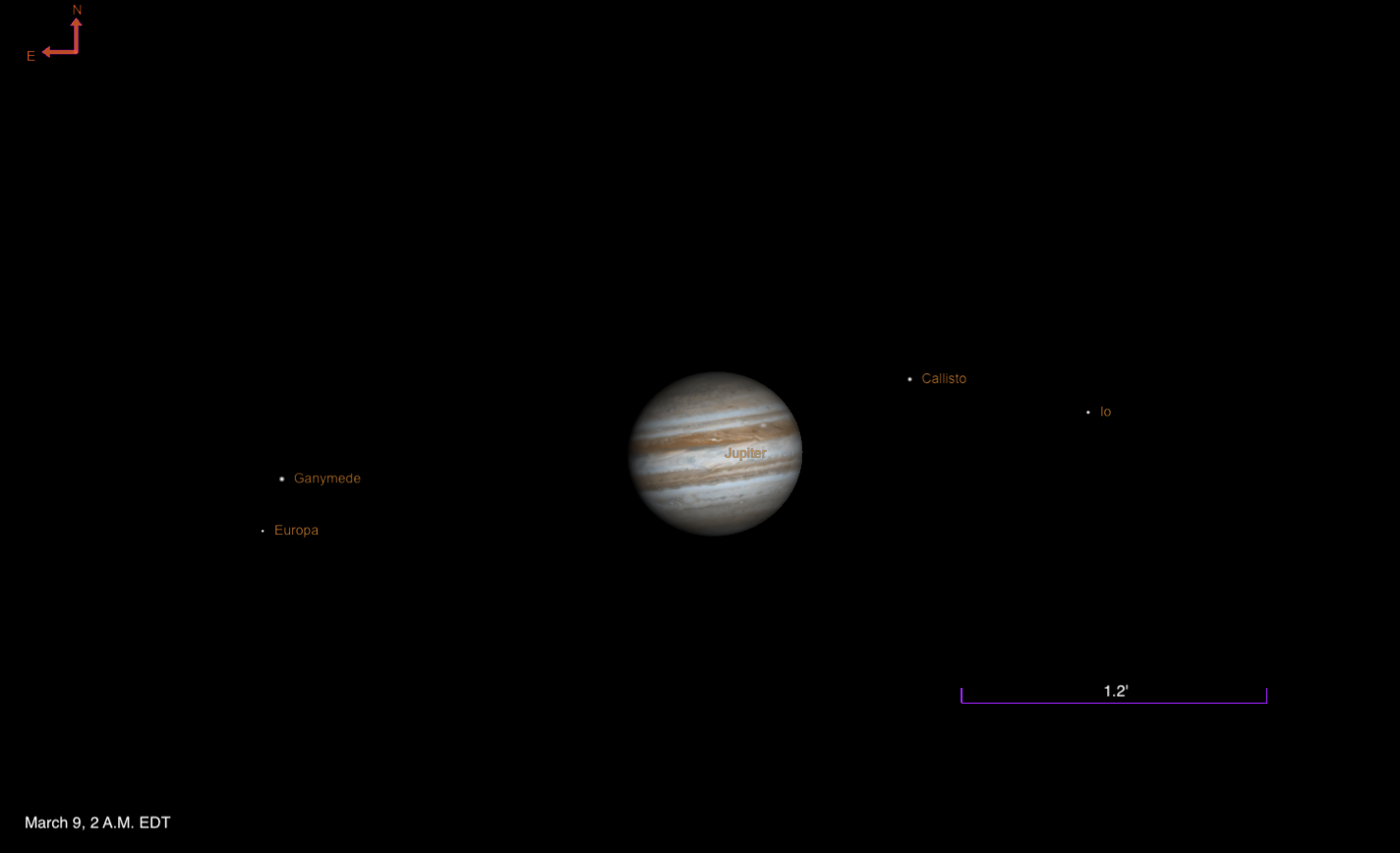 Around 2 A.M. EDT on the 9th, Jupiter’s four Galilean moons are visible, two on each side of the planet. Shortly after this, Ganymede will pass north of Europa; a few hours later, Callisto will disappear in an occultation behind the planet. Credit: Alison Klesman (via TheSkyX)
Monday, March 9
The Galilean moon Callisto disappears behind Jupiter in an occultation early this morning. The catch is that the event is only visible from the western half of the U.S., but observers farther east can still watch as the moon closes in on the planet’s limb.
Shortly after local midnight on the night of the 8th, Jupiter is some 50° high and slowly setting in the west, among the stars of Gemini. It hangs below the two bright stars marking the Twins’ heads, Castor and Pollux. Through a telescope, its Galilean moons are arrayed with two on each side of the planet: Europa and Ganymede lie to the east, while Callisto and Io sit to the west.
As the morning progresses, the moons noticeably shift positions. For two hours after midnight, Ganymede is closer to Jupiter to the east, with Europa farther away. The two moons are moving in opposite directions, however, and Ganymede passes north of Europa shortly after 2 A.M. EDT. On the other side of the gas giant, Callisto — which is moving eastward and passed north of westward-moving Io around midnight EDT on the 8th — is now moving closer to Jupiter’s western limb by the hour. The planet sets before the moon can reach it from the eastern half of the U.S., but observers in the Mountain and Pacific time zones will see Callisto disappear behind the limb around 3:30 A.M. MDT. The planet sets even for those on the West Coast before the moon completes its journey and reappears.
Sunrise: 7:21 A.M.
Sunset: 7:01 P.M.
Moonrise: 12:26 A.M.
Moonset: 10:02 A.M.
Moon Phase: Waning gibbous (62%)
Tuesday, March 10
The Moon passes 0.7° south of the star Antares in the constellation Scorpius at 8 A.M. EDT.
Earlier in the morning, around 6 A.M. local daylight time, the pair hangs some 20° high in the south, with all of Scorpius’ long, curving tail visible above the horizon from midlatitudes. The waning gibbous Moon is still bright, but the light of 1st-magnitude Antares just above and to Luna’s left should still be visible. Through a telescope especially, that light will appear orange or red to the eye — this star is a cool, aging red giant whose temperature is lower than that of our Sun.
The Moon reaches apogee, the farthest point from our planet in its orbit, at 9:43 A.M. EDT, when it will stand 251,273 miles (404,385 kilometers) from Earth.
Late this evening, Jupiter reaches a stationary point at 11 P.M. EDT, when it stands still against the background stars of Gemini. Jupiter has been moving retrograde, or westward, through our sky. After today, the planet will begin tracking eastward, or prograde.
Sunrise: 7:20 A.M.
Sunset: 7:02 P.M.
Moonrise: 1:48 A.M.
Moonset: 10:41 A.M.
Moon Phase: Waning gibbous (53%)
Wednesday, March 11
Last Quarter Moon occurs at 5:39 A.M. EDT this morning, a few hours before the Moon sets shortly before local noon.
Once again, our evening sky is clear of moonlight, setting the stage to view the zodiacal light after sunset. This soft glow, generated by the dust left behind as comets round the Sun, is visible in the evening at this time of year, rising up from the western horizon. Roughly cone-shaped, it is wider at the base and narrower the higher into the sky it reaches, stretching up through Pisces, Aries, and into Taurus. Wait about 60 to 90 minutes after sunset, when the light of true twilight has faded, to look for this ethereal glow, sometimes called the false dusk.
This month is a particularly great time to try to view this phenomenon, as it’s best seen around the equinoxes, when the ecliptic — the plane of the solar system, along which the dust responsible for the zodiacal light has settled — is nearly vertical with respect to the horizon.
Sunrise: 7:18 A.M.
Sunset: 7:03 P.M.
Moonrise: 2:46 A.M.
Moonset: 11:28 A.M.
Moon Phase: Waning crescent (43%)
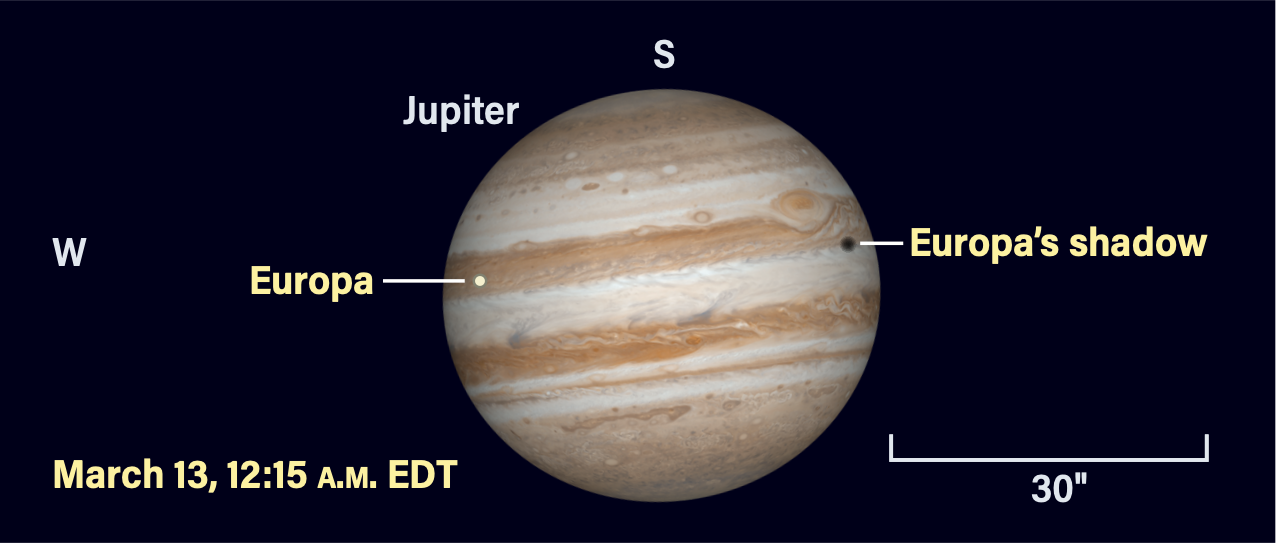 Catch Europa and its shadow on Jupiter’s disk at the same time for a brief period as the moon transits. Note that while this view occurs early on March 13 in the Eastern time zone, it is still late on March 12 farther west. Astronomy / Roen Kelly
Thursday, March 12
Europa transits Jupiter this evening, beginning shortly before 10 P.M. EDT. A few hours later, the small moon’s shadow follows it across as a dark blot on the cloud tops.
Early in the evening, Jupiter — in Gemini — is high in the south, outshining the Twins’ brightest two stars, Castor and Pollux. Observers in the Eastern and Central time zones can center their scope on the bright planet to see Europa approaching the eastern limb. Callisto lies alone far to the east, while Io (closest) and Ganymede sit to Jupiter’s west.
Europa finally crosses in front of the disk around 9:40 P.M. EDT, moving from east to west. Observers in the Mountain time zone will see the event already underway as darkness falls. About an hour and a half later, the icy moon is halfway across the disk. Around midnight EDT, with Europa quickly approaching the western limb, its shadow finally appears at the eastern limb.
Europa leaves the western limb around 12:30 A.M. EDT (now the 13th in the Eastern time zone only), leaving its shadow to transit the disk alone. An hour later, the shadow is halfway across the disk, and it finally reaches the limb shortly before 3 A.M. EDT.
Sunrise: 7:16 A.M.
Sunset: 7:04 P.M.
Moonrise: 3:39 A.M.
Moonset: 12:22 P.M.
Moon Phase: Waning crescent (34%)
Friday, March 13
For the last night of the week, we’re back in the north with our eyes this time on Ursa Major the Great Bear, whose back half is best known as the Big Dipper. The two stars on the far end of the cup from the handle are called the Pointer Stars: These are Merak (Beta [β] UMa) and Dubhe (Alpha [α] UMa). Merak is the southernmost of the two, farther from Polaris, the star these two pointers lead to. Once you’re centered on Merak, it’s a short jaunt 2.3° southeast to land on M97, a planetary nebula also known as the Owl Nebula.
Glowing at 10th magnitude, the Owl is relatively large (3’) so its overall surface brightness is low. Nonetheless, it is visible in small telescopes, though more detail emerges in medium scopes (6 inches) or larger. An Oxygen-III filter will further enhance the view if you have one. With a mid to large size scope, you have a better chance of spotting the Owl’s “eyes” — two dark areas within the larger overall disk.
Messier’s catalog contains only four planetary nebulae. These are the death throes of Sun-like stars, which puff up and then blow off their outer layers. This gas is then lit up by the white dwarf core within. The Owl’s central white dwarf glows at 16th magnitude, visible in larger scopes under good conditions.
Sunrise: 7:15 A.M.
Sunset: 7:05 P.M.
Moonrise: 4:23 A.M.
Moonset: 1:23 P.M.
Moon Phase: Waning crescent (25%)

The sky, March 7-13: Venus and Saturn at sunset added by Cosmic1 on
View all posts by Cosmic1 →
You must be logged in to post a comment Login