

Special to CosmicTribune.com, April 24, 2026
By Richard Fisher
On April 22 Pakistan’s Space and Upper Atmosphere Research Commission (SUPARCO) revealed the names of two Pakistani pilots chosen to go to China for advanced astronaut training following on a Feb. 28, 2025 agreement between SUPARCO and the China Manned Space Engineering Office (CMSEO), to train and host a Pakistani astronaut aboard China’s Tiangong space station.
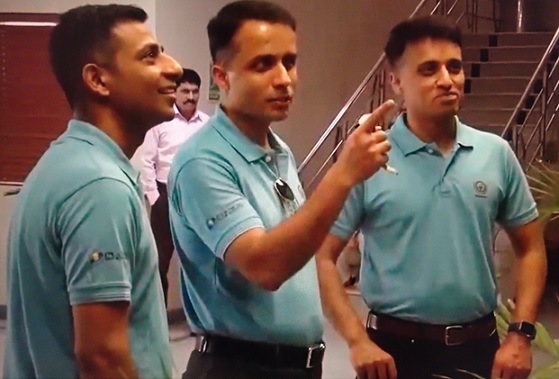
Also announcing the Pakistani astronaut selection, an April 22 statement from China Manned Space Engineering Office website stated:
“The peaceful use of outer space for the benefit of all mankind has always been China’s original aspiration and mission in vigorously developing its space program. China’s manned space program will always keep its doors open, welcoming active participation from all countries in scientific experiments, technological tests, and astronaut selection and training on the Chinese space station, jointly expanding humanity’s understanding of the universe, and contributing wisdom and strength to building a community with a shared future for mankind.”
Fine sentiments, but Pakistan’s and more importantly, China’s main motivation for enabling a Pakistani manned space program is to ensure that Pakistan’s military dictatorship is able to match India’s technological-military potential, which serves to help sustain the debilitating and costly political-military contest between Pakistan and India.
Continued Pakistani-Indian enmity, with their latest near-nuclear military clash in May 2025 involving over 100 aircraft — highlighting modern Chinese air combat technology — is a key goal for China in order to sustain Pakistan’s reliance on Chinese weapons technology so both can contain India.
In June 2025, Indian astronaut Group Captain Shubhanshu Shukla became the first Indian to fly aboard the International Space Station (ISS) as part of the two-week AX-4 mission of the commercial Axiom Space company, for which India paid about $60 million.
Also, since June 2023, India has been a signatory to the Artemis Accords, a set of principles for peaceful conduct on the Moon that creates the basis for cooperation between the United States and now 61 Artemis coalition member nations.
There is ample expectation that the U.S. Artemis Program, with its intention to build multiple Moon bases in the 2030s, will benefit India’s intentions to send its own astronauts to the Moon by 2040, after starting manned missions of its indigenous Gagayaan spacecraft in 2027.
Full Text . . . . Current Edition . . . . Subscription Information

India on their mind: China and Pakistan advance manned space cooperation added by Cosmic1 on
View all posts by Cosmic1 →
You must be logged in to post a comment Login