

Special to CosmicTribune.com, July 23, 2026
By Richard Fisher
For both the United States and China, satellite megaconstellation companies require space launch vehicles (SLVs), or rockets, while SLV makers require customers — governments or companies that require their payload to be launched into space.
In the United States there are well-known SLV-satellite “ecosystems” in which one helps to sustain the other.
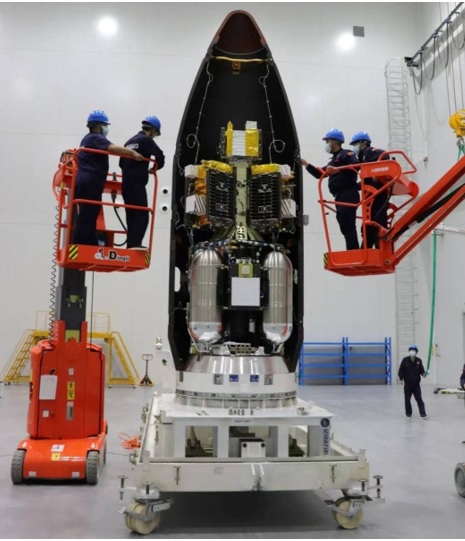
These include the SpaceX corporation’s famous Falcon-9 (22 tons to Low Earth Orbit, LEO) and Starship (100 tons to LEO) reusable SLVs that could launch most of the estimated future 42,000 SpaceX Starlink broadband satellite series, while Blue Origin’s New Glenn (45 ton to LEO) reusable SLVs could launch the bulk of Blue Origin’s planned 5,408 TeraWave communications satellites.
While both SpaceX and Blue Origin derive profits from other customers, like NASA and the U.S. Department of War, the potential profits from their satellite mega constellations are an essential investment stream required to support the development of larger and more capable SLVs.
China has had one well-established SLV-satellite megaconstellation ecosystem but is also building others — an important development that can also yield profits to supplement government subsidies that are the main source of support for China’s estimated 23 or so reusable SLV companies.
The largest Chinese SLV-satellite “ecosystem” is that of the state-owned China Aerospace Science and Technology Corporation (CASC), China’s original aerospace concern and its largest space conglomerate, responsible for much more than SLVs and satellites, to include unmanned and manned lunar systems and supporting China’s national space infrastructure of launching, tracking and training systems.
But in terms of satellite megaconstellations, CASC SLVs are currently supporting the potential 13,000 Guowang broadband satellites of the China Satellite Network Group, using satellites made by the CASC’s China Academy of Space Technology (CAST).
CASC SLVs are also supporting the eventual 15,000 satellite Qianfan/SpaceSail broadband satellite megaconstellation, funded in part by the Shanghai City government and a product of the Shanghai Spacecom Satellite Technology (SSST) corporation — and seen as a direct rival to the Starlink megaconstellation.
Full Text . . . . Current Edition . . . . Subscription Information

PLA boosted by China’s expanding SLV-satellite ‘ecosystems’ added by Cosmic1 on
View all posts by Cosmic1 →
You must be logged in to post a comment Login