

Special to CosmicTribune.com, August 6, 2026
By Richard Fisher
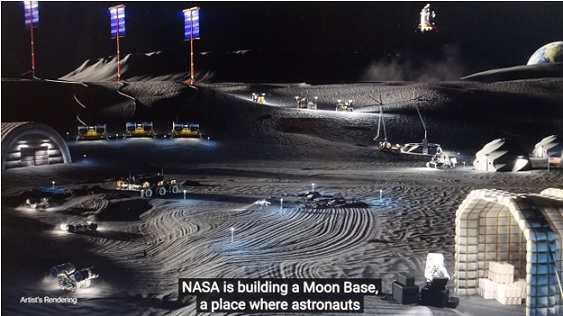
Before their astronauts set foot on the Moon, the United States (by 2028?) and China (by 2029-2030) are engaging in an “unmanned Moon race” to undertake surveys and to then deploy systems to prepare for building eventual manned Moon Bases.
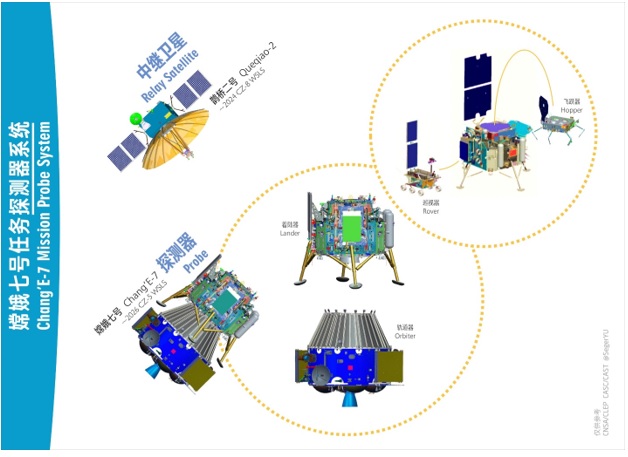
Targeting the lunar South Pole where both the U.S. and China intend to build lunar bases, on or about Aug. 24, 2026, from its Wencheng Satellite Launch Center on Hainan Island, China will launch a Long March-5 space launch vehicle (SLV) to transport its Change’-7 unmanned lunar probe to the Shackelton Crater on the South Pole.
Already in 2024, China sent its Change’-6 lunar probe to the Aitken Basin on the lunar far side South Polar area, that returned the first lunar samples from the lunar far side that usually is not warmed by the Sun.
Change’-7’s apparent top priority is to sharpen the search for lunar water-ice, regarded as a crucial element to provide oxygen and the ability to fabricate rocket fuels that can support future lunar bases; It will deploy a small lunar rover and a new novel lunar “hopper” drone to go to the shaded part of a lunar crater to try to find water-ice.
Then in about 2029 China will launch its Change’-8 unmanned lunar probe to the Leibnitz-Beta Plateau near the South Pole, to begin testing In-Situ Resource Utilization (ISRU) to use lunar regolith for 3D-printing of blocks for shelter building.
While China so far plans eight unmanned Change’ lunar probe missions, it is also waiting for its International Lunar Research Station (ILRS) partner Russia to send five unmanned probes to the Moon, that have been delayed from 12 to 4 years each, and due to Russia’s Ukraine War, will likely face further delays.
Nevertheless, as China starts to send its people to the Moon, it will also start sending additional support systems like lunar nuclear power plants, construction drones and mining systems.
With a late start, the U.S. National Aeronautics and Space Administration (NASA) plans to exceed the unmanned lunar probe rate of China, noting in an Aug. 4 video update that it intends to launch about 20 unmanned probes to the Moon by 2029, the end of the first stage of NASA’s Moon Base building plan.
An update article on the NASA web page states:
“To advance lunar surface infrastructure development, commercial partners such as Blue Origin, Firefly Aerospace, Intuitive Machines, and Voyager Lunar Systems are working toward delivering landers by 2028. These landers will deliver the foundational architecture for a sustained presence on the Moon…. Before astronauts arrive, robotic missions will deploy critical scientific instruments that characterize the lunar environment, test new technologies, and begin assembling the infrastructure needed for human habitation.”
So far, China’s unmanned lunar probes are all manufactured and launched by the state-owed China Aerospace Science and Technology Corporation (CASC), while NASA is utilizing its Commercial Lunar Payload Services (CLPS) initiative to fund lunar landers made by private U.S. companies that include:
Full Text . . . . Current Edition . . . . Subscription Information

‘Unmanned Moon race’: U.S. plans 20 probes, lunar bases at South Pole added by Cosmic1 on
View all posts by Cosmic1 →
You must be logged in to post a comment Login