

Special to CosmicTribune.com, October 5, 2026
Excerpts from weekly Sky & Telescope.com report.
SUNDAY, OCTOBER 4
■ Vega is the brightest star very high in the west at nightfall. Arcturus, equally bright, is getting low in the west-northwest. The brightest star in the vast expanse between them, about a third of the way from Arcturus up toward Vega, is Alphecca, magnitude 2.2 — the crown jewel of Corona Borealis. Alphecca is a 17-day eclipsing binary, but its brightness dips are too slight for the eye to see reliably.
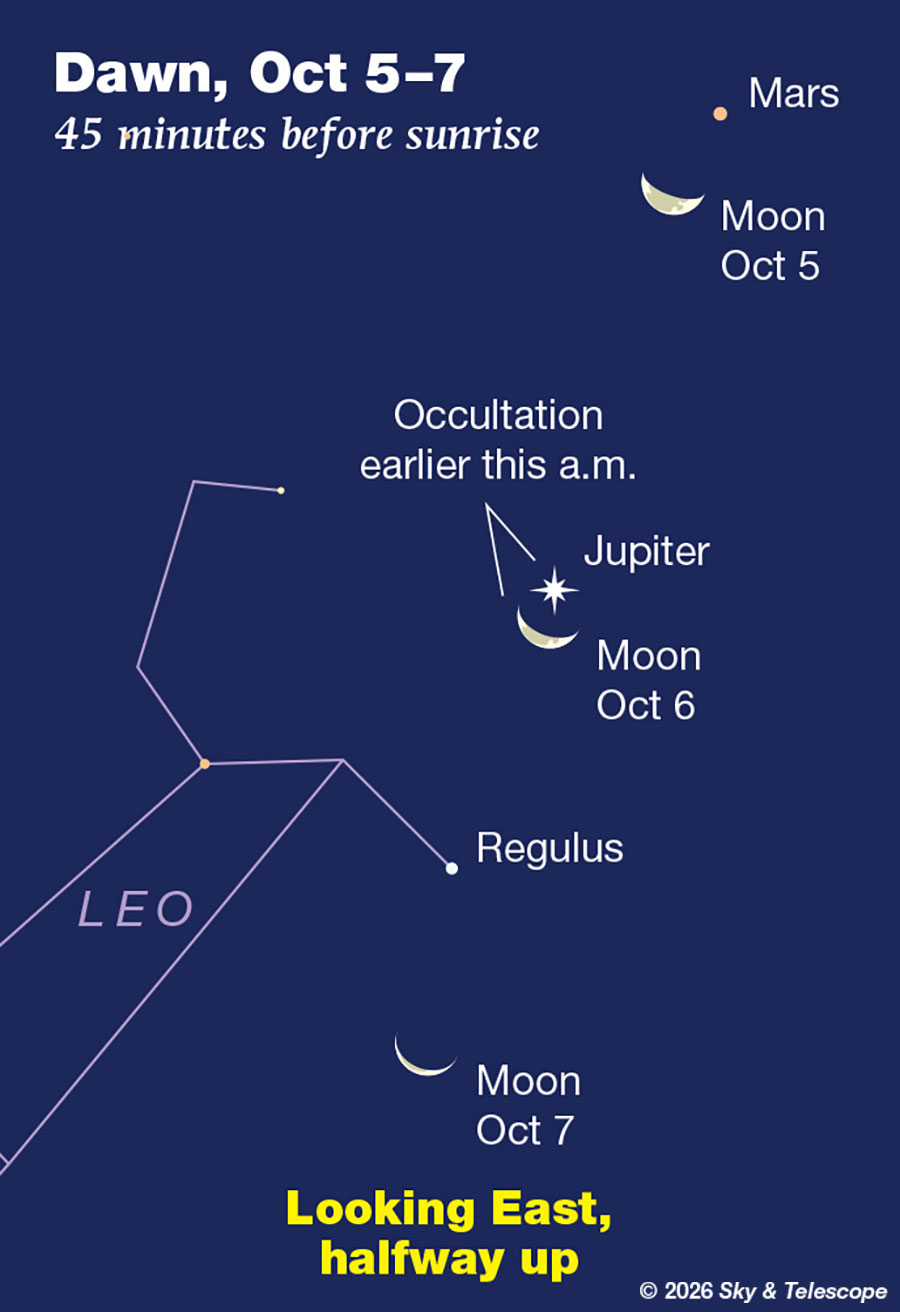
■ Before dawn begins on Monday the 5th, the Moon hangs between Mars above it and Jupiter farther below it. Binoculars can reveal the Beehive Cluster, M44, quite near the Moon (for the Americas).
MONDAY, OCTOBER 5
■ The Moon occults Jupiter very late tonight for observers in eastern and central North America and parts of the mountain region, and for much of Africa. The occultation will start as the Moon’s bright limb slowly covers the planet. Notice how much dimmer Jupiter’s surface brightness is compared with the Moon’s. That’s due to Jupiter’s five-times-greater distance from the illuminating Sun. Jupiter will reappear out from behind the Moon’s dark limb up to an hour or more later.
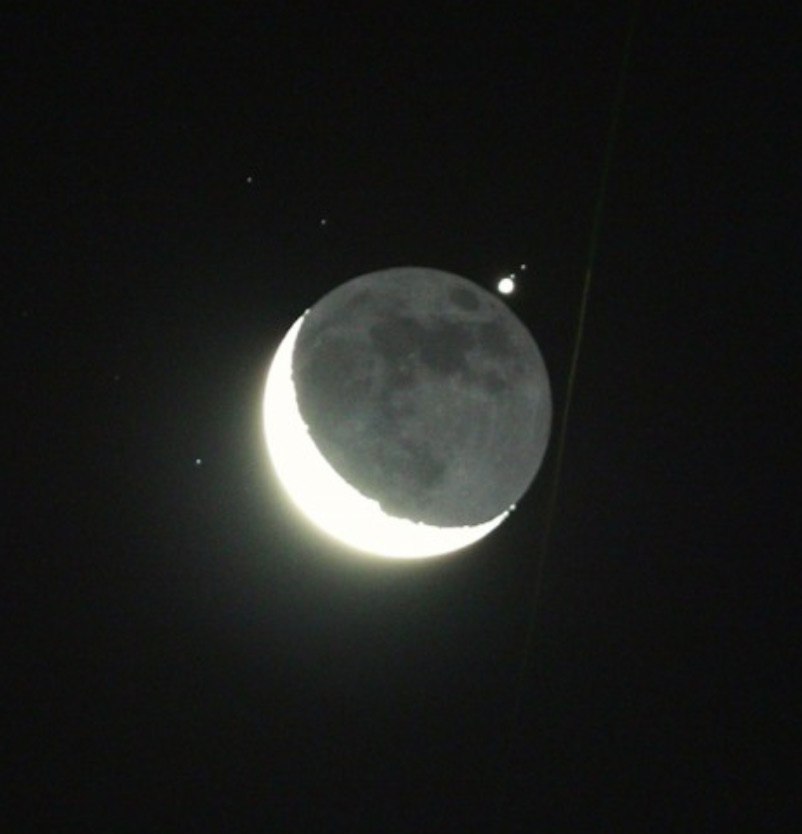 Jupiter and two of its satellites just after emerging from behind the waning Moon’s dark limb on April 2, 2014.
World map and timetables for the occultation. The first two tables, with predictions for many cities, are long. The first table gives the times of the start of Jupiter’s disappearance behind the Moon’s bright limb; the second gives its reappearance out from behind the dark limb. Scroll to be sure you’re using the correct table; watch for the new heading as you scroll down. The first two letters in each entry are the country abbreviation (CA is Canada, not California). The times are in UT (GMT) October 6th. UT is 4 hours ahead of Eastern Daylight Time, 5 hours ahead of CDT, 6 ahead of MDT, and 7 ahead of PDT.
For instance: Use the first table to see that for New York City, Jupiter begins to slip behind the Moon’s bright edge at 4:23 a.m. EDT October 6th, when the Moon will be 20° high almost due east (azimuth 87°). Jupiter starts re-emerging from behind the dark limb at 5:27 a.m. EDT, when the Moon will be 27° up.
TUESDAY, OCTOBER 6
■ Vega is the brightest star very high when you face west. While still facing west, look to the right of Vega by 14° (a little more than a fist at arm’s length) for Eltanin, the 2nd-magnitude nose of Draco the Dragon. It’s tinted orange. The rest of Draco’s fainter, lozenge-shaped head is a little farther right. Draco always eyes Vega as they wheel around the sky.
Farther on, behind Draco’s head, his long, arched back and tail loop around the Little Dipper.
The main stars of Vega’s own constellation, Lyra — faint by comparison — extend from Vega in the direction opposite from Eltanin, toward bright Altair.
■ On the morning of Wednesday the 7th, the thinning Moon shines under Regulus and Jupiter before and during dawn, as shown below.
WEDNESDAY, OCTOBER 7
■ This is the time of year when, once nightfall is complete, W-shaped Cassiopeia stands on end halfway up the northeastern sky — and when, off to its left in the north, the dim Little Dipper extends leftward from Polaris.
THURSDAY, OCTOBER 8
■ Cassiopeia lies astride the winter Milky Way. It thus offers lots of open star clusters for telescopes, including a few within range of binoculars depending on the quality of your sky. Three Cas clusters you can try for are NGC 457, the Owl or ET cluster that includes 5th-magnitude Phi Cassiopeiae; M103, dominated by a tiny line of three stars magnitudes 7.2, 8.2, and 7.5, 0.1° long; and fluffier NGC 663.
In 7 x 50 binoculars NGC 457 looks to me like a subtle little windblown candleflame of a glow, being blown northwestward from its base of Phi Cas and its 7th-mag binocular companion.
The visibility of these subtle little cluster-glows will depend, of course, on your light pollution, your instrument, and your ability to brace the binoculars still against something. When looking high up, try lying on the ground with some heavy object placed conveniently next to your head for bracing the binoculars against.
And you must know exactly where to look. The view of Cassiopeia here shows the clusters’ precise locations amid the Cassiopeia W and its star fields.
FRIDAY, OCTOBER 9
■ Soon after dark, you’ll find zero-magnitude Arcturus low in the west-northwest at the same height as zero-magnitude Capella in the northeast. When this happens, turn to the south-southeast, and there will be 1st-magnitude Fomalhaut at about the same height too — exactly so if you’re at latitude 43° north (Boston, Buffalo, Milwaukee, Boise, Eugene). Seen from south of that latitude Fomalhaut will appear higher; from north of there it will be lower.

The sky, October 4-8: The Moon occults Jupiter added by Cosmic1 on
View all posts by Cosmic1 →
You must be logged in to post a comment Login