

Special to CosmicTribune.com, August 23, 2026
Excerpts from weekly Sky & Telescope.com report.
SUNDAY, AUGUST 23
■ Late these evenings as autumn approaches, Fomalhaut, the Autumn Star, makes its inevitable appearance above the southeast horizon. Its rising time will depend on where you live. But by about 11 p.m. now, you should have no trouble identifying it low in the southeast if you have a good view in that direction. No other 1st-magnitude star is anywhere near it.
To locate Fomalhaut, or to see where it will rise, follow the diagonal line of the west (upper right) side of the Great Square of Pegasus down toward the lower right by about four fists at arm’s length.
Saturn, similarly bright but glowing more steadily, is about a fist and a half below the Great Square.
MONDAY, AUGUST 24
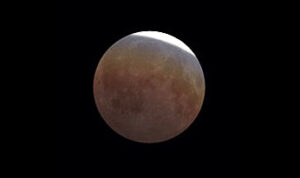
■ Another sign of the advancing season: Cassiopeia is high in the northeast, its W pattern tilting up as shown above. Below it, starry Perseus is reaching up.
The highest part of Perseus includes the wintry Double Cluster. To find it, look below the lowest two stars of the Cassiopeia W (they’re the faintest two), by somewhat more that the distance between them. You’re looking for what seems like a small spot of enhanced Milky Way glow. For practice, follow this route on the image above.
Binoculars or a finderscope will help you detect the Double Cluster even through a fair amount of light pollution. The pair are a glory in a telescope.
TUESDAY, AUGUST 25
■ How soon after sunset can you see the big Summer Triangle? Face east. Vega, the Triangle’s brightest star, is nearly at the zenith (for skywatchers at mid-northern latitudes). Deneb is the first bright star to Vega’s east-northeast. Altair shines less high in the southeast.
WEDNESDAY, AUGUST 26
■ This evening look about three fists above the Moon, and maybe a bit right, for 1st-magnitude Altair. As evening grows late, watch for rising Fomalhaut two fists in the opposite direction from the Moon.
THURSDAY, AUGUST 27
■ Full Moon tonight. An almost total eclipse of the Moon will occur for most of the Americas! Skywatchers in the eastern half of North America can watch the entire eclipse from start to finish. Westerners will see the partially eclipsed Moon rise at sunset in the evening (August 27th), with the deepest stage at mideclipse still to come.
In the Northwest, sunset and moonrise will happen somewhat after the deepest stage has already passed. See world map.
Timetable in Eastern Daylight Time (EDT), which is UT minus 4 hours. Convert to your own time zone:
Partial eclipse begins: 10:34 p.m. EDT
Mid-eclipse: 12:13 a.m. EDT, when 93% of the Moon’s diameter will be covered.
Partial eclipse ends: 1:52 a.m. EDT
Slight shading by the penumbra of Earth’s shadow will be visible on the Moon for about 40 minutes before partial eclipse begins and the same after partial eclipse ends.
FRIDAY, AUGUST 28
■ As summer progresses and Arcturus moves down the western sky, the kite figure of Boötes that sprouts up from Arcturus tilts to the right (depending on your latitude). The kite is narrow, slightly bent, and 23° long: about two fists at arm’s length. Arcturus is its bottom point where the stubby tail is tied on.
The Big Dipper poses to the right in the northwest at about the same height as Arcturus, as shown below.
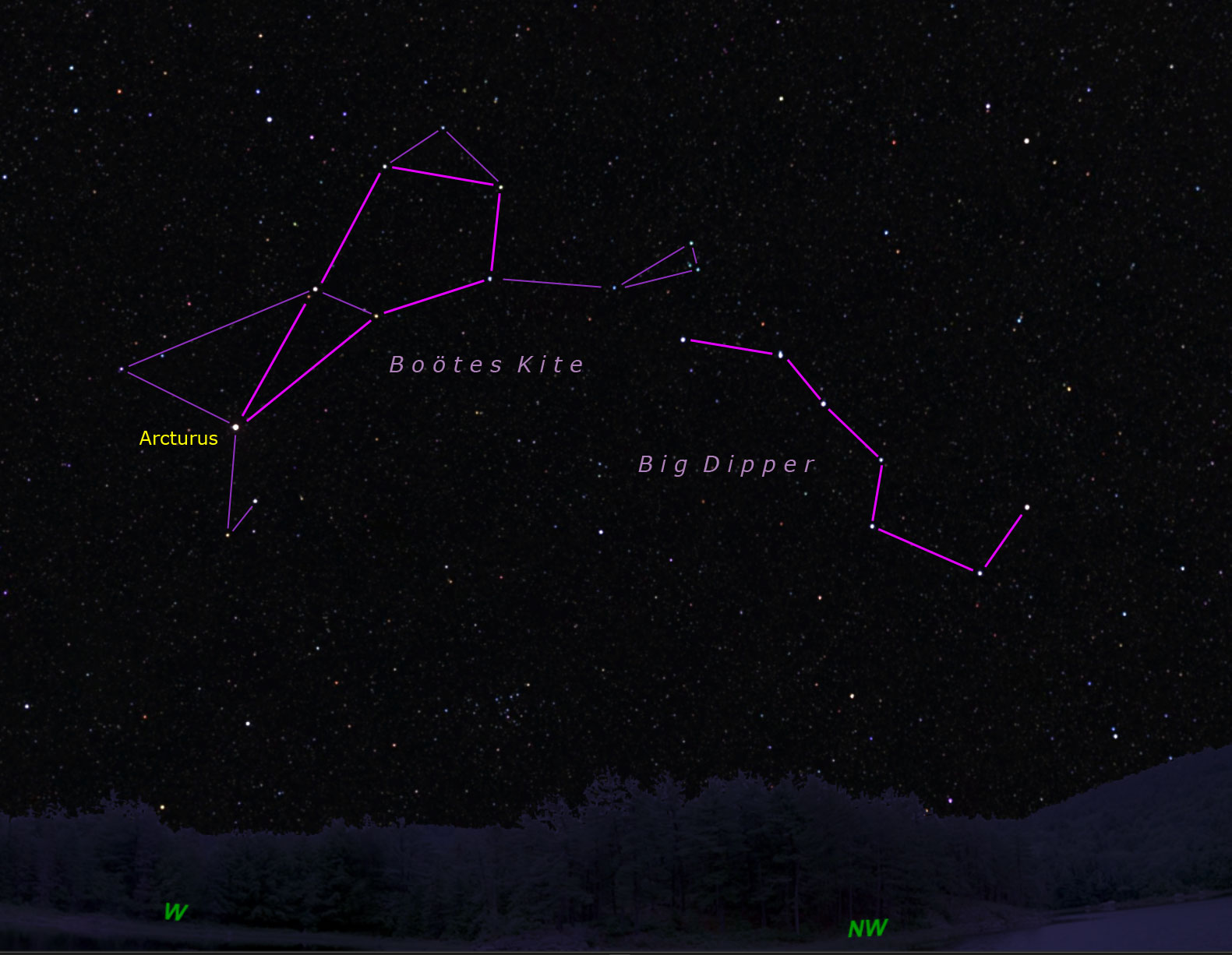 Look west-northwest on late-August evenings for the Boötes Kite asterism leaning toward the Big Dipper. The fainter purple lines outline H. A. Rey’s classic rendering of the Cowherd. He’s seen in profile, sitting and smoking a pipe. Stars by Starry Night Pro 8.
SATURDAY, AUGUST 29
■ A winter preview: Step out before the first light of dawn any time this coming week, and the sky displays the same starry panorama that it will at dinnertime around New Year’s. Orion will be striding up in the southeast, with Aldebaran and then the Pleiades high above it. Sirius sparkles far down below Orion. The Gemini twins are lying on their sides well up in the east.
Even Saturn, slow mover among planets, will be located almost the same then as in pre-dawn now: under the Great Square of Pegasus high in the south-southwest.

The sky, Aug. 23-29: Lunar eclipse, Aug. 27 around midnight added by Cosmic1 on
View all posts by Cosmic1 →
You must be logged in to post a comment Login