

Special to CosmicTribune.com, October 25, 2026
Excerpts from weekly Sky & Telescope.com report.
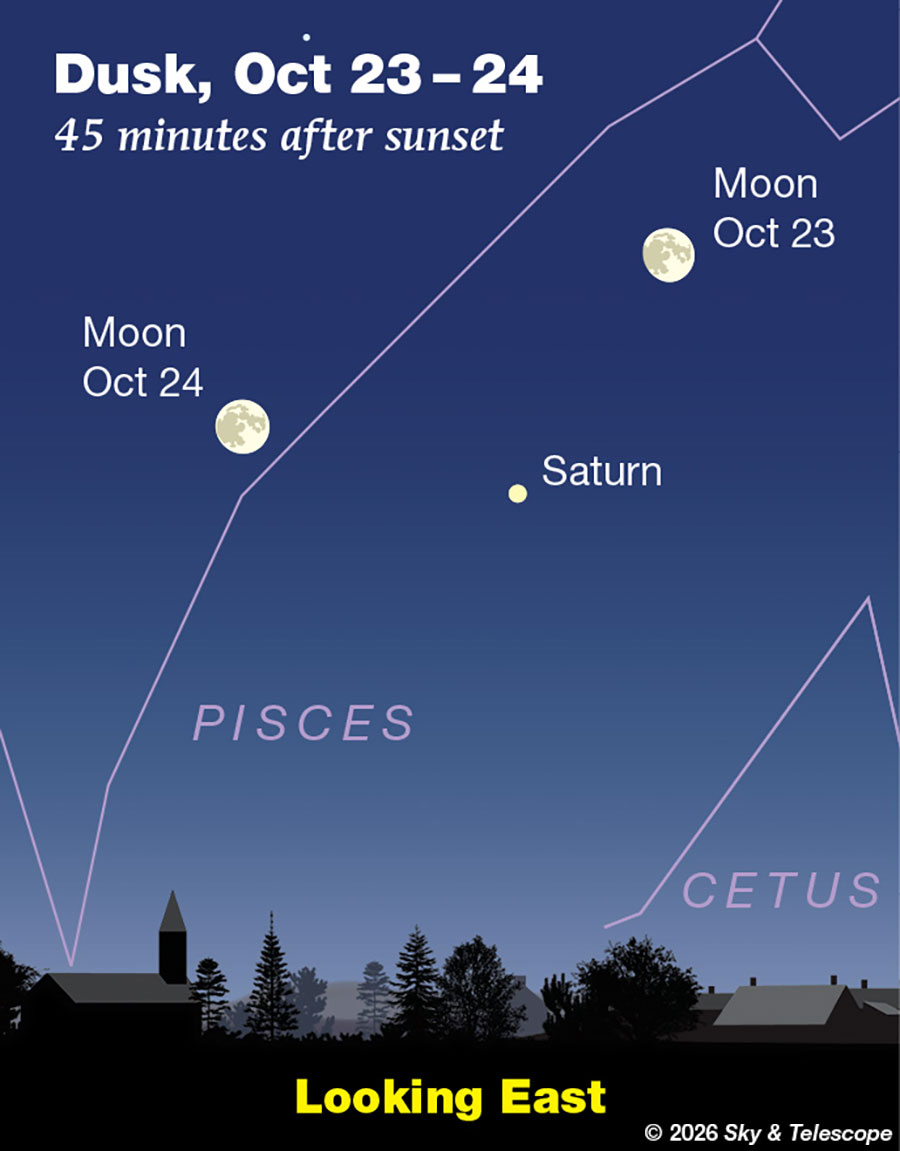
■ Saturn shines lower left of the Moon at dusk, as shown below.
 ■ This is the time of year when the Big Dipper lies down horizontal low in the north-northwest after dark. And the farther south you are the lower it is. Seen from latitude 40° north (New York, Denver) even its bottom stars twinkle nearly ten degrees high. But at Miami (26° N) the entire Dipper will skim along out of sight just below the northern horizon.
SATURDAY, OCTOBER 24
■ Catch Saturn glowing to the right of the nearly full Moon this evening, as shown above.
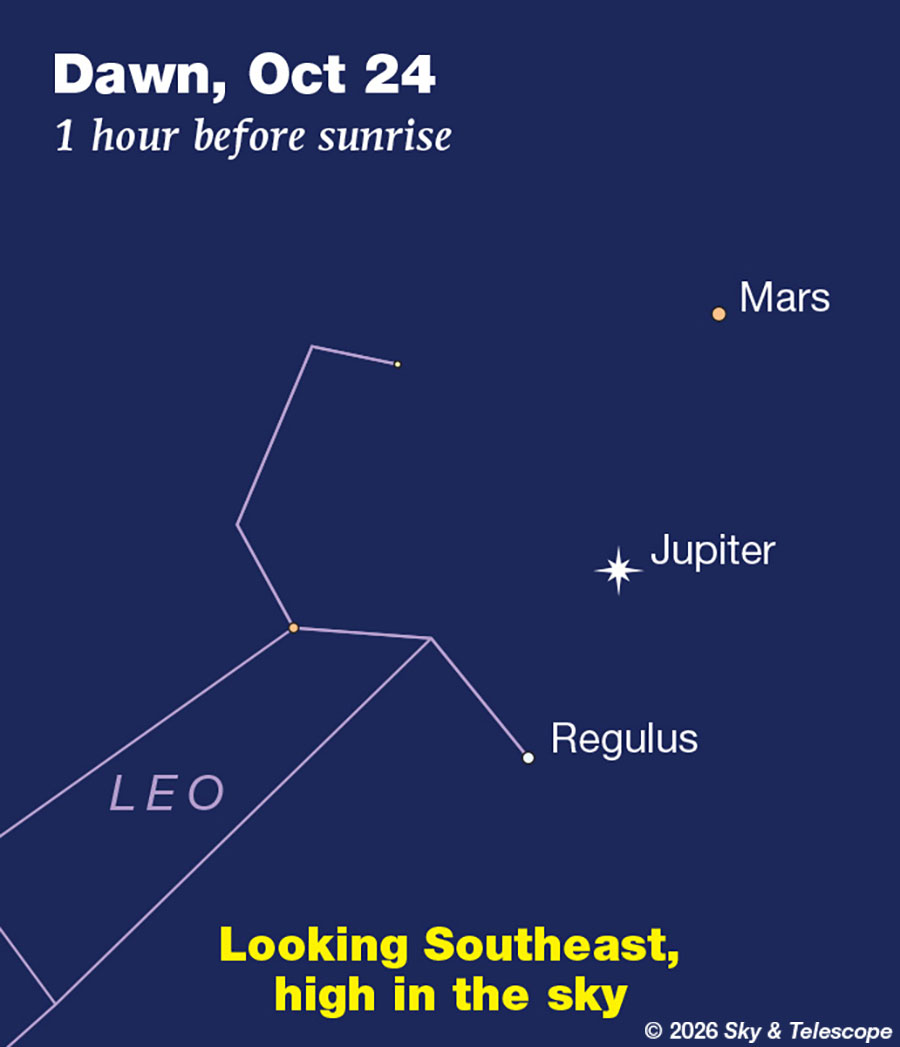
■ And before dawn, Mars, Jupiter and Regulus are still in a straight line as shown below. But the line is a little shorter than it was a week ago.
 ■ The Ghost of Summer Suns. Halloween is approaching, and this means that Arcturus, the yellow-orange star sparkling low in the west-northwest in twilight, has taken on its role as “the Ghost of Summer Suns.” For several evenings centered on October 25th every year, Arcturus occupies a special place above your local landscape. It closely marks the spot where the Sun stood at the same time by the clock during hot June and July — in broad daylight, of course!
So as Halloween approaches every year, you can see Arcturus as the wan, chilly ghost of the departed summer Sun.
SUNDAY, OCTOBER 25
■ Full Moon tonight (exactly full at 12:12 a.m. tonight EDT).
Three or four finger-widths upper left of the Moon this evening, spot the two brightest stars of Aries, 2nd and 3rd magnitude. Cover the Moon with your hand to keep its glare out of your eyes.
MONDAY, OCTOBER 26
■ This is the time of year when the Big Dipper lies down horizontal low in the north-northwest after dark. How low? The farther south you are, the lower. Seen from latitude 40° north (New York, Denver) even its bottom stars twinkle nearly ten degrees high. But at Miami (26° N) the entire Dipper will skim along out of sight just below the northern horizon.
TUESDAY, OCTOBER 27
■ The waning gibbous Moon will be very close to or even in the midst of the Pleiades this evening, depending on your time and location. Use binoculars or a telescope.
To see if any occultations will occur for your location: open an accurate planetarium program, set your location, the date, and a rough time of evening; and zoom in on the Moon until it displays with its true apparent size (meaning when it starts to expand as you zoom further in). Now run the time back and forth to see exactly when any stars will disappear on, and reappear from behind, the Moon’s dark and bright edges.
WEDNESDAY, OCTOBER 28
■ Look for bright Capella sparkling low in the northeast these evenings. Look for the Pleiades cluster about three fists at arm’s length to Capella’s right. The Moon shines roughly midway below them once it rises.
These starry harbingers of the coming cold months rise higher as evening grows late. And watch for orange Aldebaran, below the Pleiades, to come up to the right of the Moon.
Upper right of Capella, and upper left of the Pleiades, sparkle the stars of Perseus.
THURSDAY, OCTOBER 29
■ The waning gibbous Moon now rises about an hour after the end of twilight. This means we finally get about an hour-long window of dark-sky observing before moonrise.
So: Soon after dark, spot the W of Cassiopeia high in the northeast. It’s standing on end. The third segment of the W, counting down from the top, points almost straight down. Extend that segment twice as far down as its own length, and you’re at the Double Cluster in Perseus.
This pair of star-swarms is dimly apparent to the eye in a dark sky as an irregular little glow-patch in the Milky Way. Averted vision helps. With binoculars they’re visible from almost anywhere. Telescopes reveal the pair as distant, sprawling cities of stars.
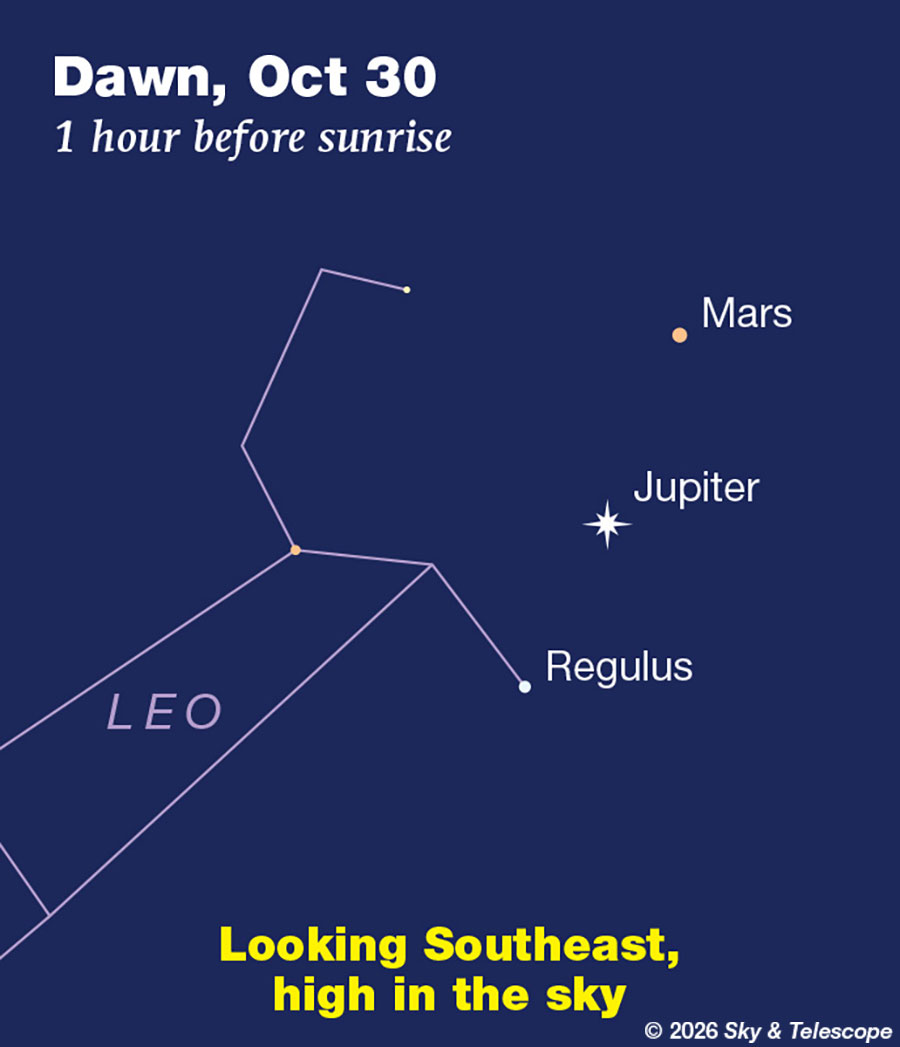 Now the Mars-Jupiter-Regulus lineup before dawn has shrunk to 12° long.
FRIDAY, OCTOBER 30
■ Spot bright Altair high in the southwest soon after dark. Brighter Vega is far to its right.
Above Altair lurk two distinctive little constellations: Delphinus the Dolphin, hardly more than a fist at arm’s length to Altair’s upper left, and smaller, fainter Sagitta the Arrow, slightly less far to Altair’s upper right.
Too much light pollution? Try binoculars! Both Delphinus and Sagitta more or less fill a typical binocular’s field of view.

The sky, Oct. 23-30: The Moon with Saturn, then the Pleiades added by Cosmic1 on
View all posts by Cosmic1 →
You must be logged in to post a comment Login