

Special to CosmicTribune.com, June 12, 2026
By Richard Fisher
The 54-year record of NASA-European Space Agency (ESA) cooperation is impressive, covering Skylab, the Hubble Space Telescope and its successor the Webb Space Telescope, and 26 individual Europeans have flown on NASA missions; 20 on Space Shuttle flights, 12 to the International Space Station.
Back on Earth in 2026, however, frictions between Europe and the Trump Administration abound, from U.S. fury over North Atlantic Treaty Organization (NATO) allies non-involvement in the war against Iran, their slow increases in defense spending, while Europe fumes over U.S. tariffs, regular threats to diminish military commitments, leading to fears of U.S. abandonment — all of which increase calls in Europe for greater autonomy from Washington.
The European Union (EU) and the (ESA) are now investing heavily in the development of new heavy-lift space launch vehicles, new sovereign space communication systems, expanded Earth observation capabilities, new in-orbit servicing capabilities to extend the lives of satellites, and new space situational awareness capabilities — all of which will reduce their dependence on the United States in space.
While ESA officials have been disappointed in NASA’s decision to “pause” the Gateway small lunar space station to which European companies would have been major contractors, ESA will still be building the European Service Module (ESM) that will power all Orion manned spaceships.
But at a time when U.S. assurance was required, NASA Administrator Jared Isaacman’s June 9 NASA crew reveal and briefing for the Artemis-III mission in 2027, signaled a new “apogee” for NASA-ESA cooperation, demonstrating to the 67 nation signatories to the Artemis Accords that there is a chance that they can send their people to the Moon.
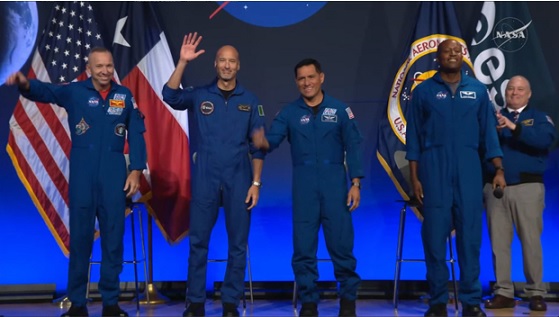
In the crew line up announced by NASA Administrator Jared Isaacman, to include: Mission Commander Randy Bresnik (58), a two space mission veteran (Space Shuttle and International Space Station, ISS) former U.S. Marine F/A-18 pilot; Mission Specialist Frank Rubio (50), a 370-day ISS veteran and former U.S. Army helicopter pilot; and Mission Specialist Dr. Andre Douglas (40), backup for the Artemis-II mission and U.S. Coast Guard veteran.
In addition, the Artemis-III Mission Pilot will be Luca Parmitano (49), a veteran of two ISS missions, with six space walks, as an astronaut with the European Space Agency, a former Colonel and test pilot with the Italian Air Force.
At the NASA briefing, the importance of Parmitano’s contribution was stressed by ESA Director General Josef Aschbacher:
“Before anyone steps foot on the moon, someone has to make that possible. That responsibility now rests, first and foremost, with NASA, but also with the crew we are honoring today. The crew will test what has never been tested at this level. You will take a system of extraordinary complexity and make it work as one. In many ways you are unlocking the lunar lending itself. And for us, at ESA, there is real bite, in knowing that alongside the NASA commander, a European astronaut will also be at the controls of this mission. ESA and NASA do more than cooperate. We build dreams and spacecraft together.”
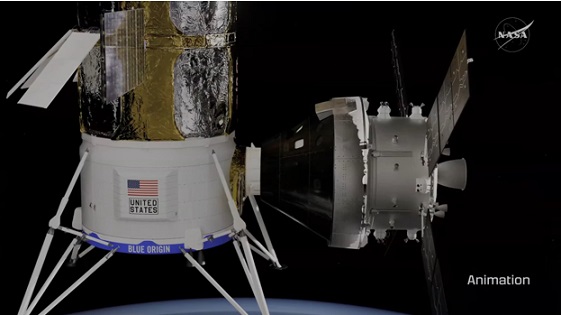
Indeed, as pilot, Parmitano will have one of the most important roles for the Artemis-III mission, that over a mission lasting two weeks, will entail the launch of three spacecraft and will test the ability of the NASA Orion manned spacecraft to dock and undock in Low Earth Orbit (LEO) with test versions of the Blue Origin Blue Moon Mk2 and SpaceX Starship Human Landing Systems (HLS) — that in following Artemis missions will then be used to take Artemis coalition astronauts to the Moon.
Full Text . . . . Current Edition . . . . Subscription Information

Artemis III briefing by NASA cites European role, commercial collaboration added by Cosmic1 on
View all posts by Cosmic1 →
You must be logged in to post a comment Login