

Special to CosmicTribune.com, February 12, 2026
By Richard Fisher
For over a decade SpaceX founder and leader Elon Musk has placed an emphatic corporate priority on developing the means — spaceships and associated habitation technology — to build permanent human settlements on Mars.
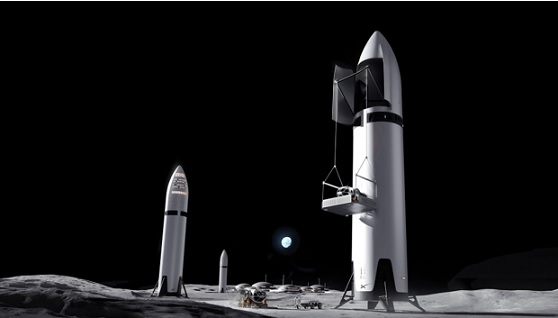
As the 4-astronaut Artemis-II circumlunar mission prepares for its 10-day journey in early March or early April, on Feb. 8 the United States push to put people back on the Moon by 2028 received a critical boost in the form of a corporate pivot by the SpaceX Corporation, which still has the lead in developing the Human Landing System (HLS) — based on its massive Starship resuable rocket.
Early in his second term President Trump even shared the goal for the United States to send people to Mars, an enthusiasm that waxed and waned with his political alliance with Musk, that was settling into a more limited friendship over shared goals by the end of 2025.
In addition, over the long process to pick the next Administrator of the National Aeronautics and Space Administration (NASA), settling on his first choice, private astronaut and aeronautical entrepreneur Jared Isaacman, Trump has also revised his focus to making sure the United States returns its astronauts to the Moon before China — which could arrive as early as 2029.
On Oct. 20, 2025, then acting NASA Administrator Sean Duffy reopened the competition for the manned HLS, putting SpaceX on notice that it was not moving fast enough to meet Trump’s goals.
So, Musk’s Feb. 8 announcement on his “X” platform was both welcome and necessary, saying:
“For those unaware, SpaceX has already shifted focus to building a self-growing city on the Moon, as we can potentially achieve that in less than 10 years, whereas Mars would take 20+ years.
The mission of SpaceX remains the same: Extend consciousness and life as we know it to the stars. It is only possible to travel to Mars when the planets align every 26 months (six month trip time), whereas we can launch to the Moon every 10 days (2 day trip time).
This means we can iterate much faster to complete a Moon city than a Mars city.
That said, SpaceX will also strive to build a Mars city and begin doing so in about 5 to 7 years, but the overriding priority is securing the future of civilization and the Moon is faster.”
Full Text . . . . Current Edition . . . . Subscription Information

Mars? Yes, but Elon Musk now prioritizes the Moon added by Cosmic1 on
View all posts by Cosmic1 →
You must be logged in to post a comment Login