

Special to CosmicTribune.com, October 1, 2026
By Richard Fisher
It was revealed by Elon Musk himself to a roomful of thousands adoring space geeks at the 2016 International Astronautical Congress in Guadalajara, Mexico (this analyst was there).
Ten years later on Sept. 28, 2026, SpaceX accomplished the first full orbital test of its Starship super heavy two-stage reusable space launch vehicle (SLV) and 14th test flight — that for the first time also deployed 26 Starlink V3 broadband satellites.
That said, the 9-meter diameter Starship only achieved three of an intended six orbits, the “Super Heavy” reusable first stage landed in water, not on land using the Mechazilla chopstick launch/recovery tower, and the Starship second stage performed a water soft landing near Chile, but also exploded on landing.
Intended by Musk in 2016 to be his workhorse spaceship to populate Mars, Starship is now being reconfigured as America’s “ace-in-the-hole” to help beat China in the race to populate the Moon, by virtue of its potential ability to place a whopping 100-tons to 150-tons of cargo on the lunar surface.
Starship still has to demonstrate Low Earth Orbit (LEO) refueling, and docking with the manned Orion spaceship for the Artemis-III mission in 2027 and perform an unmanned landing on the Moon, before its planned use in 2028 to return Americans to the Moon.
So far, according to a Reuters report from May 1, 2026, SpaceX has invested $15 billion to develop Starship and could spend up to $150 billion more to build its massive new Starbase Louisiana with 10 Starship launch pads, to help achieve up to 1,000 annual Starship launches.
Currently, Starship does not have any comparable Western reusable SLV competition; a future Blue Origin New Glenn 9×4 reusable SLV may only have a 70-ton to LEO capability, and the Rocket Labs Neutron may only have a 13-ton cargo capacity to LEO.
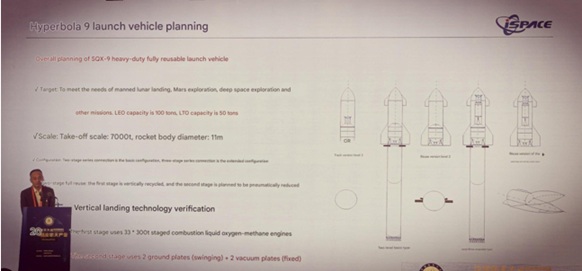
However, Starship does have potential competition from China in the form of three known super-heavy reusable SLV programs by the state-owned China Aerospace Science and Technology Corporation (CASC) and the “commercial” iSpace, LandSpace and Astrostone corporations — that answer to the People’s Liberation Army (PLA) as much as CASC.
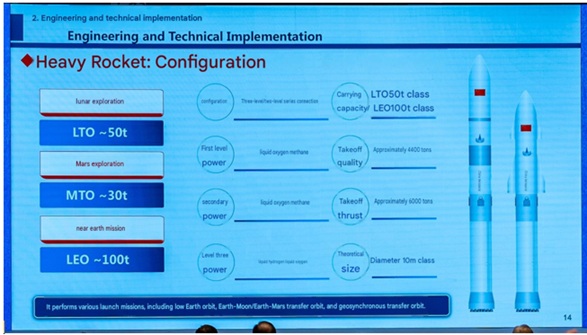
CASC’s Long March-9 (LM-9) was first revealed in 2011 as a 9-meter diameter 100-ton to LEO single-use non-reusable SLV with additional strap-on liquid fuel boosters, then comparable to the U.S. Space Launch System (SLS) then under development.
By June 2021, Chinese spokesmen like Long Lehao were revealing LM-9 evolutions that included increased 100-ton capacity to LEO and 50-tons to the Moon, and appeared to accommodate first-stage reusability.
By October 2022 Long Lehao was revealing further design evolutions including 160-tons to LEO, up to 53 tons to the Moon, and more refined reusable first stage and then second stage reusability.
The first flight for the LM-9 has long been advertised for 2030, with its first lunar mission as well, but such testing may extend into the 2030s, even though images of LM-9 fuselage components under construction have been seen in 2022 and 2023.
Full Text . . . . Current Edition . . . . Subscription Information

SpaceX made mark on Sept. 28, but here come China’s multiple starship projects added by Cosmic1 on
View all posts by Cosmic1 →
You must be logged in to post a comment Login