

Special to CosmicTribune.com, August 16, 2026
Excerpts from weekly Sky & Telescope.com report.
SUNDAY, AUGUST 16
■ Now the Moon shines about 10° left of Venus in twilight. Look too for Spica.
■ Check the sky low in the northwest or north at the end of these long summer twilights. Would you recognize shiny, ripply noctilucent clouds if you saw them? They’re the most astronomical of all cloud types, what with their extreme altitude and, sometimes, their formation on meteoric dust particles. They used to be rare, but they’ve become more common in recent years as Earth’s atmosphere changes. See Bob King’s Nights of Noctilucent Clouds.
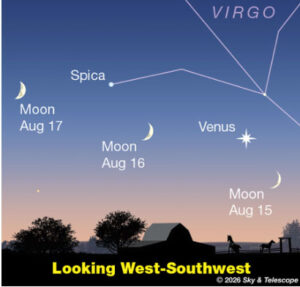 MONDAY, AUGUST 17
■ Whenever bright Vega crosses nearest your zenith, as it does after dark now, you know that the Sagittarius Teapot is posing at its highest due south.
Two hours later, when Deneb passes the zenith, it’s the turn of little Delphinus and boat-shaped Capricornus down below it to stand at their highest due south.
TUESDAY, AUGUST 18
■ After dark, spot the Big Dipper in the northwest. This is the time of year when it scoops down during evening, as if to pick up the water that it will dump from high overhead in the evening early next spring.
WEDNESDAY, AUGUST 19
■ First-quarter Moon (exact at 10:46 p.m. EDT). The Moon is in dim Libra, to the right of Antares. The distinctive, three-star head of Scorpius is between them. The stars form a roughly vertical row.
THURSDAY, AUGUST 20
■ Now the Moon returns to Antares, as it does every month. But this time the Moon is only barely past first quarter (as shown below). When it met up with Antares last month, the Moon was more gibbous.
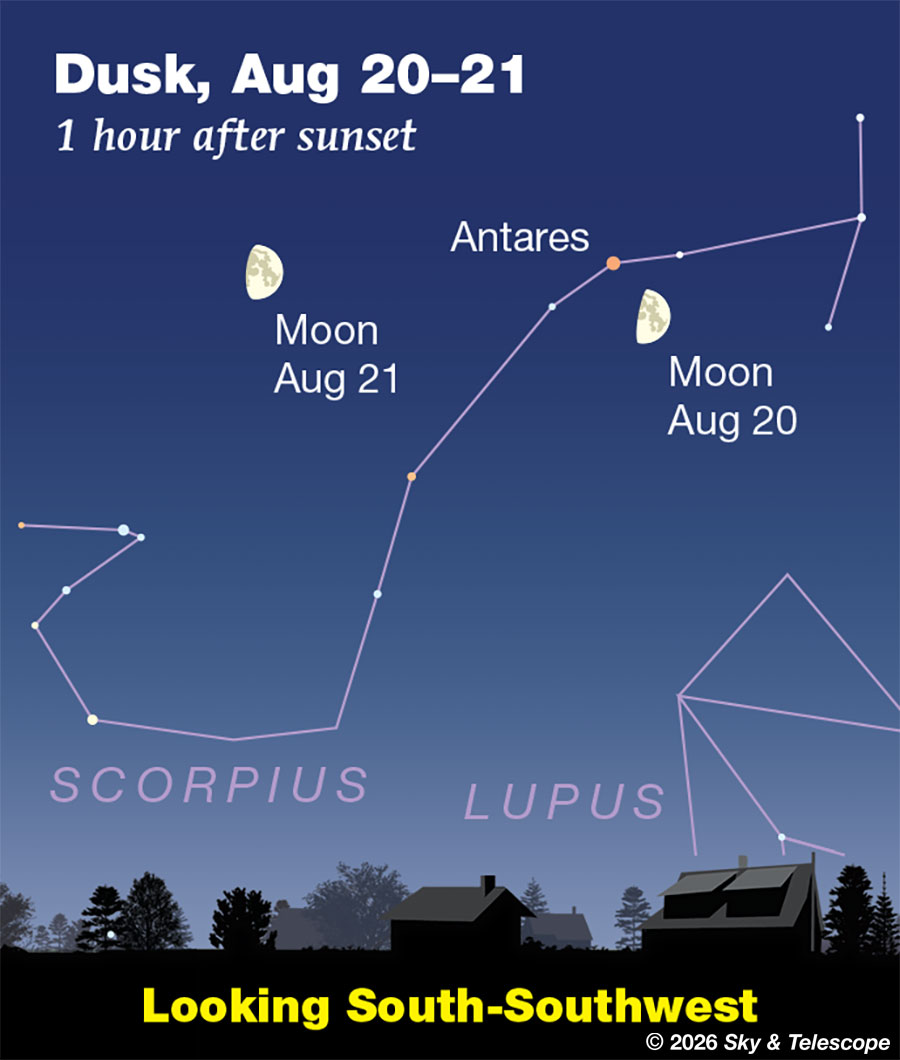 FRIDAY, AUGUST 21
■ This evening look for Antares about a fist at arm’s length to the right of the Moon, as shown. A lesser distance farther right spot Delta Scorpii, the second-brightest star of upper Scorpius.
SATURDAY, AUGUST 22
■ As August proceeds and nights begin to turn chilly, the Great Square of Pegasus looms up in the east, balancing on one corner. Its stars are only 2nd and 3rd magnitude. Your fist at arm’s length fits inside it.
From the Square’s left corner, the backbone of the constellation Andromeda extends off to the lower left: three stars (including the corner) in a slightly curving line, about as bright as those forming the Square.
Extend the line farther and you can add Alpha Persei.
A version of this whole enormous pattern was named “the Andromegasus Dipper” by the late Sky & Telescope columnist George Lovi. It’s shaped much like a giant Little Dipper. It’s currently lifting upward.

The sky, August 16-21: Moon at first quarter Wednesday, near Antares added by Cosmic1 on
View all posts by Cosmic1 →
You must be logged in to post a comment Login