

Special to CosmicTribune.com, February 16, 2026
Excerpts from weekly Astronomy.com report.
Sunday, February 15
The Moon passes 0.9° north of Pluto at 10 A.M. EST.
This evening, Saturn passes 0.9° south of Neptune at 11 P.M. EST. The two planets stand together in Pisces, located in the west after sunset. An hour after the Sun goes down, the pair is still nearly 20° high, visible together in binoculars or a telescope.
Saturn is visible to the naked eye, shining at magnitude 1.0. It’s easy to find above and slightly to the left of brighter, magnitude –0.9 Mercury, which sits about 4° above the horizon at this time (even brighter Venus has already set). Saturn is the brightest point of light in Pisces, outshining all of the stars in this region of the sky.
 Center binoculars or a telescope on Saturn, then look just north of the ringed world to land on magnitude 7.8 Neptune (not visible without optical aid). Neptune’s tiny disk measures only 2” across and will look like a “flat,” blue-gray star. Saturn, however, looks lovely at higher magnifications, with a disk 16” across and rings stretching 36” from end to end. Its brightest moon, Titan, may also be visible this evening even under lower magnification, sitting some 2.5’ west of Saturn’s center.
Sunrise: 6:53 A.M.
Sunset: 5:36 P.M.
Moonrise: 6:04 A.M.
Moonset: 3:47 P.M.
Moon Phase: Waning crescent (2%)
Monday, February 16
Now roughly 7th magnitude, Comet C/2024 E1 (Wierzchoś) is readily visible in the Northern Hemisphere once more. With New Moon less than a day away, it’s the perfect time to check in on this cometary visitor, now visible for a short time after sunset in the constellation Sculptor.
However, you’ll have to be quick — half an hour after sunset, Comet Wierzchoś is only 10° above the southwestern horizon. It sets around 7:30 P.M. local time, but you should be able to catch it in binoculars or a telescope as twilight deepens. Tonight, the comet is just over 4° southeast of 4th-magnitude Alpha (α) Sculptoris, and about 4.5° southwest of NGC 613, a lovely barred spiral galaxy. However, the latter will be difficult to pick out in twilight — observers at higher altitudes and with photographic setups may be able to image it, but conditions are unfortunately not ideal.
Wierzchoś will climb higher above the horizon each night, improving visibility in the coming days. However, the waxing Moon will float nearby by the end of the week. Nonetheless, try following the comet under medium power with your scope to look for details as its appearance evolves.
Sunrise: 6:51 A.M.
Sunset: 5:37 P.M.
Moonrise: 6:34 A.M.
Moonset: 4:55 P.M.
Moon Phase: New
Tuesday, February 17
New Moon occurs at 7:01 A.M. EST, bringing an annular solar eclipse to Antarctica and part of the Southern Ocean. Only travelers in these regions will see the Moon cover nearly all of the Sun’s disk, leaving only a thin ring of sunlight around the darkened outline of our satellite. Annular eclipses occur when the Moon is too far from Earth to completely cover the solar disk, so a thin annulus remains visible even at maximum eclipse (such eclipses are never safe to observe with the naked eye).
Additionally, the very southern tip of South America, all of Madagascar, and parts of southern Africa will see a partial eclipse, though no more than 29 percent of the Sun will be covered from any of these locations (and generally much less). Again, partial eclipses are never safe to view with the naked eye, but can be watched through eclipse glasses or with other safe solar viewing options.
You can find more information about the eclipse, as well as maps and further links, at eclipsewise.com.
Sunrise: 6:50 A.M.
Sunset: 5:39 P.M.
Moonrise: 7:01 A.M.
Moonset: 6:03 P.M.
Moon Phase: Waxing crescent (1%)
Wednesday, February 18
The Moon passes 1.8° north of Venus at 4 A.M. EST, then passes 0.1° south of Mercury at 6 P.M. EST.
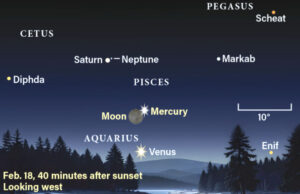
Both planets are visible in the evening sky, though Venus is low, only about 12° high in the southwest half an hour after sunset. However, Venus is bright (magnitude –3.9), so should still be easy to find in the darkening sky as long as you have a clear horizon. Mercury is higher, standing 10° above the horizon 30 minutes after sunset, nestled beside the 1.5-day-old Moon. Shining at magnitude –0.6, the tiny planet should be an easy find just to the upper right of the lunar crescent as viewed from the middle of the U.S. Note that because our Moon moves quickly through the sky, its position relative to Mercury will change depending on your location. From the East Coast, Mercury will be north of the Moon; by the time sunset occurs on the West Coast, Mercury will be west of the Moon and located to our satellite’s lower right. The chart above shows their relative position shortly after sunset from the Midwest.
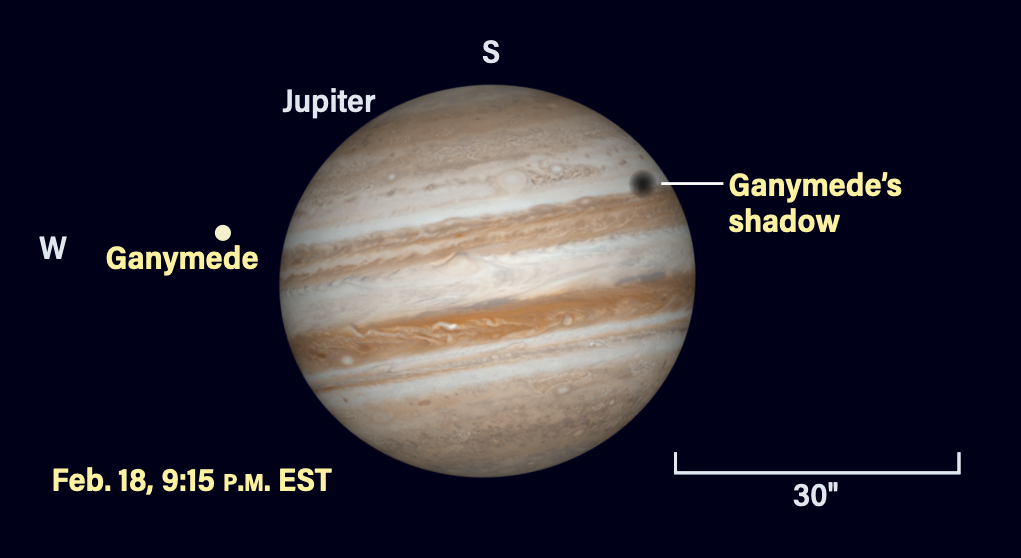 Shortly after 9 p.m. EST on Feb. 18, Ganymede has completed a transit and its shadow has appeared on Jupiter’s cloud tops for a transit of its own. Callisto is to the west, while Io and Europa lie to Jupiter’s east, outside this field of view. / Astronomy: Roen Kelly
There’s also some action occurring over at Jupiter this evening, as Ganymede transits the gas giant’s disk, followed by its shadow. Located in Gemini, Jupiter is climbing in the east after sunset. Most of the U.S. sees Ganymede already transiting as darkness falls, with the exception of the West Coast, as the moon’s transit ends at 5:44 P.M. PST, roughly sunset from this location. But there’s still more to come, as Ganymede’s huge shadow appears on the disk at the southeastern limb shortly before 9 P.M. EST, taking several minutes to fully appear. See how long it takes you to notice the dark “bite” grow along the limb. The shadow transit lasts more than three hours, ending around 12:20 A.M. EST, early on the 19th for the Eastern time zone only (and still late on the 18th for the rest of the U.S.).
Sunrise: 6:49 A.M.
Sunset: 5:40 P.M.
Moonrise: 7:25 A.M.
Moonset: 7:12 P.M.
Moon Phase: Waxing crescent (3%)
Thursday, February 19
Mercury reaches greatest eastern elongation (18°) at 1 P.M. EST. You can catch the solar system’s smallest planet in the evening sky, shining at magnitude –0.5 in the west. It stands 11° high 30 minutes after sunset, about 8° above brighter Venus, which is close to the horizon. A thin crescent Moon lies above Mercury as well, creating a lovely naked-eye trio.
The Moon passes 4° north of Neptune and 5° north of Saturn at 7 P.M. EST, as the two distant planets are still less than a degree apart in Pisces. Once the sky grows darker, 1st-magnitude Saturn should pop out against the background sky to the lower left of the Moon. It’s the brightest point of light in this region, and the third-brightest light in the sky, after Venus and Mercury. Neptune, at magnitude 7.8, is not visible to the naked eye. Once full darkness falls, however, you can find the distant ice giant by centering binoculars or a telescope on Saturn, then glancing to the north. The planets are currently just 0.8° apart.
Sunrise: 6:47 A.M.
Sunset: 5:41 P.M.
Moonrise: 7:47 A.M.
Moonset: 8:22 P.M.
Moon Phase: Waxing crescent (8%)
Friday, February 20
Rising around 7:30 P.M. local time and visible all night and into the early-morning hours, Coma Berenices is home to a lovely star cluster cataloged as Melotte 111 and Collinder 256. Also called simply the Coma Star Cluster, this open cluster of stars lies in the northwest corner of the constellation, near the 4th-magnitude star Gamma (γ) Comae Berenices. The Coma Star Cluster lies adjacent to this golden-hued star, although Gamma itself is not part of the cluster, which lies far beyond this single star.
Spanning a hefty 4° on the sky, you’ll want a wide field of view to take in the entire cluster at once. Try using binoculars or even your telescope’s finder scope. In total, the Coma Star Cluster holds about 40 young suns that are about 400 million years old.
You may notice that, strangely, the cluster doesn’t contain any faint stars (below about 10th magnitude). Astronomers suspect it once held smaller, fainter stars, but the cluster simply wasn’t massive enough to hold onto these smaller suns over time, and they have since dispersed across the sky.
Sunrise: 6:46 A.M.
Sunset: 5:42 P.M.
Moonrise: 8:10 A.M.
Moonset: 9:33 P.M.
Moon Phase: Waxing crescent (15%)

The sky, Feb. 15-20: Dark sky for the clusters and planets added by Cosmic1 on
View all posts by Cosmic1 →
You must be logged in to post a comment Login