

Special to CosmicTribune.com, July 5, 2026
Excerpts from weekly Sky & Telescope.com report.
SUNDAY, JULY 5
■ And while you’re doing globulars, here’s a rather different one. Explore the area around Antares using Matt’s column and chart in the June 2026 Sky & Telescope, page 43. In Antares’s binocular field is M4, bigger and closer to us but less condensed (compact) than M13 and M92. M4, being closer, is more easily resolvable into stars than most globulars are.
■ The Moon finally rises in the east around midnight tonight; it’s nearing last quarter. An hour later Saturn rises to the Moon’s lower left. By the beginning of dawn they’re high in the south-southeast, possibly in good, steady atmospheric seeing for a telescope at high power. Last fall Saturn turned its rings edge-on to us. The rings now are still dramatically narrow, with a tilt of 9° to our line of sight.
MONDAY, JULY 6
■ High on the eastern side of the evening sky, the Summer Triangle holds sway after dark. Its top star is Vega, the brightest. Two fists to Vega’s lower left is lesser Deneb. Altair is the brightest star farther to their lower right.
After complete nightfall, with the Moon not yet risen, perhaps you can see the Milky Way (if you’re not too light-polluted) arching grandly across the eastern sky and crossing just inside the Triangle’s bottom edge. That stretch of the Milky Way includes the Cygnus Star Cloud, one of its most star-rich regions. It’s so rich because because when we look toward Cygnus, we’re looking downstream along the local arm of our spiral galaxy.
That’s also the direction the solar system is flying at 220 kilometers per second in the Sun’s orbital motion around the Milky Way’s center.
■ Look lower left of Altair, by hardly more than a fist, for the compact little constellation Delphinus, the Dolphin.
Did you get it? Then try for even fainter, smaller Sagitta, the Arrow. It’s to Altair’s upper left a little closer. The Arrow points toward lower left, past the nose of Delphinus. Try binoculars.
■ Earth is at aphelion today, our farthest distance from the Sun for the year. But the difference is small. At perihelion in January, we’re just 3.4% closer to the Sun than we are now. Earth’s orbit is almost a circle; it’s an ellipse with an eccentricity of just 0.0167.
TUESDAY, JULY 7
■ Last-quarter Moon (exact at 3:29 p.m. EDT). The half-lit Moon rises in the east around midnight or 1 a.m. tonight (depending mostly on how far east or west you live in your time zone).
As the Moon gets higher, spot Saturn about a fist to its right and the two or three brightest stars of Aries a similar distance to the Moon’s left. By the beginning of Wednesday’s dawn, this array is much higher.
WEDNESDAY, JULY 8
■ Soon after nightfall, look due south for orange Antares on the meridian. Around and upper right of Antares are the other, whiter stars forming the distinctive pattern of upper Scorpius. The rest of the Scorpion runs down from Antares toward the horizon, then left.
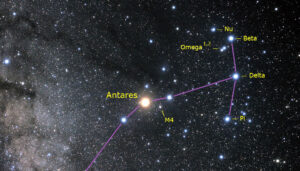
Three doubles at the top of Scorpius. The head of Scorpius — a near-vertical row of three stars — stands upper right of Antares. The top star of the row is Beta (ß) Scorpii or Graffias: a fine double star for telescopes, separation 13 arcseconds, magnitudes 2.8 and 5.0. (They’re unresolved in the photo above.)
Near Antares, nice double stars and the dim globular cluster M4 await telescope users.
Just 1° below Beta is the very wide naked-eye pair Omega1 and Omega2 Scorpii. They’re 4th magnitude and ¼° apart. Binoculars show their slight color difference; they’re spectral types B9 and G2.
Upper left of Beta by 1.6° is Nu Scorpii, separation 41 arcseconds, magnitudes 3.8 and 6.5. In fact it’s a telescopic triple. High power in good seeing reveals Nu’s brighter component itself to be a close binary, separation 2 arcseconds, magnitudes 4.0 and 5.3, aligned almost north-south.
THURSDAY, JULY 9
■ Catch Venus low in the west as twilight fades. It’s now having its conjunction with Regulus, much fainter, 1° under it as shown below. Binoculars will help reveal Regulus through the twilight.
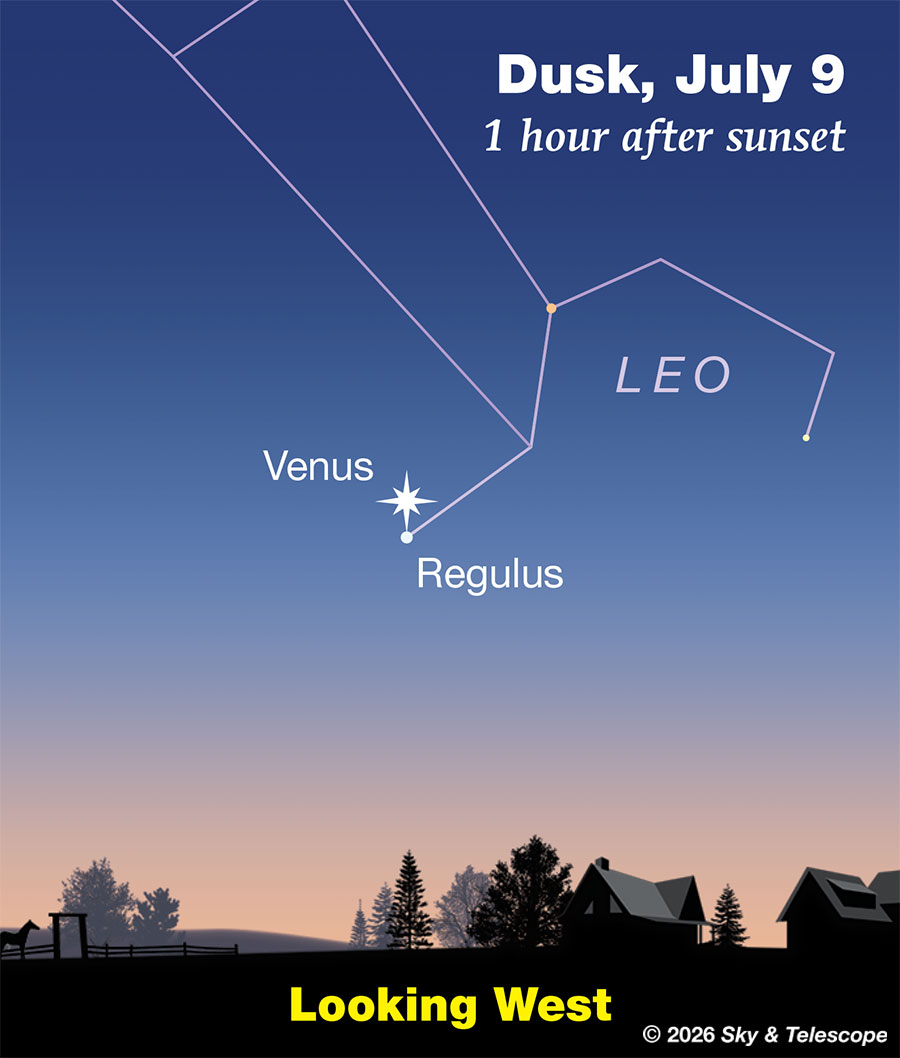 Venus passes Regulus today. Find them low in the west as twilight grows late.■ More Scorpius: To the right of Antares is that vertical row of Beta, Delta, and Pi Scorpii; the see photo above. The middle one, Delta Sco, is the brightest — obviously so. But it didn’t used to be. It used to be like Beta.Delta is a strange variable star, a fast-rotating blue subgiant throwing off luminous gas from its equator. Assumed for centuries to be stable, Delta doubled in brightness unexpectedly in summer 2000, then dipped down and up again several times from 2005 to 2010, and has remained essentially steady at peak brightness (magnitude 1.8) ever since. If anything, it has gained a little under a tenth of a magnitude in these last 15 years.
Delta has a smaller orbiting companion star that was suspected to trigger activity at 10.5-year intervals. Astronomers watched to see whether the system would have another flareup around 2022, when the companion star made its third pass by the primary star since 2000. But nothing happened. No one knows what might happen next, or when. More.
FRIDAY, JULY 10
■ In early dawn tomorrow the 11th, look east-northeast for the waning crescent Moon forming a diagonal line with Mars and Aldebaran under it, as shown below.
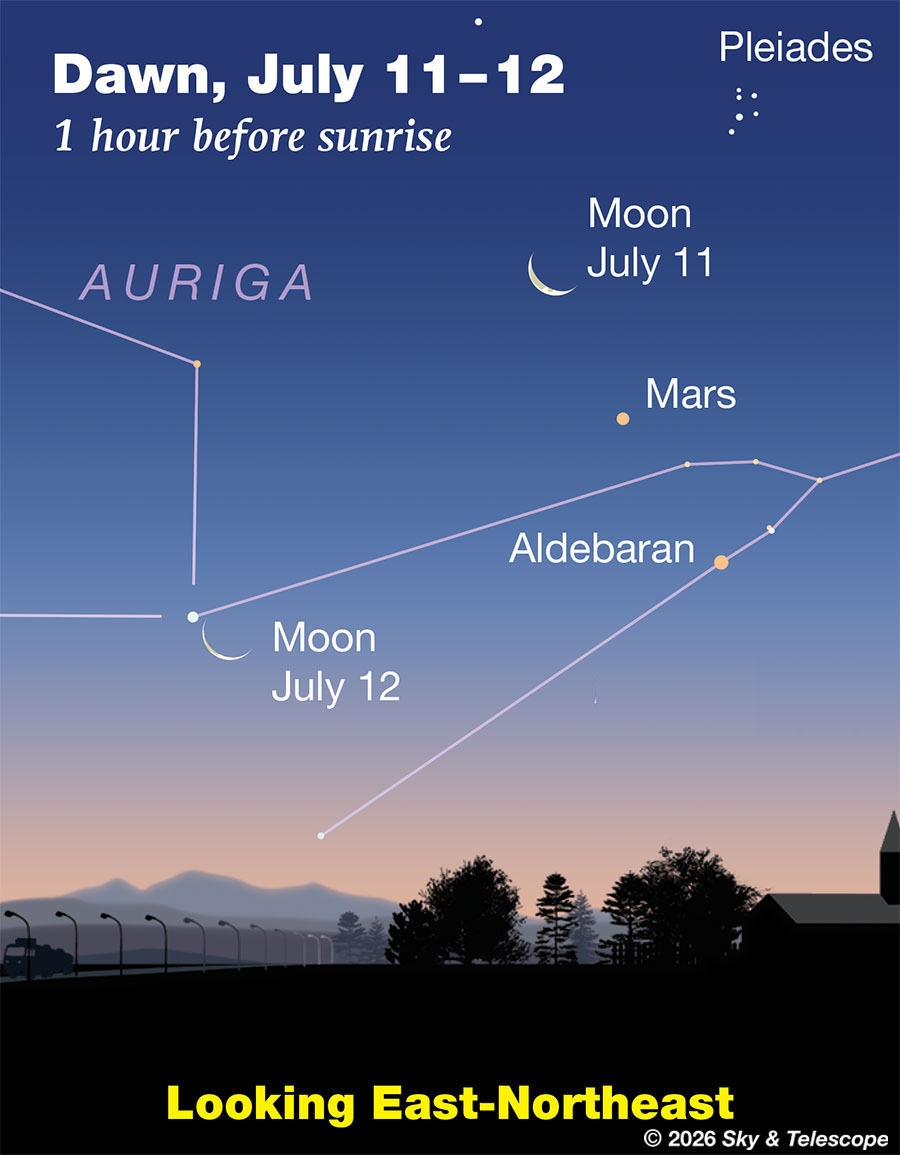 The thin waning crescent Moon lines up with Mars and Aldebaran low in the dawn on Saturday morning, July 11th.On Sunday morning the 12th, bring binoculars to catch the thinner, lower Moon now near Beta Tauri, magnitude 1.6.

The sky, July 5-10: M4 near Antares added by Cosmic1 on
View all posts by Cosmic1 →
You must be logged in to post a comment Login