

Special to CosmicTribune.com, March 2, 2026
Excerpts from weekly Astronomy.com report.
Sunday, March 1
We are quickly losing sight of Saturn in the evening sky — tonight, take some time to glimpse the glorious ringed planet before it gets too low in the west.
An hour after sunset, Venus and Mercury have set and Saturn is the brightest light in the western sky, now roughly 7° high. That’s already getting quite low, but try training your telescope on the distant world for a glimpse of its lovely ring system, now stretching about 36” from end to end and showing off its southern side. The gas giant’s disk is some 16” wide, with its southern hemisphere also fully visible. You may just be able to spot Titan, Saturn’s brightest moon, some 2.5’ west of the planet, though this observation may be difficult in the muddy air near the horizon.
Day by day, Saturn will set earlier and earlier, even as Venus rises up to meet it. We’ll get a lovely conjunction of the two worlds in about a week, right around the switch to daylight saving time.
Sunrise: 6:33 A.M.
Sunset: 5:52 P.M.
Moonrise: 4:06 P.M.
Moonset: 5:42 A.M.
Moon Phase: Waxing gibbous (98%)
Monday, March 2
The nearly Full Moon passes just 0.4° north of Regulus at 8 A.M. EST; you can catch the pair close together in the predawn sky, standing roughly 20° high in the west two hours before sunrise. The Moon is located just to the lower right of Regulus, which anchors the famous Sickle asterism of Leo, which to many looks like a backwards question mark.
Regulus is also the bright star marking the heart of the Lion. Shining at magnitude 1.4, it is in actuality a four-star system, which observers can split into the brightest two components with a telescope. (Note the companion is quite far away, some 175”, so you’re not looking for a close double!) Regulus is also located nearly on the ecliptic, the plane of our solar system and the path of the planets, Sun, and Moon, so it is often occulted by other objects as they appear to pass in front of the star from our point of view.
Although not visible in the majority of the U.S., some parts of the world (including Hawaii, Japan, and Russia) will see the Moon pass in front of Regulus today. The visibility and timing of the event are heavily location dependent — you can find more information on the In-The-Sky.org‘s page for the event here.
Asteroid 2 Pallas reaches conjunction with the Sun this morning at 10 A.M. EST, rendering it completely invisible from our point of view.
Sunrise: 6:31 A.M.
Sunset: 5:53 P.M.
Moonrise: 5:17 P.M.
Moonset: 6:09 A.M.
Moon Phase: Full
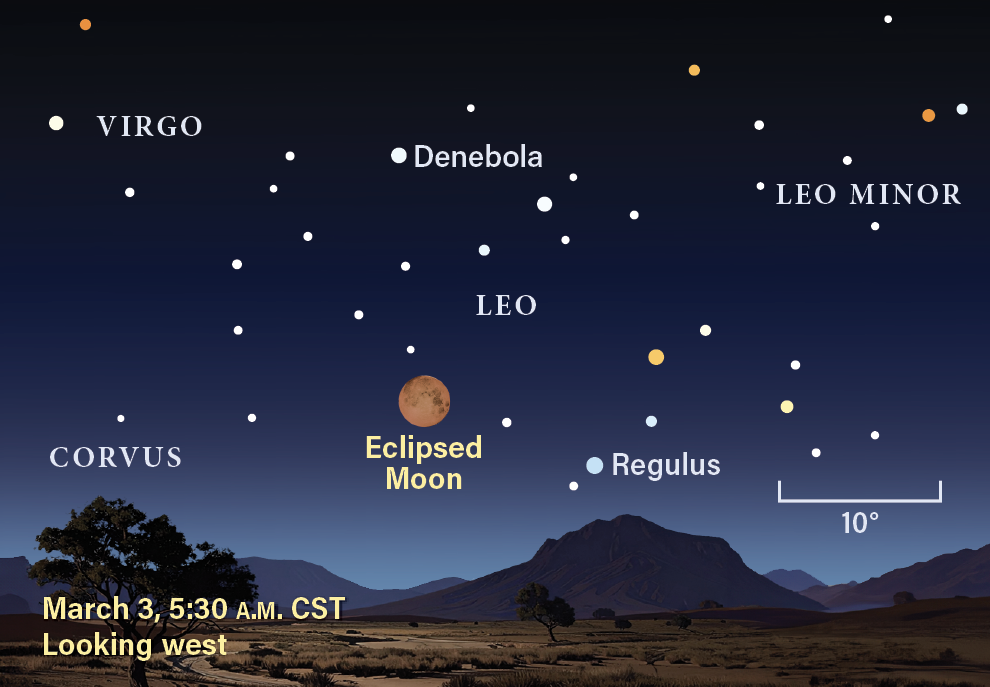 By mideclipse the morning of March 3, the Moon is some 10° high and sinking toward the horizon in the Midwest; it is higher for observers farther west. / Astronomy / Roen Kelly
Tuesday, March 3
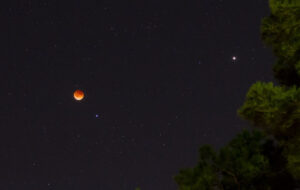
Even if you’re not normally an early riser, today is the day to make an exception as a total lunar eclipse, sometimes called a Blood Moon, occurs over much of the world, including the U.S.
Total lunar eclipses can only take place during the Full Moon. Full Moon officially occurs this morning at 6:38 A.M. EST. The March Full Moon is sometimes also called the Worm Moon. Lunar eclipses are sometimes referred to as Blood Moons as well, because the Moon changes color — often to a dark orange or deep red — as it travels through Earth’s shadow.
The eclipse officially starts this morning at 3:43 A.M. EST as the Moon, currently in Leo, first moves into the outer regions of Earth’s shadow, called the penumbra. Over the next hour or so, our satellite will slowly begin to darken. It will be subtle at first, so give it time if you don’t notice a change immediately. At 4:49 A.M. EST, the Moon reaches the darker inner shadow of our planet, called the umbra. Luna will continue to grow even darker during this time, now quite noticeably, until the start of totality at 6:03 A.M. EST.
Totality is when the Moon truly turns to blood, taking on an orangey or reddish hue as a small amount of sunlight is refracted by our atmosphere onto the lunar surface. The exact color of each eclipse is unique. At this point, many of the nearby stars — previously blotted out by the bright light of the Full Moon — should reappear in the sky around our satellite.
Totality lasts roughly an hour, ending at 6:02 A.M. CST — note the time change, as this is after sunrise (and moonset) for the East Coast and with the Moon low on the western horizon in the Midwest. Then, the eclipse proceeds in reverse, visible largely from the western half of the U.S. as the Moon slowly lightens. It passes out of the umbra at 6:17 A.M. MST, then out of the penumbra at 6:23 A.M. PST, ending the eclipse.
Sunrise: 6:30 A.M.
Sunset: 5:54 P.M.
Moonrise: 6:24 P.M.
Moonset: 6:33 A.M.
Moon Phase: Waning gibbous (99%)
Wednesday, March 4
Jupiter’s largest moon, Ganymede, transits the gas giant’s large disk overnight, beginning late on the evening of the 4th for much of the U.S.
Jupiter remains a fixture in Gemini the Twins, now visible in the west late tonight. You can find the planet hanging below the bright stars Castor and Pollux as the region sets. Zoom in on Jupiter and you’ll spot Callisto alone far to the planet’s west; on its eastern side, Ganymede is closing in on the southeastern limb, while Io and then Europa lie farther east.
Ganymede finally the limb and begins its transit at 12:33 A.M. EST (now the 5th in the Eastern time zone only). Because it’s so large, it will take the moon several minutes to fully cross onto the disk. After that, the moon slowly treks from east to west, reaching midway across the disk around 2:15 A.M. EST (early on the 5th for much of the U.S., and with Jupiter less than 20° high along the East Coast). The transit ends around 2:48 A.M. CST — note the time change, as well as that this is around the time Jupiter is setting in the Midwest.
Observers along the West Coast can catch the start of the moon’s shadow transit, which begins around 2 A.M. PST, as Jupiter is very low in the Mountain time zone (although observers there at higher altitudes might be able to watch the shadow appear as well). Jupiter sets with the shadow crossing the disk for West Coast observers.
Sunrise: 6:28 A.M.
Sunset: 5:55 P.M.
Moonrise: 7:31 P.M.
Moonset: 6:55 A.M.
Moon Phase: Waning gibbous (97%)
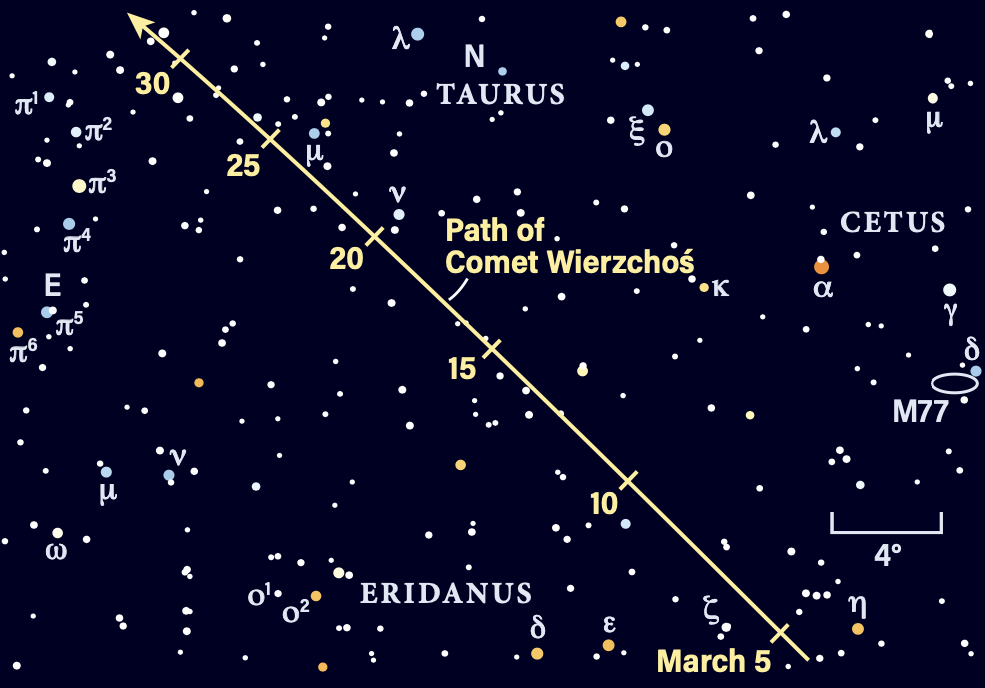 Comet Wierzchoś is moving quickly but can be found with binoculars early in the month. This chart shows the comet’s path starting March 5, when moonless viewing begins. / Astronomy / Roen Kelly
Thursday, March 5
The moonless window for observing Comet C/2024 E1 (Wierzchoś) opens today! You’ll find it this evening after sunset in the southwest, slowly sinking toward the horizon. Two hours after sunset, Wierzchoś is still 20° high, located in the large constellation Eridanus. Tonight it’s relatively easy to find, just 2.9° east of 4th-magnitude Eta (η) Eridani. Note the comet’s asymmetric shape — its northern flank should be much more defined than its softer southern side.
While your attention is in this region, skim your view northwest to central Cetus, where the “wonderful” variable star Mira (Omicron [ο] Ceti) has been brightening as it approaches peak brightness early this year.
Mira is a long-term variable whose brightness changes over the course of roughly a year (332 days). And that brightness changes significantly, swinging from 2nd magnitude all the way to 10th magnitude — completely out of the range of naked-eye visibility. Now, it’s on the brighter end of that swing, currently observed at magnitude 3.6 — well within range of the naked eye. Early this evening, you’ll find it about 12.7° directly below brighter Menkar (Alpha [α] Ceti) as the constellation sets in the few hours after sunset.
Sunrise: 6:27 A.M.
Sunset: 5:56 P.M.
Moonrise: 8:35 P.M.
Moonset: 7:16 A.M.
Moon Phase: Waning gibbous (92%)
Friday, March 6
Now it’s Io’s turn to transit Jupiter’s broad disk, beginning at midnight EST tonight.
On the East Coast, Jupiter is still 40° high in the west at local midnight, readily visible as the brightest point of light in Gemini the Twins. Through a telescope, you’ll see the gas giant’s other three moons lined up west of the planet as Io approaches the southeastern limb.
Io’s crossing takes much less time than Ganymede’s a few days ago, thanks to the former’s tighter orbit. An hour later, at 1 A.M. EST (now the 7th for the eastern half of the U.S.), Io has reached the middle of the disk — just minutes after that, Io’s shadow appears at the southeastern limb around 1:05 A.M. EST.
By 2 A.M. EST on the 7th, both Io and its shadow are readily visible together on the disk, as Io approaches the western limb and its shadow is nearly central. Io’s transit ends just under 20 minutes later, with the shadow now roughly in the center of Jupiter’s disk. The shadow takes just over another hour to finish crossing; its exit around 2:25 A.M. CST on the 7th is visible in the western two-thirds of the U.S.
Sunrise: 6:25 A.M.
Sunset: 5:58 P.M.
Moonrise: 9:39 P.M.
Moonset: 7:39 A.M.
Moon Phase: Waning gibbous (86%)

The sky, March 1-6: Total lunar eclipse on March 3 added by Cosmic1 on
View all posts by Cosmic1 →
You must be logged in to post a comment Login