

Special to CosmicTribune.com, May 10, 2026
Excerpts from weekly Astronomy.com report.
Sunday, May 10
Although still best for experienced observers with larger scopes, Comet 10P/Tempel (also called Tempel 2) is quickly brightening. Glowing at roughly magnitude 15, Tempel 2 is currently in Aquila the Eagle, rising late in the evening and gaining altitude overnight. The best time to observe it is a couple of hours after midnight; it reaches 20° above the southeastern horizon by 2 A.M. local daylight time.
If you’ve got country-dark skies, a 4- to 6-inch scope will net you a view. Under brighter skies, go larger. The easiest way to find the comet right now is to start at Lambda (λ) Aquilae, the 3rd-magnitude star marking the Eagle’s tail. From here, slide about 6.5° southeast to find the comet. This icy, faraway fuzzball may appear lopsided, as solar radiation pushes on dust liberated from the nucleus as the comet sails toward the Sun.
Compare Tempel 2’s appearance to 9th-magnitude NGC 6638, located in nearby Sagittarius. You can find this globular cluster just 0.7° southeast of Lambda Sagittarii, the lid of the Teapot asterism. By contrast, the globular should look rounder and more symmetrical than the comet.
Tempel 2 is expected to reach 8th magnitude this summer, so keep an eye out and watch its progress!
Sunrise: 5:50 A.M.
Sunset: 8:04 P.M.
Moonrise: 2:26 A.M.
Moonset: 1:15 P.M.
Moon Phase: Waning crescent (38%)
Monday, May 11
Asteroid 13 Egeria is a great 10th-magnitude target in the evening sky, already high after sunset as it floats through the large constellation Virgo. Today is a particularly good day to view it, as it’s passing near magnitude 5.7 80 Virginis, offering a clear signpost against which to measure the asteroid’s drift in just a couple of hours.
A few hours after sunset, Virgo is high in the south. It’s easy to find its brightest star, magnitude 1.0 Spica, about 40° above the horizon and due south around 11 P.M. local daylight time. Egeria lies above and slightly to the left of this star, 6° north-northeast of it. There, you should spot a faint star by eye — that’s 80 Vir. Tonight, Egeria is just less than a degree from this star, located to its southwest. The asteroid is also moving southwest, away from the star and toward a fainter, 9th-magnitude field star. Center your view on 80 Vir and draw a quick sketch or snap a photo, then come back in two or three hours. In a comparison sketch or shot, you should notice Egeria’s movement.
Sunrise: 5:49 A.M.
Sunset: 8:05 P.M.
Moonrise: 2:50 A.M.
Moonset: 2:21 P.M.
Moon Phase: Waning crescent (28%)
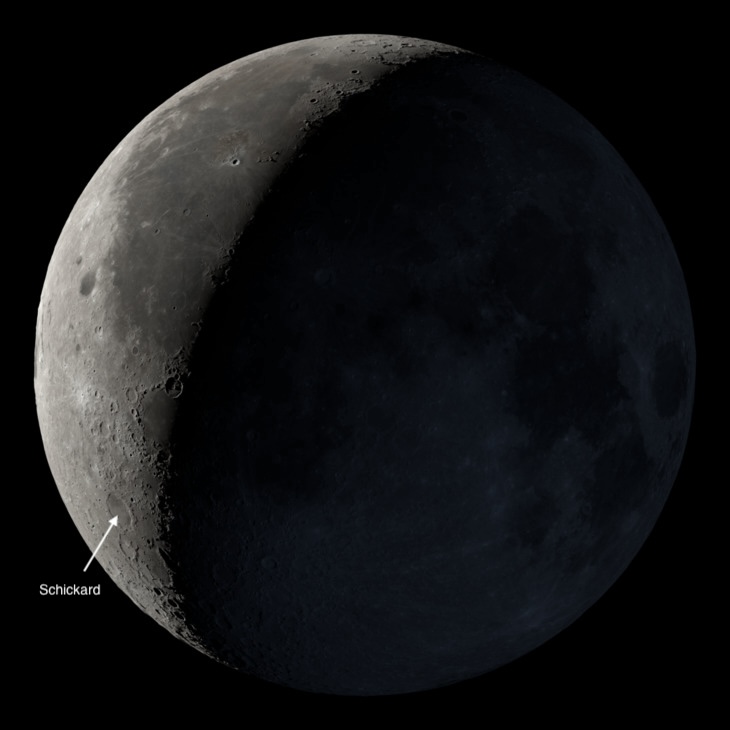 On the morning of May 12, the crater Schickard is readily visible, as libration has carried it farther from the limb. / NASA Scientific Visualization Studio
Tuesday, May 12
Early risers have a great view of a lunar feature normally located near the limb. An hour before sunrise, the Moon is roughly 20° above the eastern horizon. About 25 percent of its nearside is still lit, as sunset slowly occurs across the lunar disk.
Zoom in on the lunar southwest with a telescope and you’ll immediately notice a broad, shallow crater with a bright eastern rim and a dark, flat floor. This is 132-mile-wide (212 kilometers) Schickard, a circular feature that often appears artificially elongated thanks to its location near the limb. Today, though, it should look more round than on other occasions, as lunar libration — the nodding or wobbling motion of our Moon as it orbits — brings it more into view, carrying it farther from the limb.
Look particularly at Schickard’s floor: Some but not all of it has been flooded with lava. There should be a noticeable textural difference between the southwest and northeast regions within the walls. Additionally, several smaller craterlets pockmark the floor, showing that they came much later than the initial impact that formed the larger Schickard.
Sunrise: 5:48 A.M.
Sunset: 8:06 P.M.
Moonrise: 3:13 A.M.
Moonset: 3:30 P.M.
Moon Phase: Waning crescent (18%)
Wednesday, May 13
Rising around 3:30 A.M. local daylight time, the Moon passes 4° north of Neptune at 5 A.M. EDT. Both are in Pisces. While the Moon will be easy to view shortly after rising, distant, faint Neptune will be more of a challenge, as it fails to climb very high above the horizon before dawn starts to lighten the sky. However, you’ll more easily catch magnitude 0.9 Saturn to the Moon’s lower right in the hour or two before dawn — it’s the brightest point of light in this region of the sky, although telescopic views may still be a bit muddy. The Moon will pass 6° north of Saturn at 6 P.M. EDT this evening.
Speaking of evening, bright Venus stands proudly between the horns of Taurus the Bull after sunset tonight, forming a nearly straight line with the stars marking the tips of the horns. Visible in the west within an hour or two of sunset, Venus will stand out first — it’s magnitude –3.9 and unmistakable. To Venus’ upper right is Elnath (Beta [β] Tauri), shining at magnitude 1.7. To Venus’ lower left is fainter Zeta (ζ) Tau, glowing at magnitude 3.0. The trio sets around 10:30 P.M. local daylight time, so there’s plenty of time to enjoy the view.
Sunrise: 5:47 A.M.
Sunset: 8:07 P.M.
Moonrise: 3:36 A.M.
Moonset: 4:40 P.M.
Moon Phase: Waning crescent (11%)
Thursday, May 14
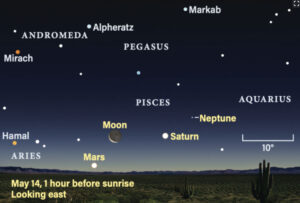
The Moon now guides the way to Mars in the early-morning sky; the Red Planet stands just 7° from the delicate crescent Moon, visible shortly before the Sun rises.
Try looking east about an hour before sunrise. You’ll have the best luck if your horizon is clear, and particularly if you can get to an observing spot higher than your surroundings. Mars remains low, just over 1° high an hour before sunrise, and it’s only magnitude 1.3, adding to the challenge. However, binoculars or any small scope should show it, hanging 7° to the lower left (east) of the 9-percent-lit lunar crescent. They’ll rise higher as time passes, although of course the sky is also growing brighter as sunrise approaches. The Moon will pass 5° due north of Mars at 9 P.M. EDT. (Make sure to stop using any optics several minutes before sunrise from your location.)
Mercury reaches superior conjunction at 10 A.M. EDT this morning. Currently invisible in this configuration, the solar system’s smallest planet will appear in the evening sky later this month.
Dwarf planet 1 Ceres is also in conjunction with the Sun today, officially reaching this point at 11 P.M. EDT.
Sunrise: 5:46 A.M.
Sunset: 8:08 P.M.
Moonrise: 4:02 A.M.
Moonset: 5:56 P.M.
Moon Phase: Waning crescent (4%)
Friday, May 15
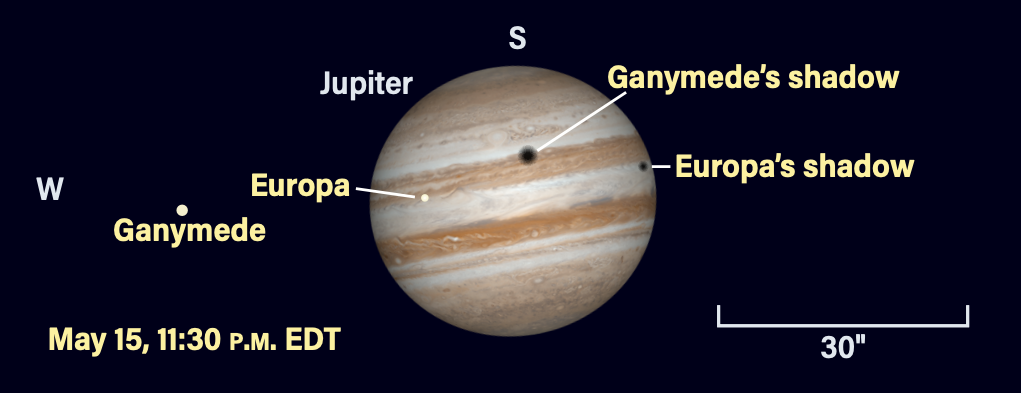
Jupiter remains prominent in eastern Gemini after sunset, glowing brightly to the lower left of the Twins’ two heads, Castor and Pollux. Overnight tonight, there’s a double shadow transit visible on the gas giant’s cloud tops, as the shadows of both Europa and Ganymede travel from east to west.
Eastern time zone observers can get started once the sky grows dark to catch Europa itself already transiting the planet. Ganymede’s large shadow is the first shadow to appear, at 9:58 P.M. EDT, as darkness is falling across the Midwest. Ganymede itself is already west of Jupiter, having completed its own transit. Io lies just to Ganymede’s northwest, while Callisto is alone far east of the planet.
Bright Europa and Ganymede’s dark shadow cross together until 11:20 P.M. EDT, when Europa’s shadow finally appears at the eastern limb. Jupiter is now getting low for observers along the U.S. East Coast, but follow it as long as you can. Europa slips away from the disk entirely at 11:03 P.M. CDT (note the time zone change), leaving only the two shadows to finish crossing the planet’s face. Europa’s smaller shadow, east of Ganymede’s, will gain some ground and pull closer over time, but it never overtakes the larger moon’s shadow. Ganymede’s shadow transit ends at 11:26 P.M. MDT, best seen from the western half of the U.S. Europa’s shadow transit ends at 11:12 P.M. PDT, bringing the entire event to a close.
Sunrise: 5:45 A.M.
Sunset: 8:09 P.M.
Moonrise: 4:31 A.M.
Moonset: 7:15 P.M.
Moon Phase: Waning crescent (1%)

The sky, May 10-15: Mars reappears in the East at sunrise added by Cosmic1 on
View all posts by Cosmic1 →
You must be logged in to post a comment Login