

Special to CosmicTribune.com, September 27, 2026
Excerpts from weekly Sky & Telescope.com report.
SUNDAY, SEPTEMBER 27
■ Now Saturn shines about a fist to the Moon’s right in the evening, as shown above. You’ll find it lower right of the Moon after midnight.
■ Algol should be at its minimum brightness for a couple hours centered on 8:11 p.m. EDT. It takes several hours before and after to fade and rebrighten.
MONDAY, SEPTEMBER 28
■ Vega is the brightest star very high when you face west. While you’re still facing west, look to the right of Vega by 14° (a little more than a fist at arm’s length) for Eltanin, the 2nd-magnitude nose of Draco the Dragon. It’s tinted orange. The rest of Draco’s fainter, lozenge-shaped head is a little farther right. Draco always eyes Vega as they wheel around the sky.
Farther on, behind Draco’s head, his long, arched back and tail loop around the Little Dipper.
The main stars of Vega’s own constellation, Lyra — faint by comparison — extend from Vega in the direction opposite from Eltanin: toward bright Altair.
TUESDAY, SEPTEMBER 29
■ The starry W of Cassiopeia stands high in the northeast right after dark. The right-hand side of the W (the brightest side) is tilted up. Look at the second segment of the W counting down from the top. It’s not quite horizontal. Notice the dim naked-eye stars along that segment (not counting its two ends). The brightest of these, on the right, is Eta Cassiopeiae, magnitude 3.4. It’s a remarkably Sun-like star just 19 light-years away. But unlike the Sun it has an orange-dwarf companion, magnitude 7.3. Their separation of 13 arcseconds makes them a lovely binary in almost any telescope.
Left of Eta, and quite a bit fainter, is a naked-eye pair in a dark sky: Upsilon1 and Upsilon2 Cassiopeiae, 0.3° apart, magnitudes 4.8 and 4.6. They’re yellow-orange giants unrelated to each other, 400 and 200 light-years distant from us. Upsilon2 is slightly the brighter of the pair. It’s also the closer one.
WEDNESDAY, SEPTEMBER 30
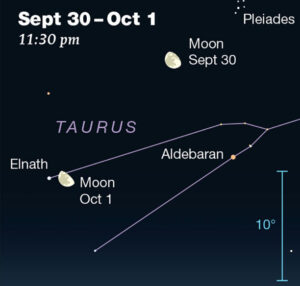
■ The waning gibbous Moon rises in the east-northeast about an hour after dark, with the Pleiades less than a fist to its upper right. Aldebaran comes up below the Moon about an hour behind it. They all climb through the night, as shown above. Stay up late, and the eerie waning gibbous Moon will guide you to an early seasonal sighting of the Pleiades, Aldebaran, and the dim Hyades V asterism lying on its side.
THURSDAY, OCTOBER 1
■ Globular clusters are at their most abundant on summer evenings. Now in this first week of October, with moonlight gone from the evening sky, set up your telescope to look in on four that remain high that in 2021 Josh Urban called The Last Wildflowers: Globular Clusters Greet Autumn. There’s “Sagittifolia,” the Arrowhead Flower, M71 next to Sagitta; “Queen Anne’s Lace,” M15 sneezed from the nose of Pegasus; “Watercress by the Stream,” M2 in Aquarius a little farther south; and “Seaflower of the Deep,” M30 deep in southern Capricornus.
FRIDAY, OCTOBER 2
■ With the evening sky now moonless, this is a great week for the Milky Way under a dark sky. When Cygnus crosses your zenith, around 9 p.m. now, the Milky Way does too — running straight up from the southwest horizon, across the zenith, and straight down to the northeast horizon.
■ Algol should be at its minimum brightness for about two hours centered on 9:33 EDT.
■ Last-quarter Moon tonight (exact at 9:25 a.m. Saturday morning October 3rd). The Moon rises in the east-northeast around 11 p.m., about two fists below Capella.

The sky, Sept. 27-Oct. 2: Saturn tracks the Moon, Vega high in the West added by Cosmic1 on
View all posts by Cosmic1 →
You must be logged in to post a comment Login