

Special to CosmicTribune.com, June 25, 2026
By Richard Fisher
The demand for commercial manned space activity in Low Earth Orbit (LEO) has been demonstrated recently by the success of Long Beach, California-based space station developer VAST having signed up astronaut clients from three European countries just during the month of June 2026.
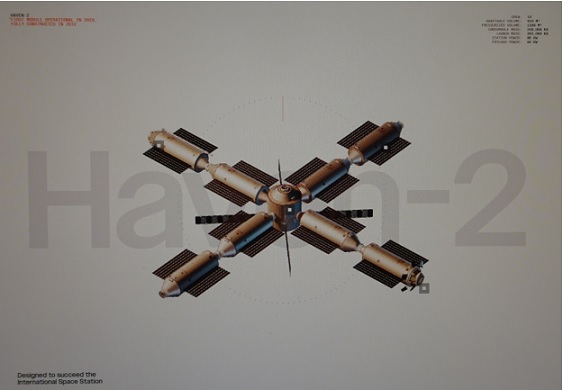
Founded only in 2021 and now with about 1,000 employees, the new contracts with European governments will help VAST along the road to its larger ambition of deploying by 2032, or at least the early 2030s, its 282-ton space station comprised of 8x HAVEN-2 modules, a central hub connecting module, with the capability of hosting a crew of twelve.
This HAVEN-2 module-based space station would be one possible successor to the 419-ton International Space Station (ISS), now 27-years old and approaching retirement by 2030 or 2032, sometimes complicated by relations with major partner Russia, but that could host up to 9 to 11 astronauts/cosmonauts for short periods of time.
The other post-ISS space station provider is Axiom Space, which is scheduled to launch the first module of its Axiom Station in the late 2020s, that will connect to the ISS before detaching, and then connecting with other modules to form an independent commercial space station.
Both VAST and Axiom Space also organize commercial spaceflights to the ISS, contracting flights on the SpaceX Dragon space capsule, as part of the National Aeronautics and Space Administration’s (NASA) Commercial Low Earth Orbit Destinations (CLD) program.
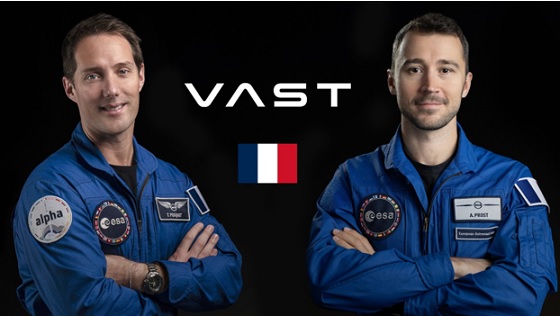
On June 1, France took advantage of NASA having awarded the CLD flight for the 6th Private Astronaut Mission (PAM) to the ISS to VAST, by entering into an agreement to take one French European Space Agency (ESA) astronaut, Thomas Pesquet, to the ISS, and another, Arnaud Prost, to the new VAST HAVEN-1 commercial space station; both flights scheduled for 2027.
This was followed by a June 5 signing of a memorandum of understanding (MOU) between VAST and the British government, for a HAVEN-1 mission to allow British ESA astronaut and surgeon, John McFall, who lost a leg in a motorcycle accident, to advance research that could help disabled people on Earth.
And then on June 8, on behalf of the Czech Republic, the European Space Agency signed a MOU, building on a previous 2024 Czech-VAST MOU, to send Czech ESA astronaut Ales Svoboda to the ISS in 2027.
Full Text . . . . Current Edition . . . . Subscription Information

VAST makes space deals in Europe for NASA’s LEO program added by Cosmic1 on
View all posts by Cosmic1 →
You must be logged in to post a comment Login