

Special to CosmicTribune.com, December 21, 2025
Excerpts from weekly Astronomy.com report.
Sunday, December 21
The winter solstice occurs today at 10:03 A.M. EST. This marks the beginning of astronomical winter in the Northern Hemisphere and astronomical summer in the Southern Hemisphere. (Note that meteorological winter began December 1st, so you may have already heard news outlets saying it is wintertime before this date.)
On the winter solstice, the Northern Hemisphere experiences its shortest duration of daylight. After this date, the Sun will begin to remain above the horizon for longer, although it may take a few days for sunrise and sunset times to change, depending on your location.
The solstice itself — at 10:03 A.M. EST — is the exact moment the Northern Hemisphere is tilted farthest from the Sun. On this date, the Sun makes its lowest arc through the Northern Hemisphere sky as well, while our star sits directly overhead at noon for those on the Tropic of Capricorn in the Southern Hemisphere.
Astronomical winter will last until the spring equinox, which will occur March 20, 2026, at 10:46 A.M. EDT.
Sunrise: 7:19 A.M.
Sunset: 4:38 P.M.
Moonrise: 8:54 A.M.
Moonset: 5:59 P.M.
Moon Phase: Waxing crescent (4%)
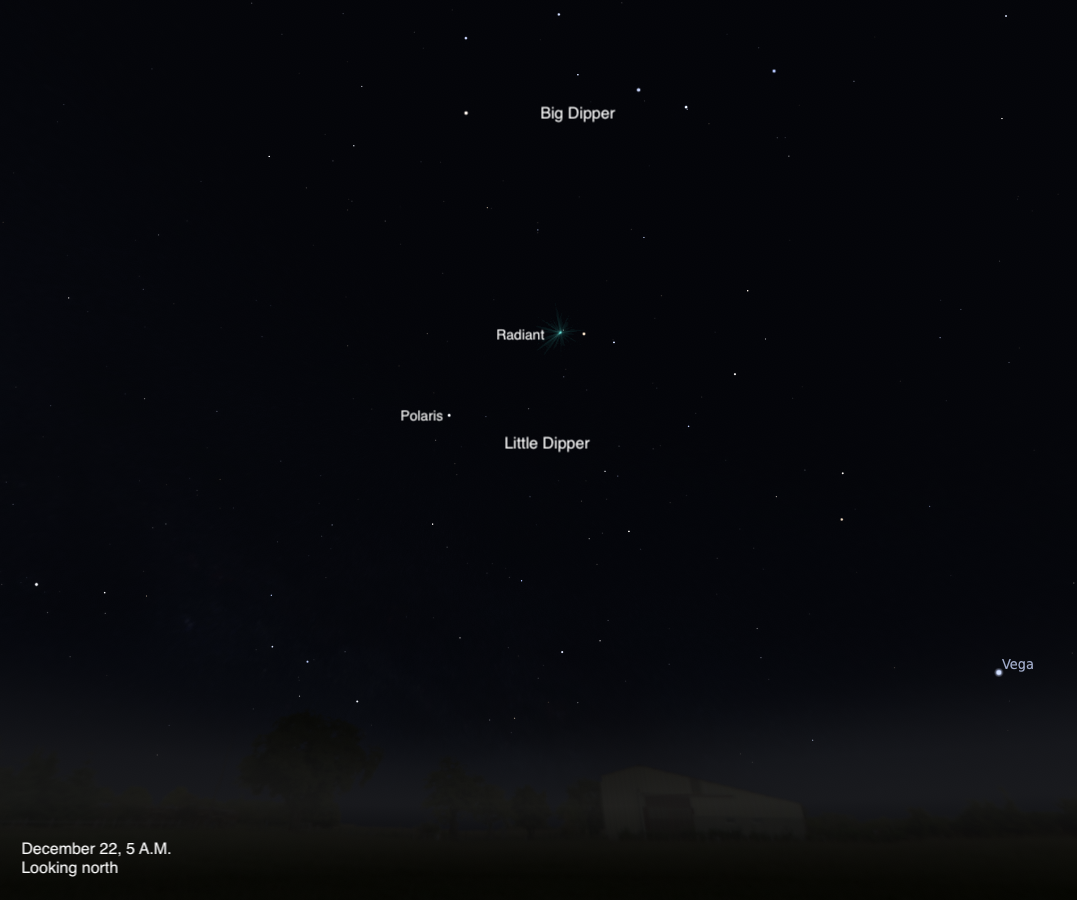 The Ursids’ radiant lies near the cup of the Little Dipper, which stands below the Big Dipper early in the morning. / Stellarium
Monday, December 22
This morning offers a chance to catch the last major meteor shower of the year: the Ursids. This short-lived shower is active for only about a week and peaks this morning under dark, moonless skies.
Although the Ursids’ peak rate is just ⅒ that of the Geminids last week — meaning at its best, it will only produce about 10 meteors per hour — it’s still worth stepping outside before sunrise to see if you can catch a few shooting stars. In fact, the radiant in the north is visible all night for much of the Northern Hemisphere, meaning you can watch for meteors late on the 21st as well as again this evening.
The Ursids’ radiant is located just off the cup of the Little Dipper. It is nearly 50° high in the north by 5 A.M. local time, to the upper right of the North Star, Polaris. If you can find the Big Dipper in the northern sky — upside-down early this morning — look beneath its cup to find the matching, smaller cup of the Little Dipper. These cups always appear to pour into each other as the stars wheel around the North Celestial Pole, anchored by Polaris.
The Moon passes 0.6° north of Pluto at 4 P.M. EST during daylight hours.
Sunrise: 7:19 A.M.
Sunset: 4:38 P.M.
Moonrise: 9:32 A.M.
Moonset: 7:04 P.M.
Moon Phase: Waxing crescent (9%)
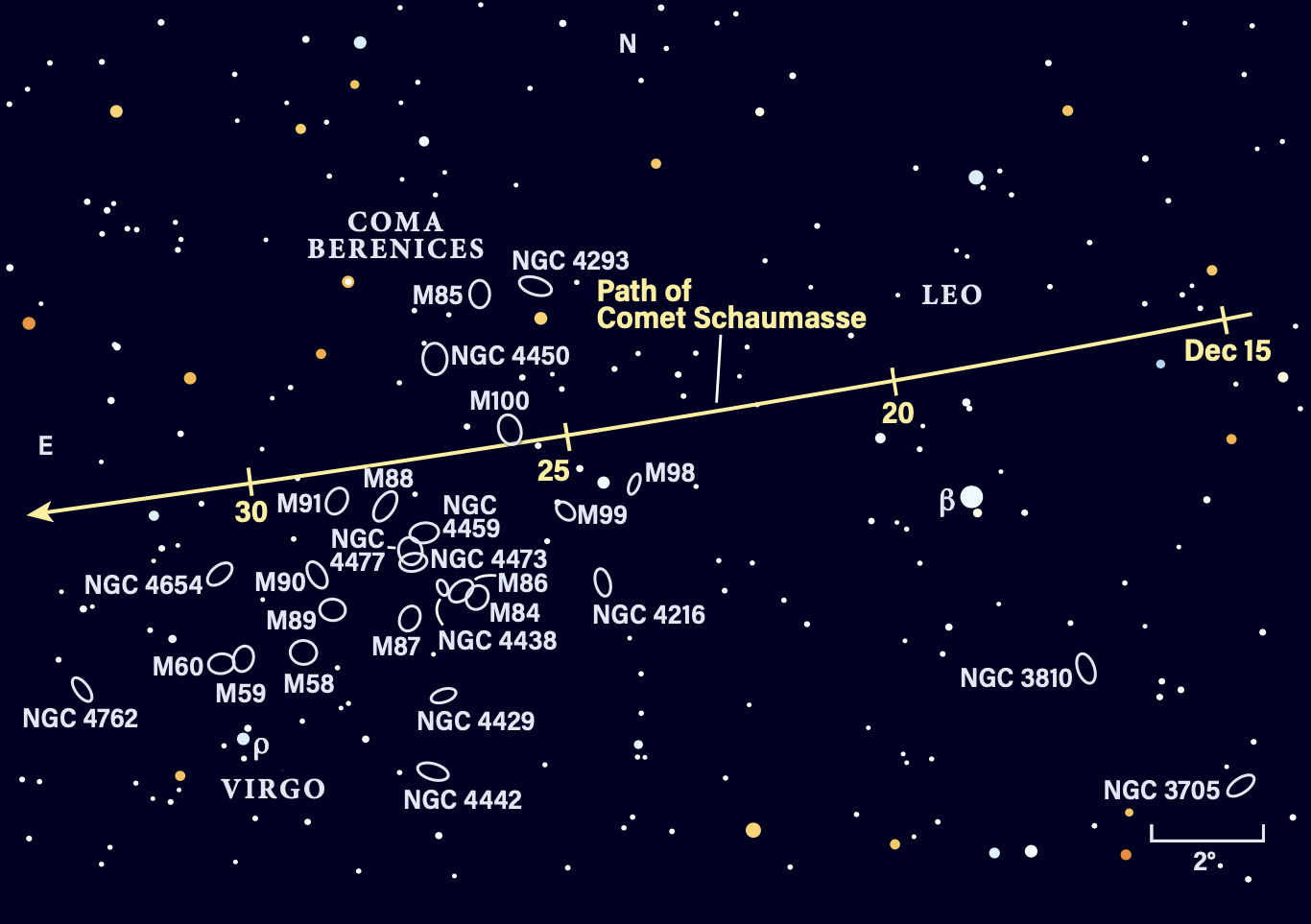 This chart shows the path of Comet 24P/Schaumasse in the second half of December. Galaxies are shown down to magnitude 11. Credit: Astronomy / Roen Kelly
Tuesday, December 23
Rising around midnight and visible in the early-morning sky, Comet 24P/Schaumasse glows at roughly 11th magnitude as it prepares to enter the rich Virgo Cluster.
Now in far southwestern Coma Berenices, Schaumasse is just 1.7° northwest of M98, an edge-on spiral galaxy that, at magnitude 10.1, glows slightly brighter than the comet. Not far away are M99 (a little farther southeast of Schaumasse) and M100 (about 3.4° east of the comet). M99 is a face-on spiral that contrasts nicely with M98, glowing at roughly the same magnitude (9.9). M100 is brighter at magnitude 9.3 — in fact, it’s one of the brighter galaxies in the Virgo Cluster, offering a lovely example of what astronomers call a grand design spiral, with well-defined arms wrapping around its bright nucleus.
Take your time with this region, enjoying the scene as the faint, fuzzy comet approaches the galactic gaggle. Schaumasse will be passing through this rich region for the rest of the month — hang onto the chart provided above to help you identify both the comet and the galaxies it’s passing over time.
Sunrise: 7:20 A.M.
Sunset: 4:39 P.M.
Moonrise: 10:03 A.M.
Moonset: 8:10 P.M.
Moon Phase: Waxing crescent (15%)
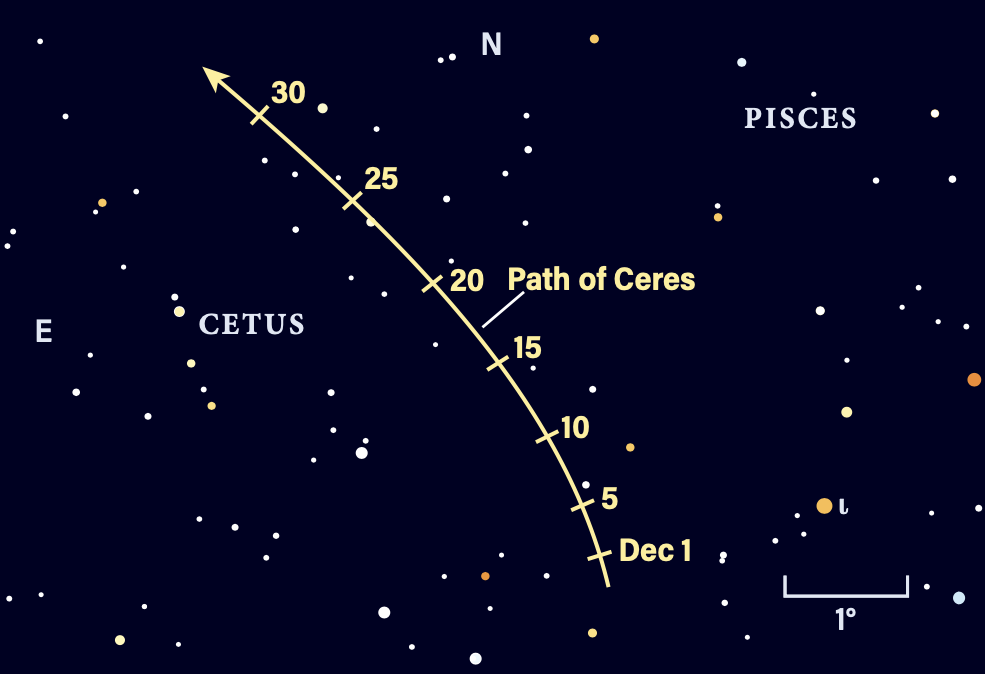 Ceres remains close to Iota Ceti all month, tracing out a path that should be relatively easy to follow. / Roen Kelly
Wednesday, December 24
Dominating the main belt, dwarf planet 1 Ceres now shines at 9th magnitude in Cetus the Whale. The small dot is passing close to a background star this evening, appearing as one component in a temporary double system you can enjoy for one night only.
Ceres is located about 4.4° northeast of magnitude 3.6 Iota (ι) Ceti, which itself stands to the upper right of brighter magnitude 2.0 Diphda (Beta [β] Cet) in the south around 8 P.M. local time. Once you’ve found Iota, skim slowly northeast with binoculars or a telescope, looking for a 7th-magnitude star. This is HD 3126 (also cataloged as HIP 2710) — it may even be in your go-to scope’s stellar library, allowing you to zoom right over with the push of a button. Once there, Ceres is the fainter spot just 2’ north of this star.
Earlier in the evening, Titan makes its last transit of Saturn for the year. This event is largely only visible for observers in Europe and the U.K. The transit begins at 16:58 UT (11:58 A.M. EST) and ends about six hours later, around 23:50 UT. Note that this is 5:50 P.M. EST, so quick observers on the U.S. East Coast might be able to catch the last few moments of the transit, as Titan slides off the ringed planet’s northwestern limb.
Sunrise: 7:20 A.M.
Sunset: 4:40 P.M.
Moonrise: 10:29 A.M.
Moonset: 9:17 P.M.
Moon Phase: Waxing crescent (24%)
Thursday, December 25
As Orion and Gemini rise in the east after dark, they carry between them the lesser-known constellation Monoceros. Within this star pattern is our target for tonight: the festive Christmas Tree Cluster.
Cataloged as NGC 2264, this pine tree-shaped group of stars is part of a combination open cluster and star-forming region. It lies near the Cone Nebula, which appears to reach toward the top of the tree as if to touch it.
To find the magnitude 3.9 cluster, wait until around 9 or 10 P.M. local time, when this region reaches 40° in altitude above the eastern horizon. Look with binoculars or a telescope toward the region between Orion and Gemini, about 6.5° south of 2nd-magnitude Gamma (γ) Geminorum or 11.5° east of magnitude 0.5 Betelgeuse in Orion. You’re looking for several bright stars in the rough shape of a triangle or arrowhead, pointing toward the south. (Note that this means the top of the tree might not be oriented up in your eyepiece.) The base of the tree, its trunk, is anchored by the cluster’s brightest star, magnitude 4.7 15 Monocerotis. Under magnifications of 50x, about a dozen stars will appear. Higher powers reveal more stars. The entire cluster stretches about 20’ on the sky.
Observers with larger scopes (on the order of 12 inches) will begin to pick up some of the nebulosity of the surrounding star-forming region. The adjacent Cone Nebula may start to appear as well, also visible only in large scopes.
Sunrise: 7:20 A.M.
Sunset: 4:40 P.M.
Moonrise: 10:53 A.M.
Moonset: 11:23 P.M.
Moon Phase: Waxing crescent (33%)
Friday, December 26
The Moon passes 4° north of Saturn at 11 P.M. EST. The pair is visible all evening, sinking toward the western horizon later on. Earlier in the evening, around 7 P.M. local time, the two worlds stand roughly 40° high in the southwest, with Saturn to the lower left of the nearly First Quarter Moon.
Saturn shines at magnitude 0.7, still easy to pick out with the naked eye. Through a telescope, its disk stretches 17” across, its rings some 39” from end to end. Those rings are tilted just 0.8° to our line of sight, appearing close to edge on. The planet’s brightest moon, Titan, lies just over 2’ west of the center of the planet. Far to the east, Iapetus is at its faintest (12th magnitude) nearly 8.5’ away. Closer to the ringed world are 10th-magnitude Tethys, Rhea, and Dione. These three moons cluster close to each other on Saturn’s western side tonight, inside the orbit of Titan.
Now drop your gaze far below Saturn toward the horizon. Do you see a similarly bright light, this one only about 13° high? That’s magnitude 1.2 Fomalhaut, the brightest star in Piscis Austrinus the Southern Fish. This young star is famous for the large, dusty disk of planet-forming material around it. Several years ago, astronomers found what they believed was a young planet orbiting within the disk, which they named Fomalhaut b. Yet in 2014, after 10 years of observations, it disappeared from view. Astronomers ultimately determined Fomalhaut b likely hadn’t been a planet at all, but a collection of debris from the previous smash-up of protoplanetary pieces within the disk. As that debris cloud expanded and spread out, it faded until it was no longer detectable from Earth.
Sunrise: 7:21 A.M.
Sunset: 4:41 P.M.
Moonrise: 11:15 A.M.
Moonset: 11:31 P.M.
Moon Phase: Waxing crescent (43%)

The sky, Dec. 21-26: Winter solstice added by Cosmic1 on
View all posts by Cosmic1 →
You must be logged in to post a comment Login