

Special to CosmicTribune.com, August 30, 2026
Excerpts from weekly Sky & Telescope.com report.
SUNDAY, AUGUST 30
■ The waning gibbous Moon rises in the east in late twilight. Saturn follows it up about 30 minutes later. Another hour and they’re nicely high free and clear.
Although they look close together (about 5°), Saturn is currently 3,400 times farther away — and it’s 35 times bigger in diameter than the Moon, not even counting the rings. And that dot is 9 times larger than the whole Earth. Nowhere in human experience but astronomy are things so different than they appear. It took millennia to figure that out; you are lucky.
 MONDAY, AUGUST 31
■ The end of August means that Scorpius, which was the proud starring constellation in the south on July evenings, is now tilting over and lying down in the southwest after dark, preparing to bed down and drift off for the season.
TUESDAY, SEPTEMBER 1
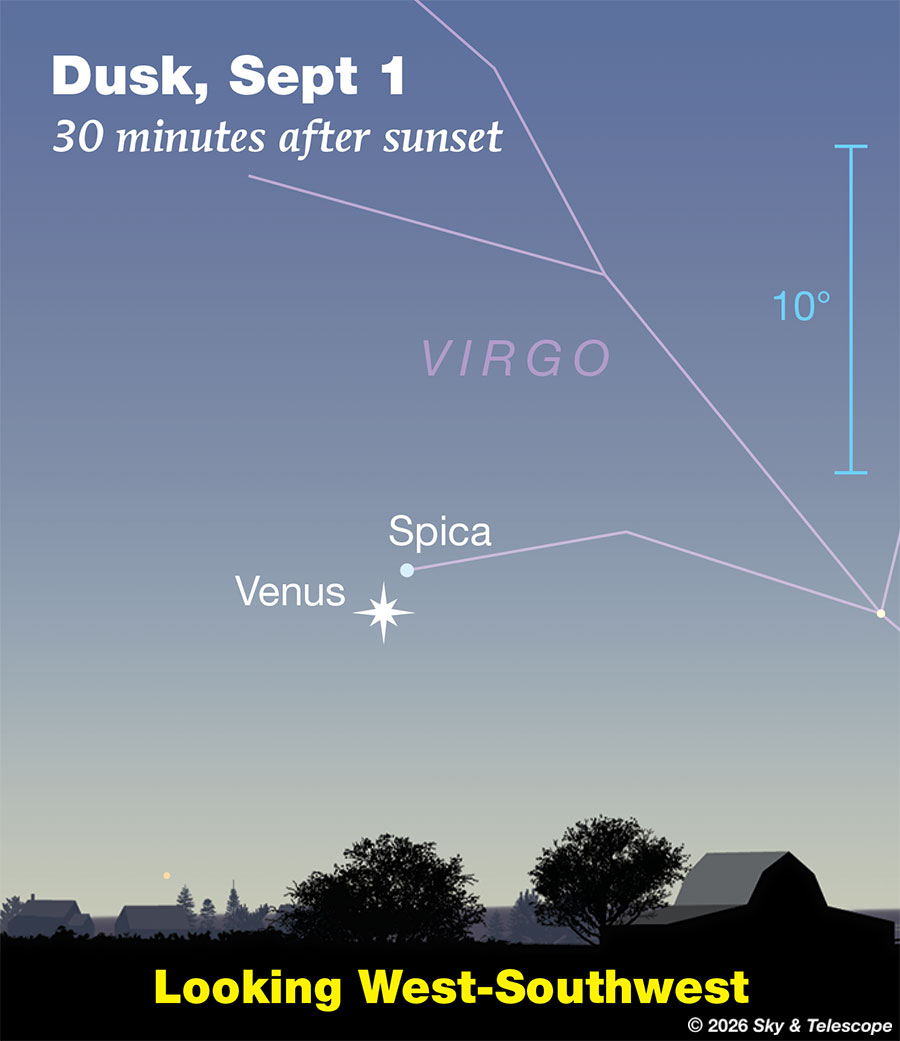
■ Venus and Spica are in conjunction at dusk, as shown below. Venus will be getting very low in the west-southwest as twilight fades. Can you make out tiny Spica 1.5° above it? Spica is only 1/160 as bright! And they get lower by the minute. Bring binoculars.
The Venus-Spica conjunction. Think photo opportunity, but getting a good image of Spica through the bright twilight will be tricky. Take various exposures, and don’t be afraid to image-process the results — gently, of course.
WEDNESDAY, SEPTEMBER 2
■ Now Spica and Venus are 1.7° apart, with Spica to Venus’s upper right. If it was cloudy last night, try again for a good image now.
THURSDAY, SEPTEMBER 3
■ Last quarter Moon tonight (exactly last-quarter at 3:51 a.m. Friday morning EDT ). The Moon will rise around 11 p.m. daylight-saving time, making this one of the earliest-to-rise last quarter Moons of the year. Watch for it to come up in the east-northeast almost two fists lower right of Capella.
By the first glimmer of dawn Friday morning the Moon will be shining very high, between the Pleiades to its upper right and Beta Tauri closer to its lower left.
FRIDAY, SEPTEMBER 4
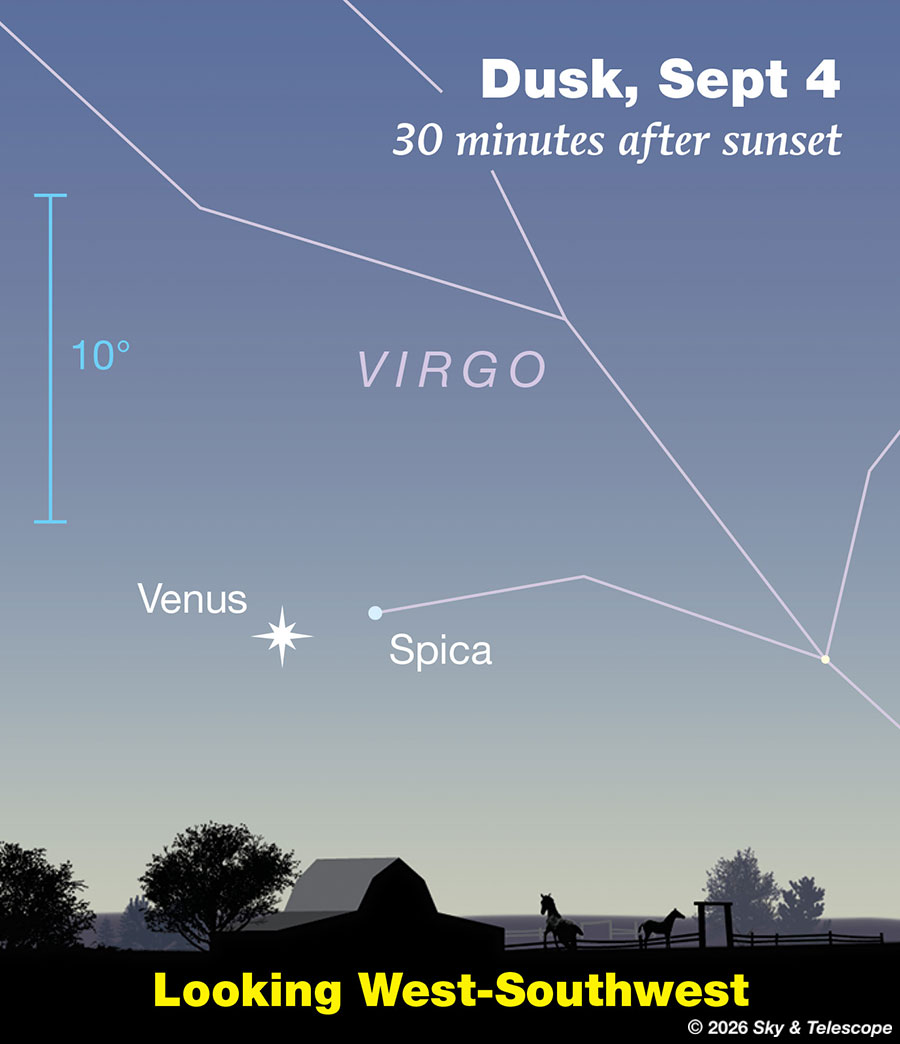
■ Venus and Spica are three days past their conjunction, 2.5° apart now as shown below. Bring binoculars. They’re getting lower in twilight by the day.
 ■ Altair is that bright star high towards the south soon after dark. Find little Sagitta, the Arrow, barely a fist at arm’s length above it as shown below. If your light pollution is too heavy, try binoculars.
Now imagine rotating the Arrow on its point a third of a turn counterclockwise. Its middle star would now rest almost at M27, the Dumbbell Nebula.
The name Dumbbell Nebula was bestowed by John Herschel in 1828. He was referring to the exercise weights we still call dumbbells, but in his day they were sometimes made by connecting two heavy bells top-to-top by a short pipe. The bells were missing their clappers, so they were literally dumb bells. I saw examples once in a vintage photo of a gym. They really did look like the nebula’s hourglass shape.
A more recent name for M27, more realistic to modern eyes, is the Applecore Nebula. The earliest use of this name that I find using Google Books is from 1997.

The Dumbbell Nebula, M27. This view is 0.9° wide, about the width of a typical 60-power eyepiece view in a telescope. North is up, east is left.The star 14 Vulpeculae (the middle of the “M”) is magnitude 5.6. HD 189733, magnitude 7.7, is a yellow-orange K dwarf 63 light-years away from us, notable for having one of the first exoplanets discovered (a hot Jupiter). The nebula is far in the background, about 1,360 light-years away.

The sky, Aug. 30-Sept. 4: Venus and Spica in conjunction added by Cosmic1 on
View all posts by Cosmic1 →
You must be logged in to post a comment Login