

Special to CosmicTribune.com, December 10, 2025
By Richard Fisher
On Dec. 3, 2025, the first of at least 15 Chinese companies developing reusable space launch vehicles (RSLVs) conducted its first RSLV test launch, beginning a future wave of Chinese RSLV testing and boosting the growth of China’s subsidized “private” SLV sector — vice its already massive “state owned” space sector.
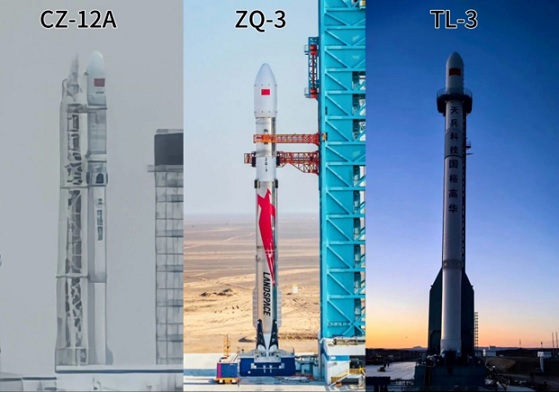
At least 15 years ago China decided that pioneering U.S. private SLV developer SpaceX was enough of a threat that China had to bury this competition by subsidizing a new Chinese SLV sector — owned by “private” not state capital — creating scores of companies, much as China created hundreds of unmanned system companies starting in the early 2000s, and also subsidized its globally dominant electric vehicle (EV) sector.
Fast forward, in its Dec. 5, 2025 issue, China state media flagship People’s Daily reported that China’s private space sector has grown to $351 billion and that:
“China is achieving a dynamic synergy that is accelerating technological advancements, reducing costs, and expanding the range of applications within its space industry. As a result, China’s space industry is gaining more visibility and vibrancy on the global stage.”
It further noted that, “China’s development of “space infrastructure” is advancing steadily, especially as the deployment of low-orbit satellite internet networks enters a phase of large-scale constellation expansion. However, the country faces a prominent challenge: the demand for satellite launches now exceeds the available capacity of traditional rockets. Relying solely on traditional rockets is far from sufficient to meet these growing needs. In this context, the development of commercial space initiatives is essential to providing the necessary launch capacity for widespread space-based network deployment.”
However, the scale of China’s state funded subsidy to this new private SLV sector was revealed in a Nov. 26 report by Chinese state media Xinhua, noting that the China National Space Administration (CNSA) had created, “an action plan to back commercial space firms and encourage them to pursue international cooperation over the next two years.”
This plan proposed to expand the ability of China’s wannabe SpaceX’s to access to “national network of civilian tracking, telemetry and control (TT&C) stations, data-receiving sites, calibration ranges and validation fields, as well as to large test assets such as rocket-engine test stands and space-environment simulation facilities.”
They will be further subsidized by invitations “to take part in cutting-edge, key space programs, ranging from advanced propulsion and next-generation satellite platforms and payloads to integrated communications, navigation and remote-sensing applications.”
CNSA will further subsize the space private sector with a “national commercial space development fund,” urge local governments to use their funds to “establish technology-innovation centers focused on reusable rockets and smart satellites,” and to “fold commercial-space projects into China’s international cooperation agenda —” meaning China’s massive Belt and Road Initiative (BRI) will fund foreign commercial space projects.
Full Text . . . . Current Edition . . . . Subscription Information

China subsidies power its new space launch vehicle era added by Cosmic1 on
View all posts by Cosmic1 →
You must be logged in to post a comment Login