

Special to CosmicTribune.com, June 21, 2026
Excerpts from weekly Sky & Telescope.com report.
SUNDAY, JUNE 21
■ Today is the longest day of the year for the Northern Hemisphere, and the official start of summer. The summer solstice comes at 4:25 a.m. EDT, when the Sun ends its northward journey for the season and begins its six-month return south.
The Sun today crosses your sky the highest it ever can (if you’re in the North Temperate Zone). So today your shadow becomes the shortest it can ever be at your location. This happens at local apparent noon (noon “solar time”), which at your location is probably rather far removed from noon by the clock.
This is also the day when the Sun rises and sets farthest north on your horizon. Though the difference in the rise and set points is extremely slight for several days before and after.
■ First-quarter Moon (exact at 5:55 p.m. EDT). After dusk, look for 1st-magnitude Spica about two fists to the Moon’s left or upper left, and 2nd-magnitude Denebola, tail star of Leo, the same distance to the Moon’s upper right. Lower left of the Moon, Corvus is on its way to setting.
The Moon’s straight terminator has now unveiled all of Tranquillitatis and Serenitatis.
MONDAY, JUNE 22
■ After dark, look southeast for orange Antares. (It’s about five fists left of the Moon.) Antares has been called “the Betelgeuse of summer”; both are 1st-magnitude “red” supergiants. Around and upper right of Antares are the other, whiter stars of upper Scorpius, forming their distinctive pattern. The rest of the Scorpion runs down from Antares, then left. The farther north you are, the lower Scorpius will appear.
■ Three or four fists above the Moon shines Arcturus. Less than a fist to the Moon’s upper left is Spica. A fist below the Moon the four-star pattern of Corvus, the springtime Crow, is slipping down and away.
TUESDAY, JUNE 23
■ At nightfall, look for Spica about 5° upper right of the Moon. Later in the evening, as the sky twists, Spica will shine more directly to the Moon’s right.
WEDNESDAY, JUNE 24
■ Leo the Lion is mostly a constellation of late winter and spring. But he’s not gone yet. As twilight ends look due west, upper left of bright Venus, for 1st-magnitude Regulus, his brightest and now lowest star. It’s the forefoot of the Lion stick figure.
The Sickle of Leo extends upper right from Regulus. The rest of the Lion’s constellation figure runs for almost three fists to the upper left from the Sickle, to his tail star Denebola, now the highest. Leo will soon be treading offstage into the sunset.
THURSDAY, JUNE 25
■ Venus and Jupiter now shine 15° apart in the western sky as twilight fades, making a diagonal line. Extend the line the same distance upper left from Venus tonight and you’ll land on fainter Regulus, magnitude +1.4. How early in twilight can you first see Regulus pop into definite view?
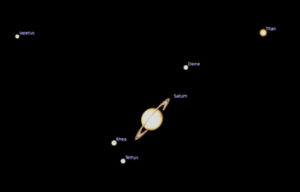
Pull out your telescope about two hours before sunrise, when Saturn has reached an altitude of 20° in the eastern sky. It’s easy to find the ringed world, as it’s the brightest object in this part of the sky. Once you home in on Saturn, you’ll of course see its stunning ring system, stretching nearly 40” across as it encircles the planet, whose angular size is 17”.
Saturn’s brightest moon, Titan, should be easy to spot some 1.7’ to the planet’s west. Tenth-magnitude Tethys, Rhea, and Dione are visible as well, clustered closer to Saturn. Dione sits west of Saturn, while Rhea and Tethys are to the planet’s east. And, again, 11th-magnitude Iapetus is north of the planet, about 1.9’ from its center.]
FRIDAY, JUNE 26
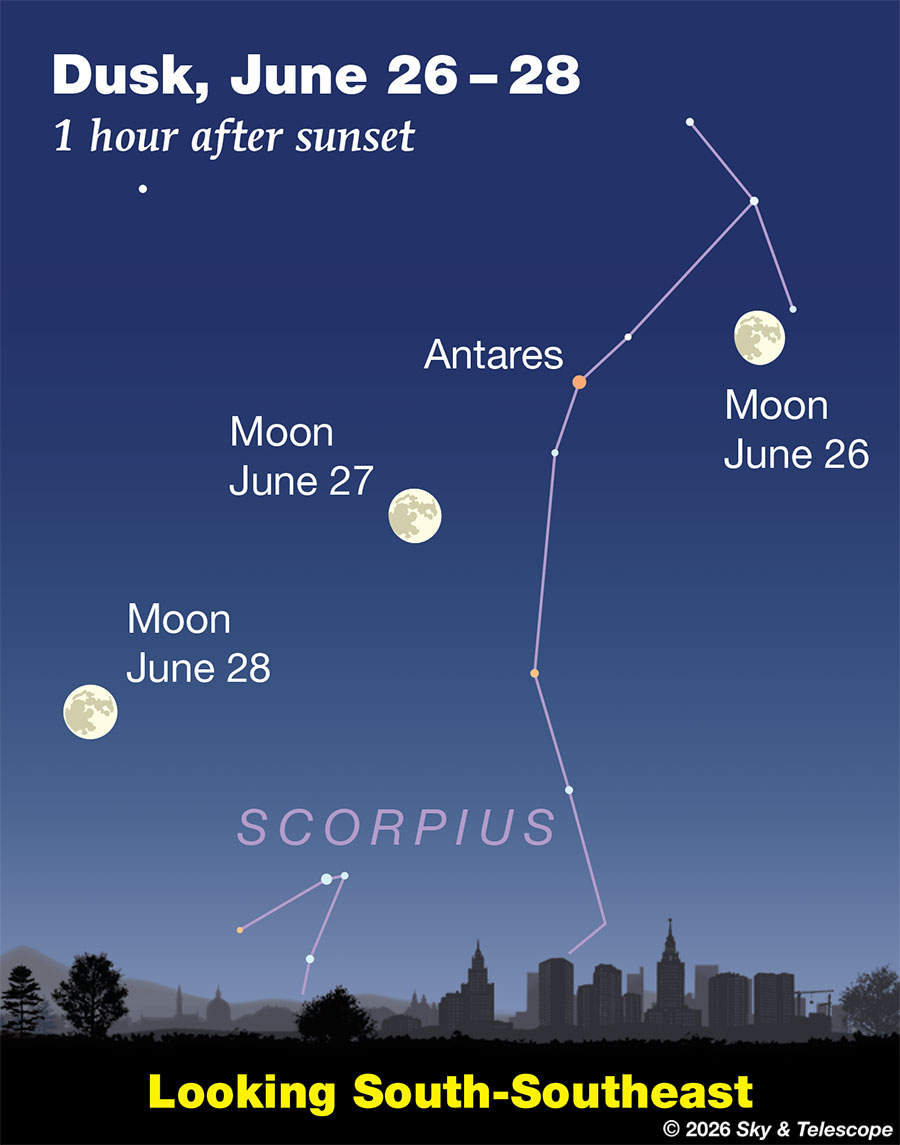
■ This evening the waxing gibbous Moon shines under the three-star head of summery Scorpius, as shown below. Orange Antares, the Scorpion’s 1st-magnitude heart, glimmers 5° or 6° to the Moon’s left. That’s about three finger-widths at arm’s length.

The sky, June 21-26: Summer solstice begins with first quarter Moon added by Cosmic1 on
View all posts by Cosmic1 →
You must be logged in to post a comment Login