

Special to CosmicTribune.com, September 20, 2026
Excerpts from weekly Astronomy.com report.
Sunday, September 20
Now is the best time to catch 145-mile-wide Juno as it passes through a random collection of 9th- and 10th-magnitude stars. Now located in far southern Aquila near its border with Sagittarius, Juno glows at magnitude 9.6. Around 9 P.M. local daylight time, it stands some 14° above the waxing gibbous Moon in the south.
The closest bright star is 4th-magnitude Algedi (Alpha [α] Capricorni), which lies just under 9° east-southeast of Juno. Slightly closer but fainter is 5th-magnitude Kappa (κ) Aquilae, which is 4.6° north-northwest of Juno. Once you’ve homed in on Juno’s location, you’ll spot a gaggle of stars. Draw or photograph the view, then come back tomorrow night and do it again. Comparing the two views will reveal Juno’s location, as it’s the only dot here that will have moved from one night to the next. From the 20th to the 21st, Juno slides nearly 7’ to the southeast, clearly changing its position relative to the fixed background stars.
Sunrise: 6:46 A.M.
Sunset: 7:00 P.M.
Moonrise: 4:03 P.M.
Moonset: 12:16 A.M.
Moon Phase: Waxing gibbous (71%)
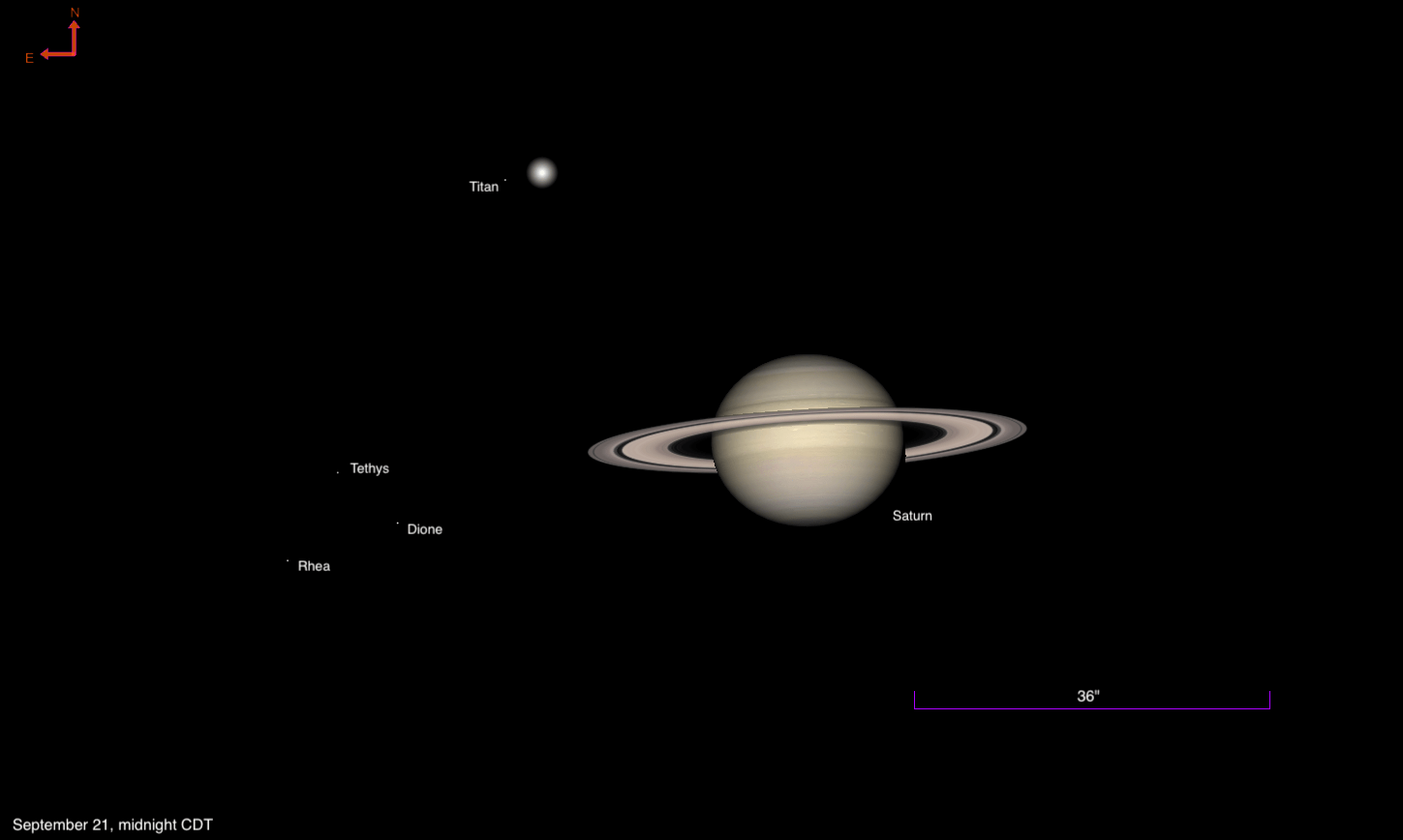 An interloper “enters” the saturnian system overnight on September 21/22, as Titan passes close to a field star around midnight CDT. Note that only objects brighter than 11th magnitude are shown. / Alison Klesman (via TheSkyX)
Monday, September 21
Rising around 7:30 P.M. local daylight time, Saturn reaches an altitude above 40° in the southeast by local midnight. Visible to the naked eye, it is the brightest point of light in this region of the sky, sitting near the border of southern Pisces and northern Cetus.
The ringed planet always looks magnificent in a telescope, and tonight there’s an added bonus: its brightest moon, Titan, stands just northeast of the planet. It passes due north of Saturn during the daylight hours of the 22nd in the U.S. and will sit northwest of the planet in tomorrow night’s sky.
Around midnight Central time, the view is a bit crowded: to Saturn’s east lie mid-8th-magnitude Titan (northeast) as well as 10th-magnitude Tethys, Dione, and Rhea (all east and southeast). But don’t be fooled — there’s another mid-10th-magnitude point of light just northeast of Saturn, close to Titan. This is a field star Saturn is passing as the planet moves across our sky. Although the star is very near Titan, the moon is about a magnitude brighter, allowing you to distinguish the two. Brighter Titan will move some 2″ south of the star at 1:17 a.m. EDT on the 22nd (still late on the 21st for the Mountain and Pacific time zones). It’s a unique sight to see, so try to catch it if you’re able.
After that, Saturn and its moons will pull away from the star toward the southwest in the early hours of the 22nd.
Sunrise: 6:47 A.M.
Sunset: 6:59 P.M.
Moonrise: 4:37 P.M.
Moonset: 1:18 A.M.
Moon Phase: Waxing gibbous (79%)
Tuesday, September 22
The autumnal equinox occurs at 8:05 P.M. EDT. This moment marks the changing of the astronomical seasons; for those in the Northern Hemisphere, this is when summer ends and autumn begins. However, meteorological fall began a few weeks ago, starting on September 1st.
On the equinox, the Sun appears directly above the equator, crossing the celestial equator (a projection of our planet’s equator out into space) from north to south. Day and night are roughly of equal length on this date, although they do not balance exactly. There are two reasons why. First, the Sun is not a single point in space, but a large disk spanning roughly 32’ on average. That means it takes time for the entire disk to appear or disappear at sunrise and sunset, respectively, offering a few extra minutes of daylight. Further, the air in our atmosphere refracts (or bends) sunlight the same way water can distort images, rendering the Sun visible for a short time even when it is physically below the horizon. This also adds a few more minutes of daylight, making the day slightly longer than the night even during the equinox, when the Sun rises and sets 12 hours apart.
Sunrise: 6:48 A.M.
Sunset: 6:57 P.M.
Moonrise: 5:06 P.M.
Moonset: 2:22 A.M.
Moon Phase: Waxing gibbous (87%)
 Wednesday, September 23
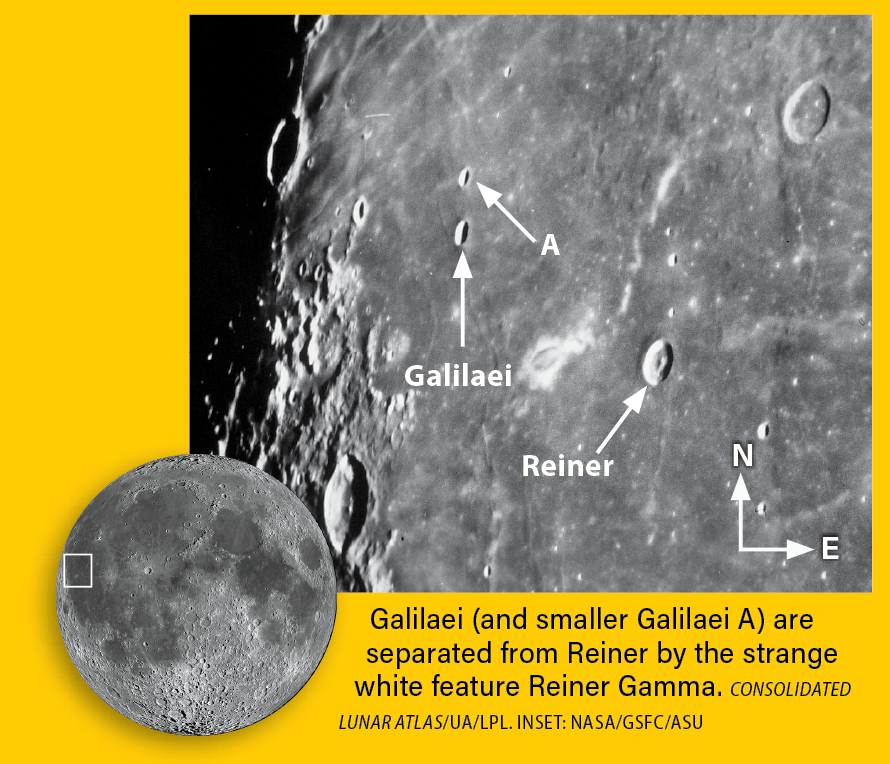
The bright Moon stands prominently in Aquarius the Water-bearer this evening, quickly waxing toward Full. Swing your scope up toward Earth’s lone satellite tonight and focus in on a point just east of the terminator dividing night and day, roughly midway along the western limb. There, a strange light-colored feature, Reiner Gamma, just barely catches the eye. Astronomers aren’t sure what caused this swirly, splotchy mark, although they know it is a magnetic feature and not a topological one. It will stand out even more tomorrow night, on the 24th, if you’re having trouble seeing the light-dark contrast here tonight.
Just east of Reiner Gamma is the crater Reiner, which hosts a noticeable central peak. And just west of Reiner Gamma is Galilaei and its smaller companion, Galilaei A, to the north. Can you see the rille snaking between Galilaei and Galilaei A? Northeast of these two craters lie the Marius Hills, a gaggle of volcanic domes once considered as an Apollo landing site, though it was never actually visited by astronauts. Just west of these domes is the wriggling shape of another rille, called Rima Galilaei.
Sunrise: 6:49 A.M.
Sunset: 6:55 P.M.
Moonrise: 5:32 P.M.
Moonset: 3:27 A.M.
Moon Phase: Waxing gibbous (93%)
Thursday, September 24
Neptune stands close to a slightly fainter background star this evening, offering a colorful contrast between the two.
Just one day from opposition, Neptune rises around sunset and is 30° high in the southeast by 10 P.M. local daylight time. You can find it in southern Pisces, to the left of the Moon and to the right of bright Saturn, which is easily visible to the naked eye. Neptune itself, however, is invisible without optical aid — using binoculars or a telescope, scan about 9° west-southwest of Saturn to find the distant ice giant, glowing at magnitude 7.7. Its tiny, 2”-wide disk may look like a “flat,” grayish-blue star.
Just 1.5’ from Neptune tonight lies HIP 968, a yellow, magnitude 8.7 background star. When viewed together in the same field of view, their contrasting colors will likely pop out even more.
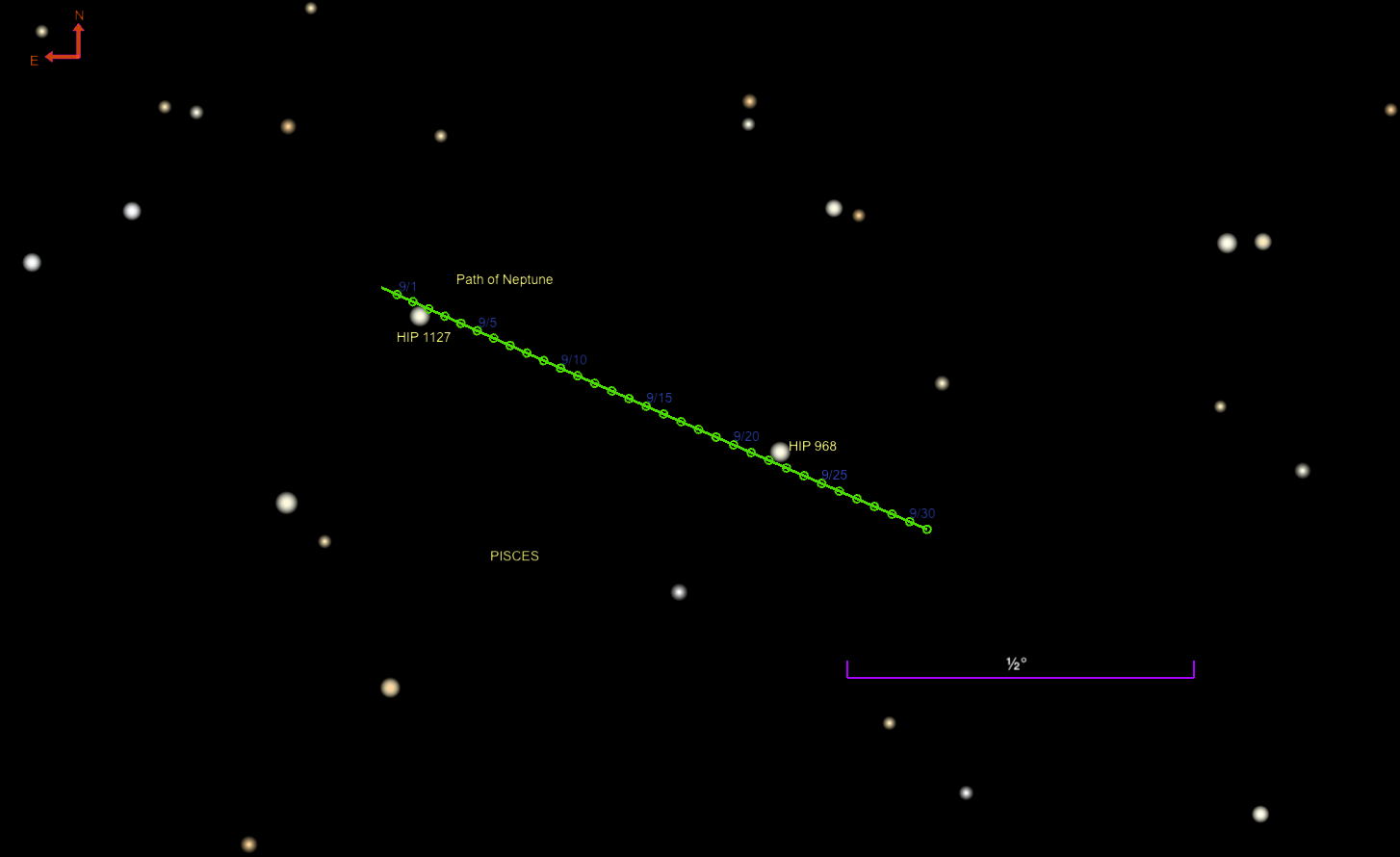 Neptune slides slowly southwest throughout the month of September. Use the two background stars HIP 1127 and HIP 968 to guide you. / Alison Klesman (via TheSkyX)
Sunrise: 6:50 A.M.
Sunset: 6:54 P.M.
Moonrise: 5:55 P.M.
Moonset: 4:32 A.M.
Moon Phase: Waxing gibbous (97%)
Friday, September 25
Mercury passes 1.0° north of Spica at 9 P.M. EDT. The pair sets around 7:30 P.M. local daylight time, roughly 40 minutes after the Sun. To catch them, you’ll need to be quick. Opt for an observing site with a clear western horizon, and one ideally elevated slightly above your surroundings as well if you’re able.
About 25 minutes after sunset, Mercury is roughly 3° high, shining at magnitude –0.2. Just to its lower left is magnitude 1.0 Spica — if you can’t spot the star without aid, try using binoculars or a small telescope to scan 1° to Mercury’s south. You should be able to pick up both objects in the same field of view.
Mercury’s disk now spans 5” and is 82% lit. Compare that to much brighter (magnitude –4.8) Venus, which should be easy to find to the left of the pair, also in Virgo. Venus’ disk stretches 44” across and is 20% lit. It is about 1° higher than Mercury at this time, so you’ve got a little more time to observe it after sunset, although not much.
As the sky darkens, you may also start to see a few other stars begin to pop out. Above Venus, one of the first might be magnitude 2.8 Zubenelgenubi, Libra’s alpha star.
Neptune reaches opposition tonight at 10 P.M. EDT. Opposition is when planets lie directly opposite the Sun from our point of view, making them easiest to observe. We’ll focus on the ice giant’s appearance in next week’s column, so stay tuned.
Full Moon doesn’t officially occur until 12:49 P.M. EDT on Saturday, but our satellite will appear roughly Full to the naked eye in the evening sky tonight, as it is 99.6% illuminated by 11 P.M. EDT (10 P.M. CDT).
Sunrise: 6:50 A.M.
Sunset: 6:52 P.M.
Moonrise: 6:17 P.M.
Moonset: 5:39 A.M.
Moon Phase: Full

The sky, September 20-25: Autumn Equinox on Sept. 22 added by Cosmic1 on
View all posts by Cosmic1 →
You must be logged in to post a comment Login