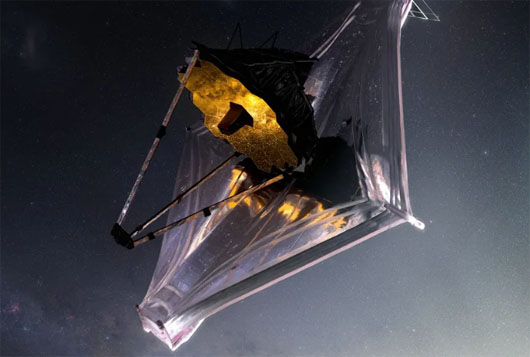
Special to CosmicTribune.com, June 9, 2022 NASA’s James Webb Space Telescope was struck by a larger than expected micrometeoroid in late May, slightly damaging one of the spacecraft’s 18 primary mirror segments. NASA said that the telescope is “still performing at a level that exceeds all mission requirements.” The telescope cost NASA nearly $10 billion […]
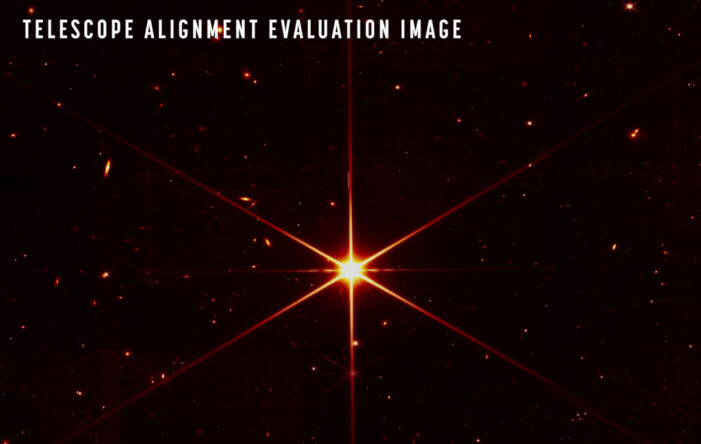
Special to CosmicTribune.com, March 23, 2022 2MASS J17554042+6551277 is the coordinate-based catalog designation of the star centered in this sharp field of view of the world’s largest space telescope which was launched on Dec. 25, 2021. The diffraction pattern is created by the 18 hexagonal mirror segments of the James Webb Space Telescope. After unfolding, […]
Special to CosmicTribune.com At the same time Hurricane Florence was bearing down on the east coast of the U.S. and a massive hole opened in the Sun’s corona, at least seven solar observatories/space webcams shut down worldwide, reports say. The National Solar Observatory in Sunspot, New Mexico shut down on Sept. 6 and has not […]
Special to CosmicTribune.com By Bill Federer, Aug. 25, 2018 The Polish astronomer Nicolaus Copernicus (1473-1543), made a major contribution to the scientific revolution by discovering that the planets revolved, not around the Earth, but around the Sun. Copernicus, who had a doctorate in cannon (church) law, wrote: “The Universe, wrought for us by a supremely […]
July 24, 2017 [CLICK HERE FOR HIGH RESOLUTION: Mike O’Day] Behold the largest ball of stars in our galaxy. Omega Centauri is packed with about 10 million stars, many older than our Sun and packed within a volume of only about 150 light-years in diameter. The star cluster is the largest and brightest of 200 […]
[Click Here for High Resolution, Lóránd Fényes] Is our Galaxy this thin? We believe so. The magnificent spiral galaxy NGC 4565 is viewed edge-on from planet Earth. Also known as the Needle Galaxy for its narrow profile, bright NGC 4565 is a stop on many telescopic tours of the northern sky, in the faint but […]
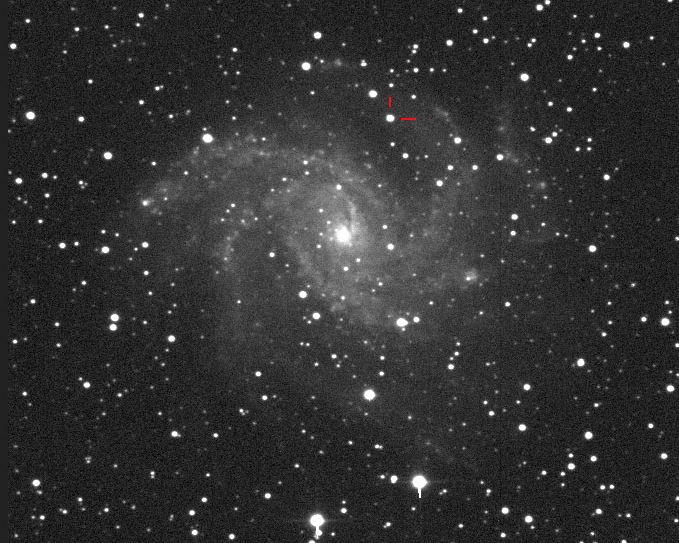
May 21, 2017 Utah amateur Patrick Wiggins discovered a possible bright supernova in the spiral galaxy NGC 6946 in Cygnus on May 13. If confirmed, 2017 eaw will become the 10th supernova found in this explosion-rich galaxy in the past century, reaffirming its reputation for fireworks of the grandest kind. It was Wiggins’s third supernova, […]
What is pictured is a sharp telescopic view of a magnificent edge-on spiral galaxy NGC 3628, a puffy galactic disk divided by dark dust lanes. Of course, this deep galactic portrait puts some astronomers in mind of its popular moniker, The Hamburger Galaxy. The tantalizing island universe is about 100,000 light-years across and 35 million […]
April 25, 2017 On April 12, as the Sun was blocked by the disk of Saturn the Cassini spacecraft camera looked toward the inner Solar System and the gas giant’s backlit rings. At the top of the mosaicked view is the A ring with its broader Encke and narrower Keeler gaps visible. At the bottom […]
March 12, 2017 [CLICK ON IMAGE FOR HIGH RESOLUTION, Christoph Kaltseis, CEDIC 2017] Near the center of this sharp cosmic portrait, at the heart of the Orion Nebula, are four hot, massive stars known as the Trapezium. Tightly gathered within a region about 1.5 light-years in radius, they dominate the core of the dense Orion […]